Home
Class 11
PHYSICS
A block of mass m is placed on the incli...

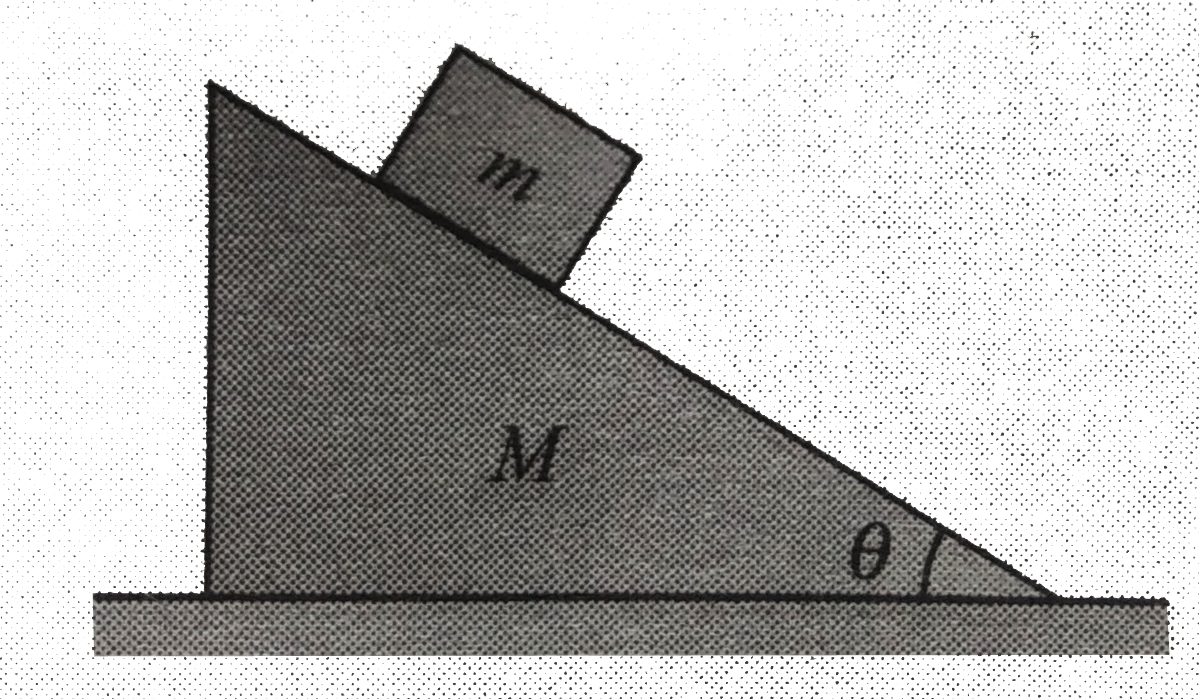
A block of mass m is placed on the inclined sufrace of a wedge as shown in fig. Calculate the acceleration of the wedge and the block when the block is released. Assume all surfaces are frictionless.

Text Solution

Verified by Experts
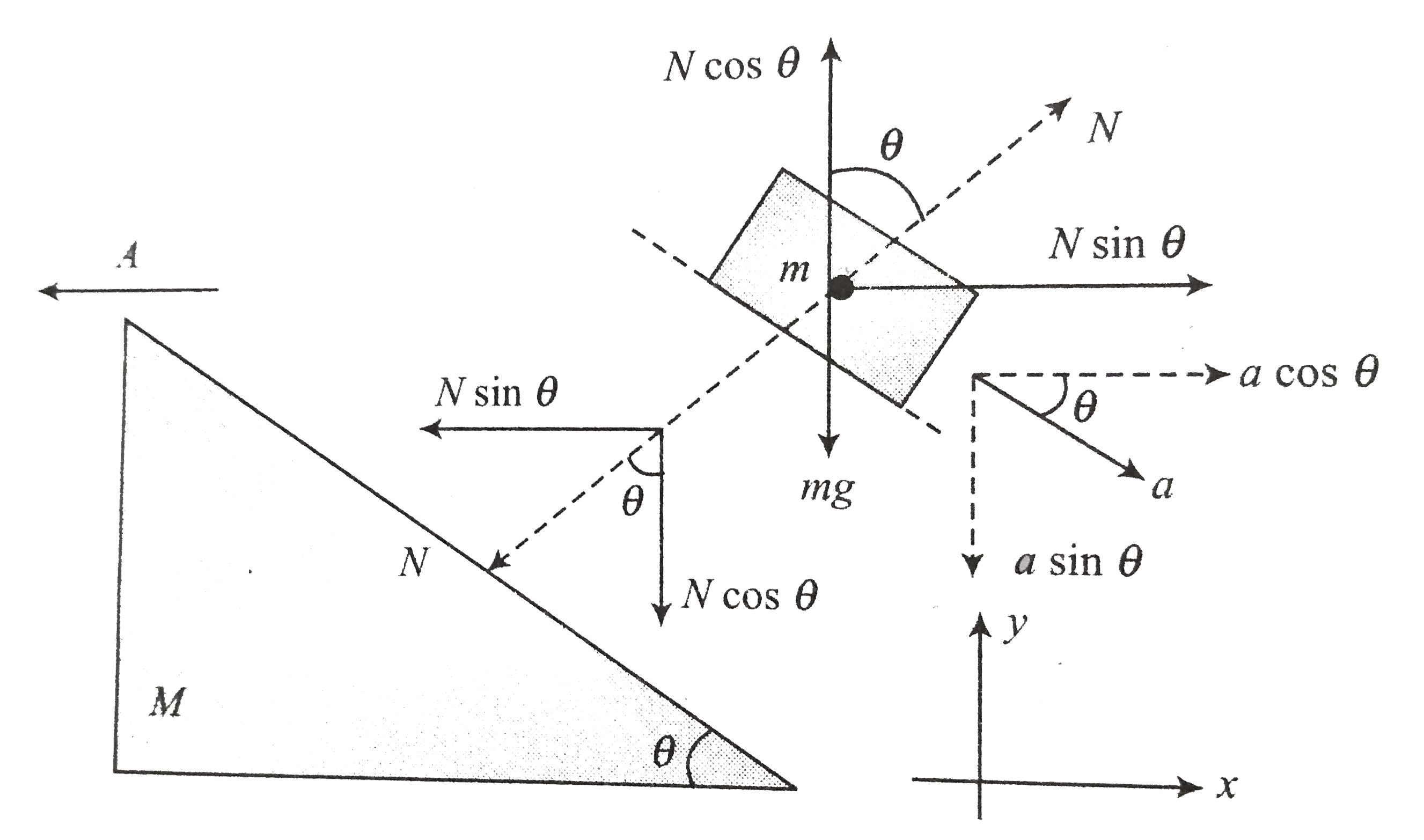
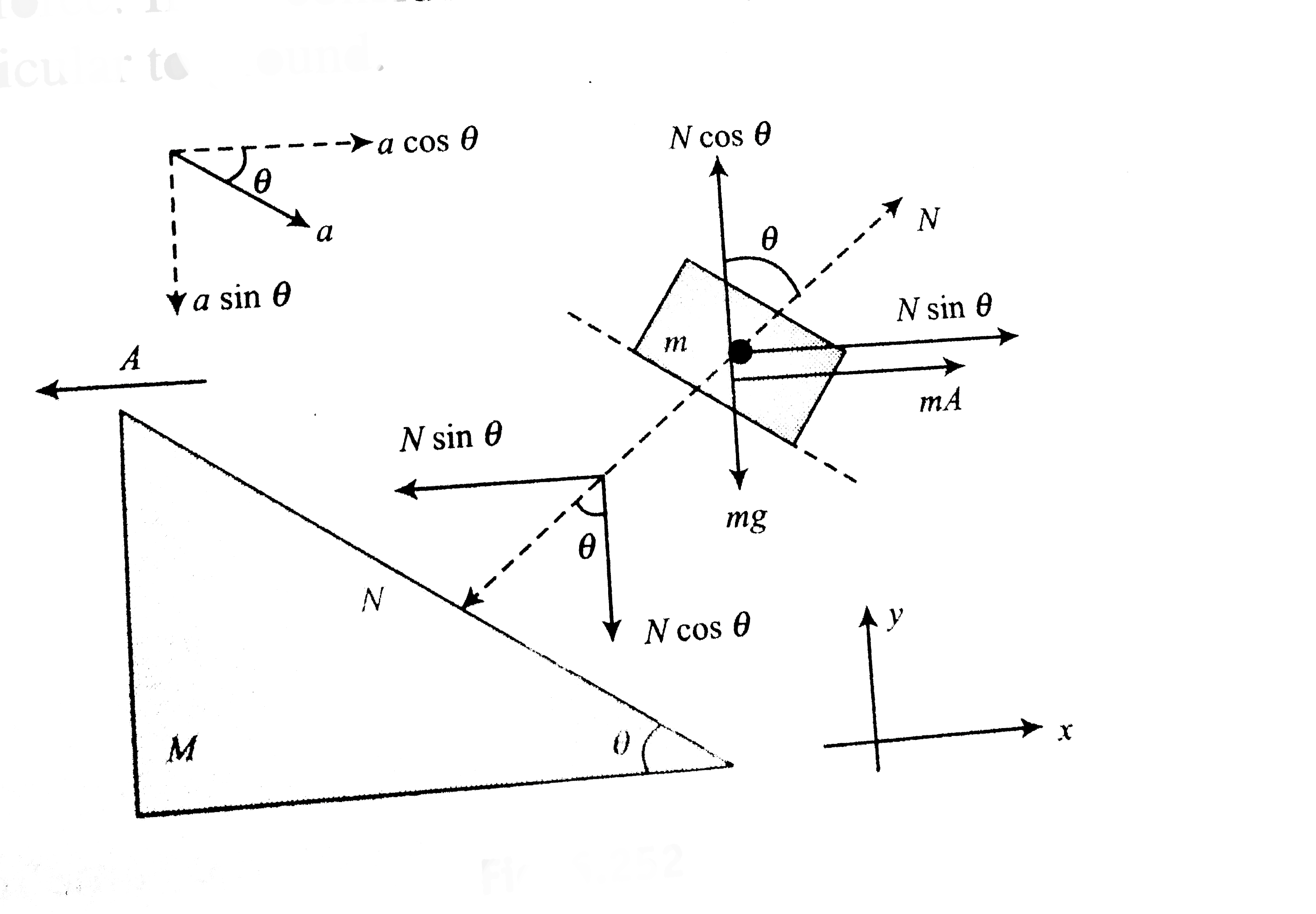
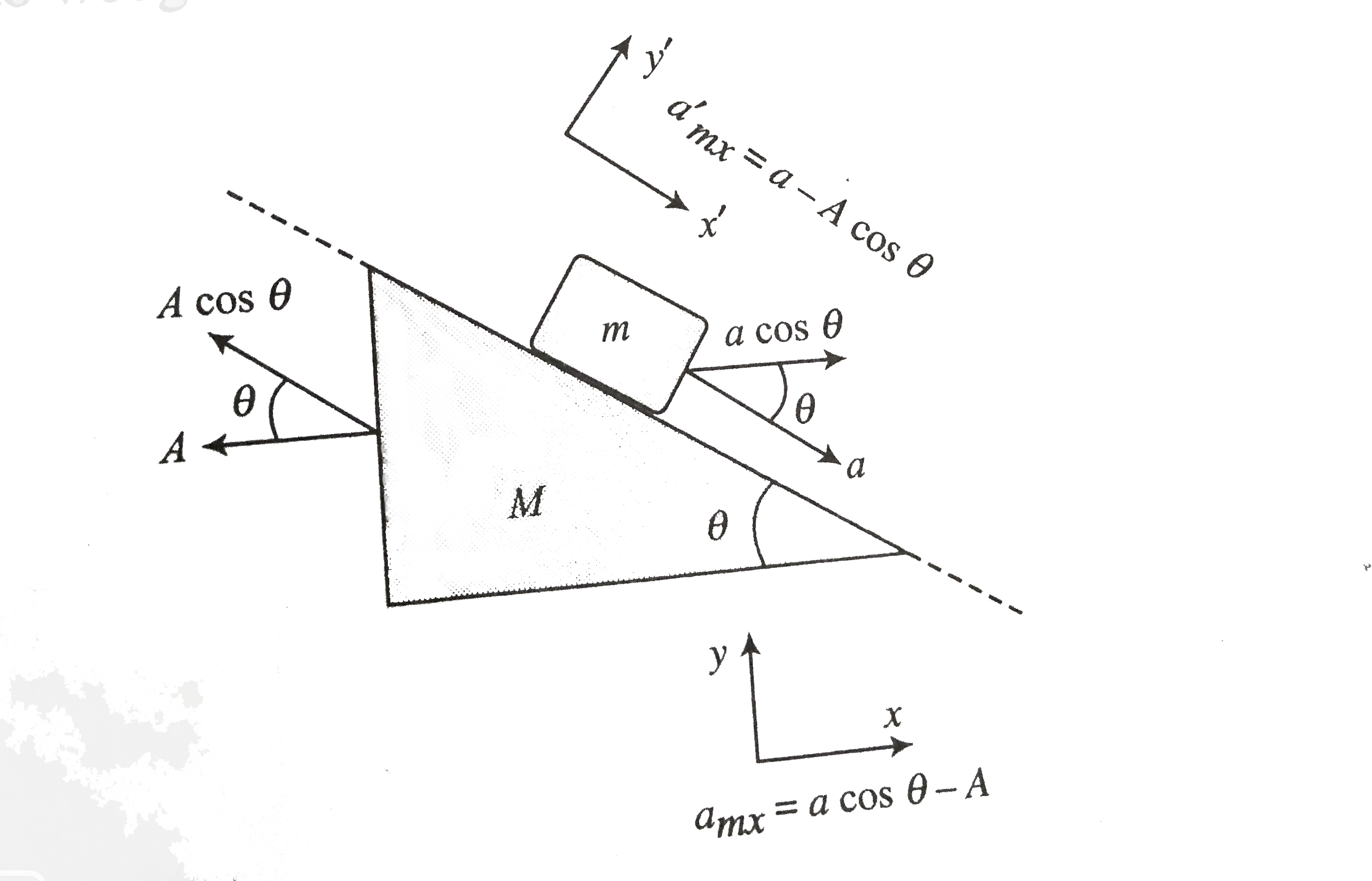
Method 1: Analysis form ground frame: Let the acceleration of wedge be A and that of block be a (w.r.t wedge).
Then, acceleration of m w.r.t ground is
`vec(a)_(m)=vec(a)_(m,M)+vec(a)_(M)=(a cos theta hat(i)- a sin theta hat(j))-Ahat(i)`
`=(a cos theta-A)hat(i)-a sin theta hat(j)`...(i)

For M: `N sin theta = MA` ...(ii)
For m: `mg-N cos theta=ma sin theta` ...(iii)
`N sin theta = m(a cos theta-A)`...(iv)
Solve (ii), (iii) and (iv) to get
`A=(mg sin theta cos theta)/(M+m sin^(2)theta)` and `((M+m)g sin theta)/(M+m sin^(2)theta)`
Now acceleration of block can be found by putting the values of a in (i)
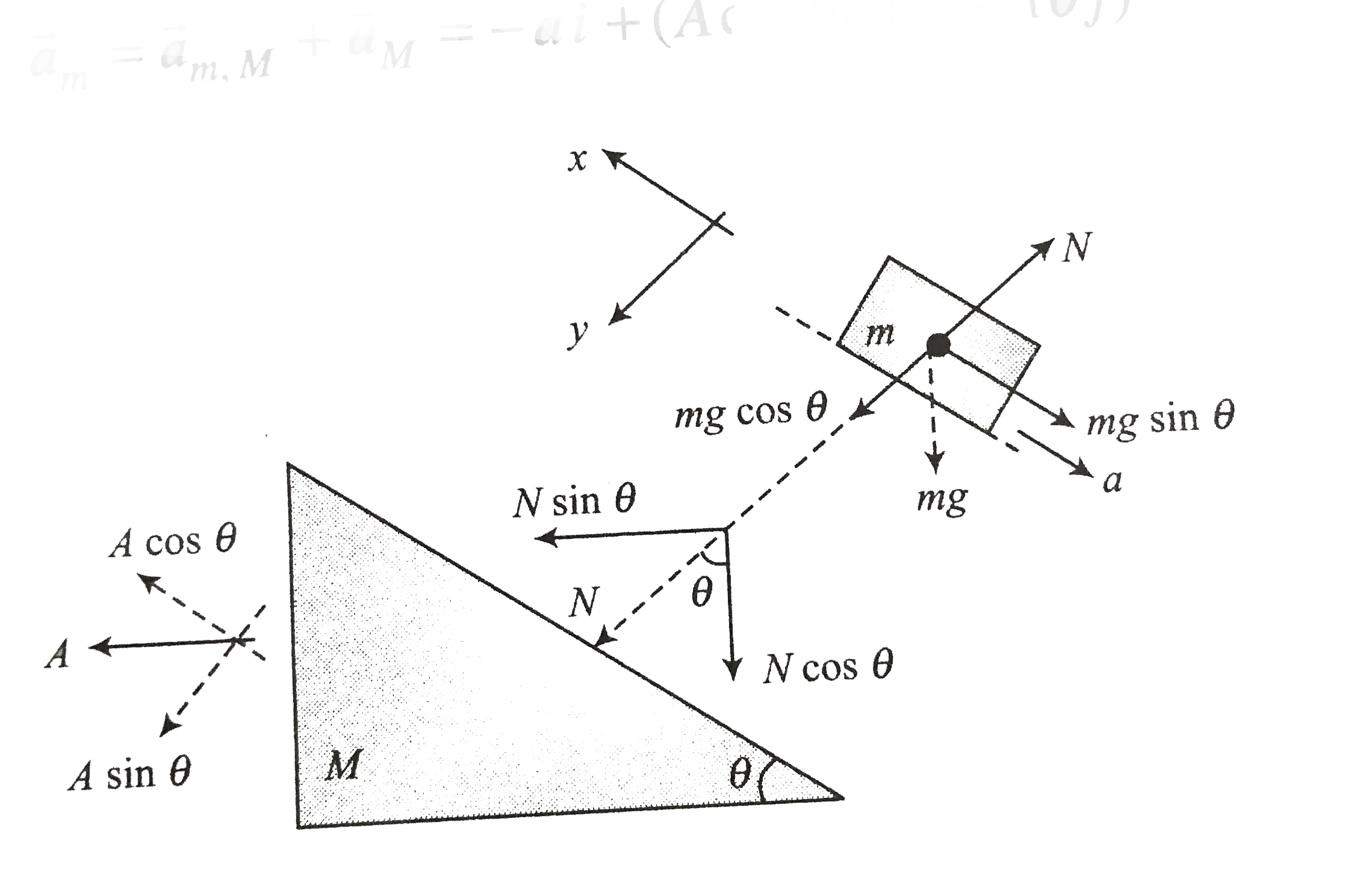
Method 2: If we consider the motion of block parallel and perpendicular to sloping surface w.r.t. ground, acceleration of m can also be written as :
`vec(a)_(m)=vec(a)_(m,M)_vec(a)_(M)=-a hat(i)+(A cos theta hat(i)+A sin theta hat(j))`

`vec(a)_(m)=(A cos theta-a)hat(i) +A sin theta hat(j)` ...(v)
For M: `N sin theta=MA` ...(vi)
For m: `-mg sin theta=m(A cos theta-a)` ...(vii)
`mg cos theta-N=mA sin theta` ...(viii)
From above equation we can get the valuve of
`A=(mg sin theta cos theta)/(M+m sin^(2)theta)` and `((M+m)g sin theta)/(M+m sin^(2)theta)`
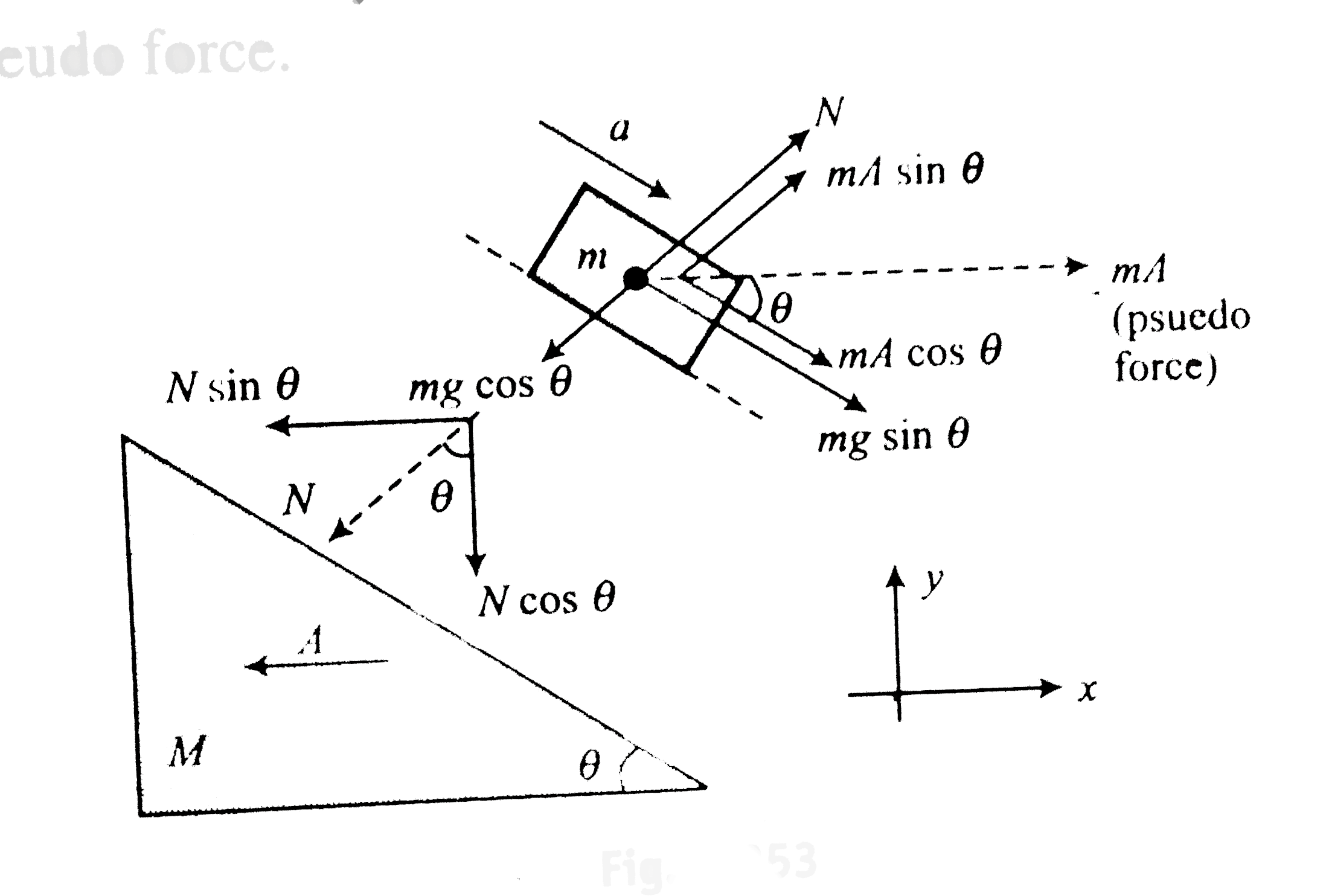
Method 3: Analysis from non-inertial frame: With the help of pseudo force. If we consider the motion of block parallel and perpendicular to ground.

let us make teh FBD of m w.r.t. M.
For M: `N sin theta=MA`...(ix)
For m: `N sin theta+mA=ma cos theta` ...(x)
`mg-N cos theta=ma sin theta` ...(xi)
From above equations, we can get the value of
`A=(mg sin theta cos theta)/(M+m sin^(2)theta)` and `((M+m)g sin theta)/(M+m sin^(2)theta)`
Method 4: Analyses from non-inertial frame: With the help of pseudo force.

When the forces are resolved in directions along the plane and perpendicular to the plene:
For M: `N sin theta=MA`
for m: `mg sin theta+mA cos theta=ma`
`mg cos theta=N+mA sin theta`
From above equations, we can get the value of
`A=(mg sin theta cos theta)/(M+m sin^(2)theta)` and `((M+m)g sin theta)/(M+m sin^(2)theta)`
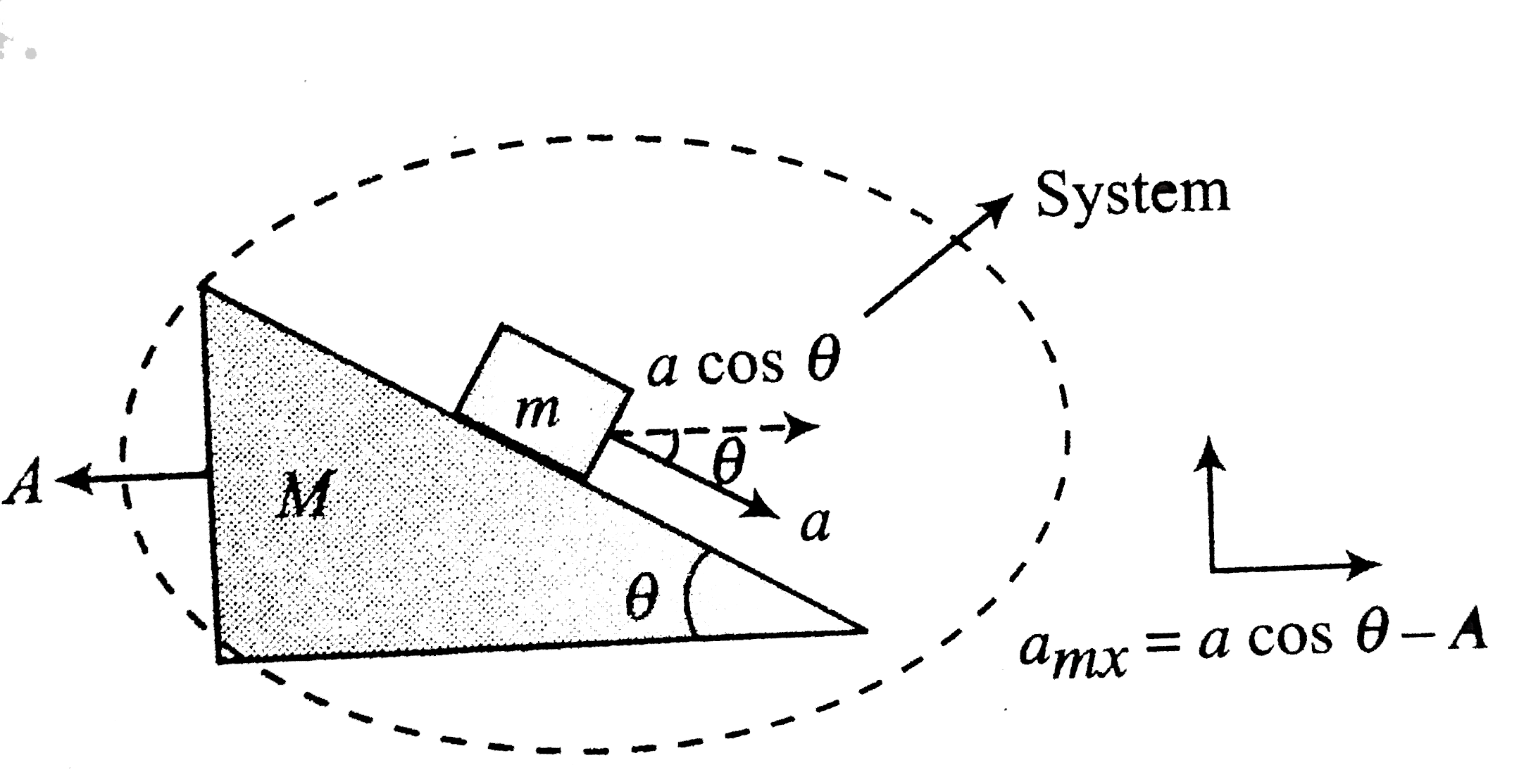
Method 5: Taking system together:
Considering wedge and block together as a system as shown in fig.

When the system is released, the wedge will start moving towards left with acceleration A and the block will starts sliding on the sloping surface of the wedge with acceleration a with respects to wedge as shown in fig.

Now analyzing the system in the horizontal directon, the system is not having any external force in horizontal direction. So we can apply
`Sigma vec(F)_(x)=Sigmam_(i)vec(a)_(i)=mvec(a)_(m)+Mvec(a)_(M)`
`Sigma vec(F)_(x)=0 implies -MA + m(a cos theta-A)=0`
`implies a=((m+M)A)/(m cos theta)` ..(i)
Now considering the motion of block parallel to the sloping side. Writing the equation of motion with respect to ground.
`Sigma vec(F)_(x')=Sigma mvec(a)_(x')`
`implies mg sin theta=ma'_(x)`
`=m(a-A cos theta)` ...(ii)
Solve (i) and (ii) to get
`A=(mg sin theta cos theta)/(M+m sin^(2)theta)` and `((M+m)g sin theta)/(M+m sin^(2)theta)`
Promotional Banner

Topper's Solved these Questions

  • NEWTON'S LAWS OF MOTION 1

    CENGAGE PHYSICS ENGLISH|Exercise Exercise 6.1|11 Videos
  • NEWTON'S LAWS OF MOTION 1

    CENGAGE PHYSICS ENGLISH|Exercise Exercise 6.2|35 Videos
  • NEWTON'S LAWS OF MOTION 1

    CENGAGE PHYSICS ENGLISH|Exercise Integer|5 Videos
  • MISCELLANEOUS VOLUME 2

    CENGAGE PHYSICS ENGLISH|Exercise INTEGER_TYPE|10 Videos
  • NEWTON'S LAWS OF MOTION 2

    CENGAGE PHYSICS ENGLISH|Exercise Integer type|1 Videos

Similar Questions

Explore conceptually related problems

A block of mass m is placed on a smooth wedge of mass M, as shown in the figure . Just after placiing block m over wedge M.

Find the minimum acceleration of the wedge, so that the block is under free fall (assume all surfaces tivate v are smooth).

A block is released on the convex surface of a hemispherical wedge as shown in Fig. Determine the displacement of the wedge when the block reaches the angular position theta

A block of mass m is at rest on a rought wedge as shown in figure. What is the force exerted by the wedge on the block?

In fig. mass m is being pulled on the incline of a wedge of mass M. All the surfaces are smooth. Find the acceleration of the wedge.

A block of mass m is at rest on a rough wedge as shown in figure. What is the force exerted by the wedge on the block?

A block of mass m is at rest on a rough wedge as shown in figure. What is the force exerted by the wedge on the block?

A block of mass 'm' is released on the top of a frictionless incline as shown in the figure. The time period of the oscillation of the block is

A small block of mass m is kept on the inclined surface of a wedge of mass M. The inclined surface of the wedge makes an angle theta with the horizontal. The wedge is kept on a frictionless rigid horizontal floor. You can neglect friction between the block and the wedge also. An external agent applies a horizontal force F on the wedge. The value of the force F so that the wedge remains at rest is F_(1) . Which of the options is incorrect?

A small block of mass m is kept on the inclined surface of a wedge of mass M. The inclined surface of the wedge makes an angle theta with the horizontal. The wedge is kept on a frictionless rigid horizontal floor. You can neglect friction between the block and the wedge also. An external agent applies a horizontal force F on the wedge. The value of the force F so that the wedge remains at rest is F_(1) . Which of the options is incorrect?