Home
Class 11
PHYSICS
Consider a system of a small body of mas...

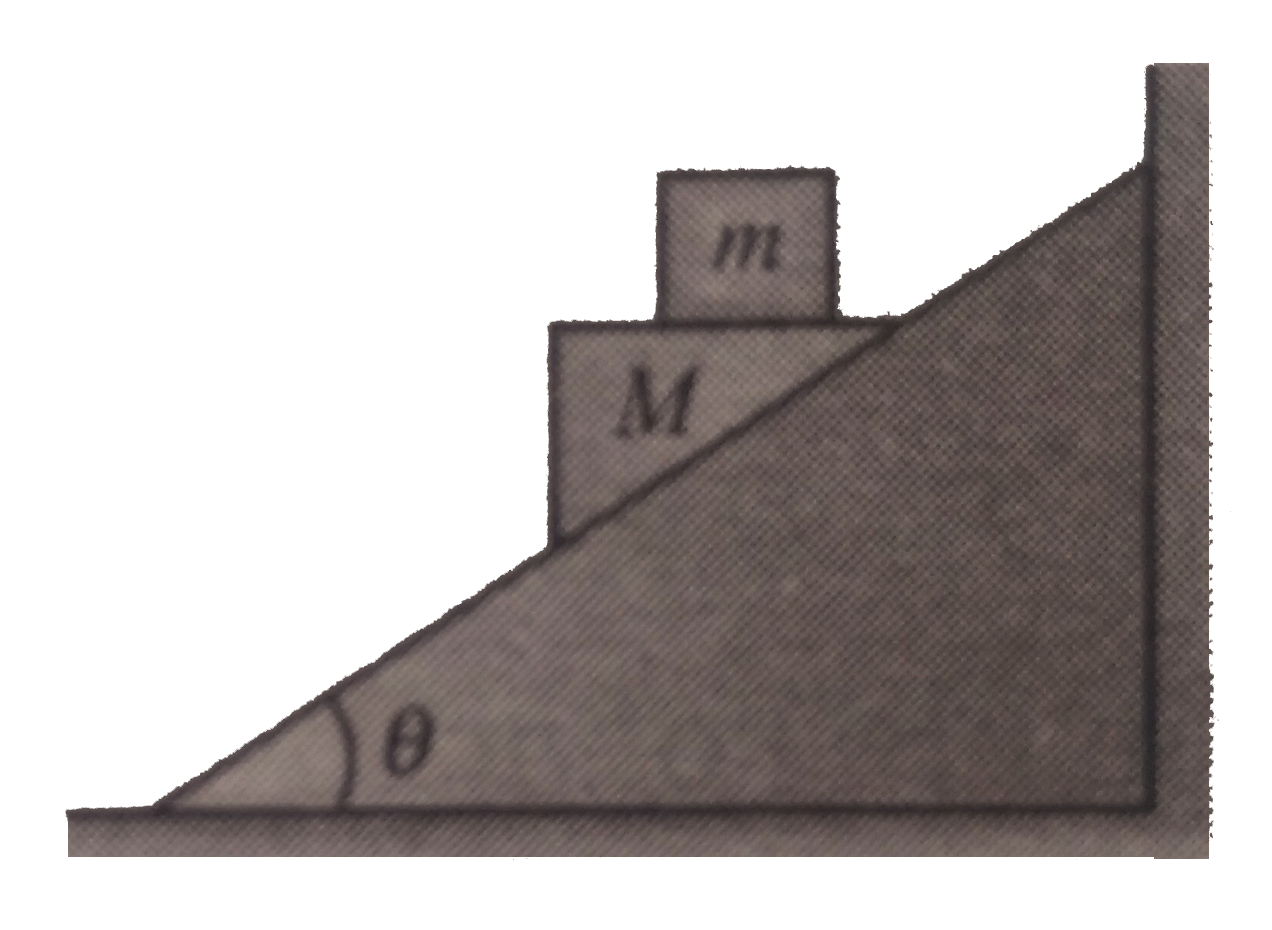
Consider a system of a small body of mass m kept on a large body of mass M placed over an inclined plane of the angle of inclination `theta` to the horizontal. Find the acceleration of m when the system is set in motion. Assume an inclined plane to be fixed. all the contact surfaces are smooth.

Text Solution

Verified by Experts
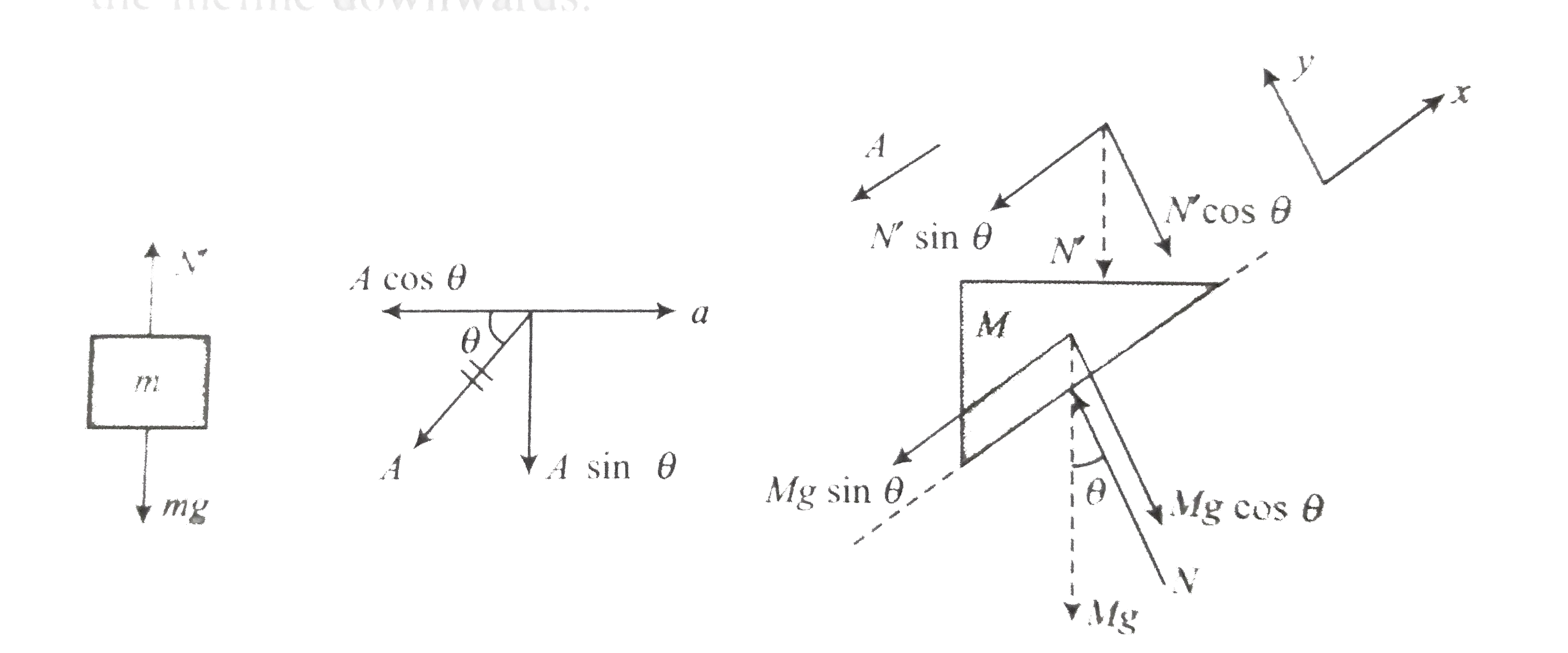
Method 1: Analysis in an inertial reference frame attached to the ground :
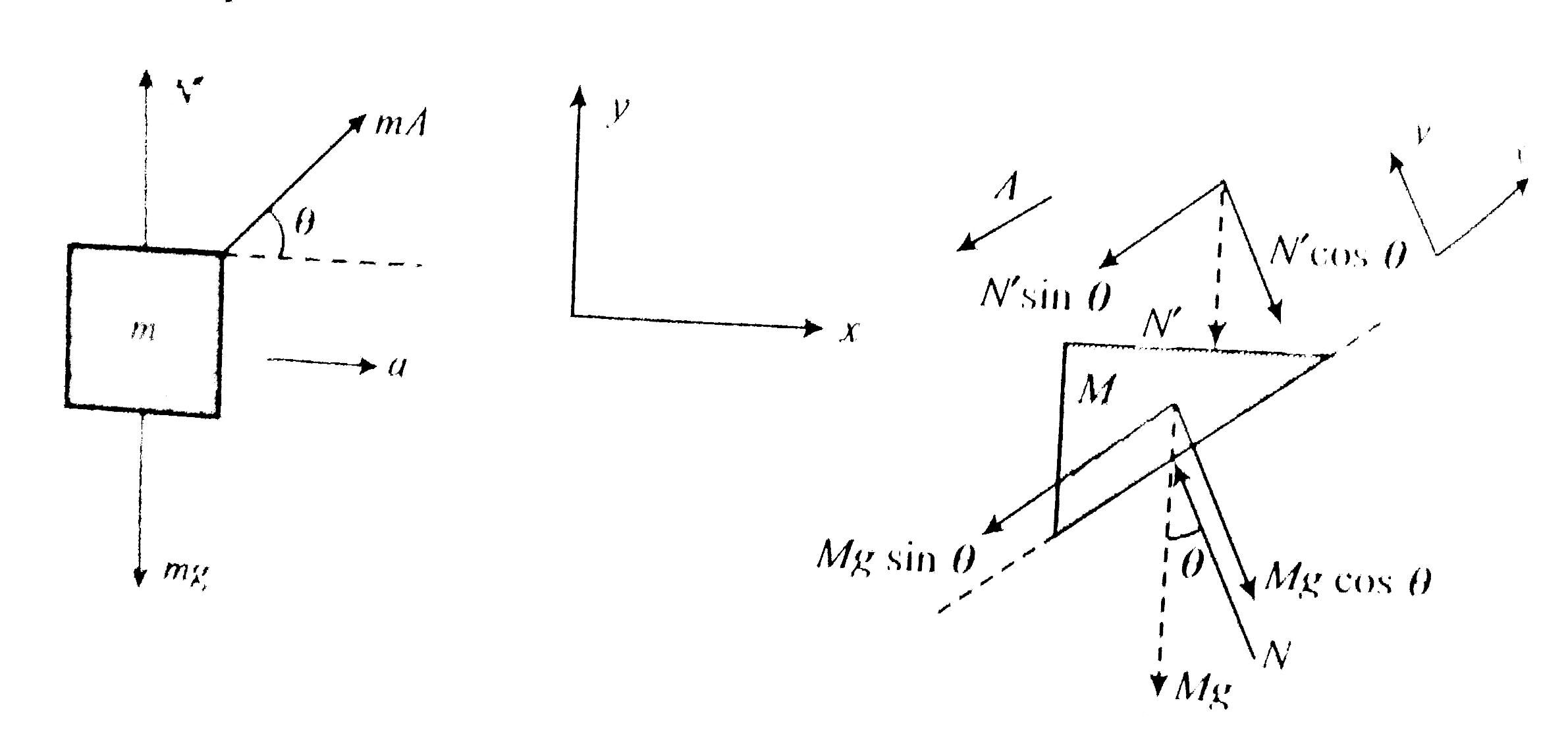
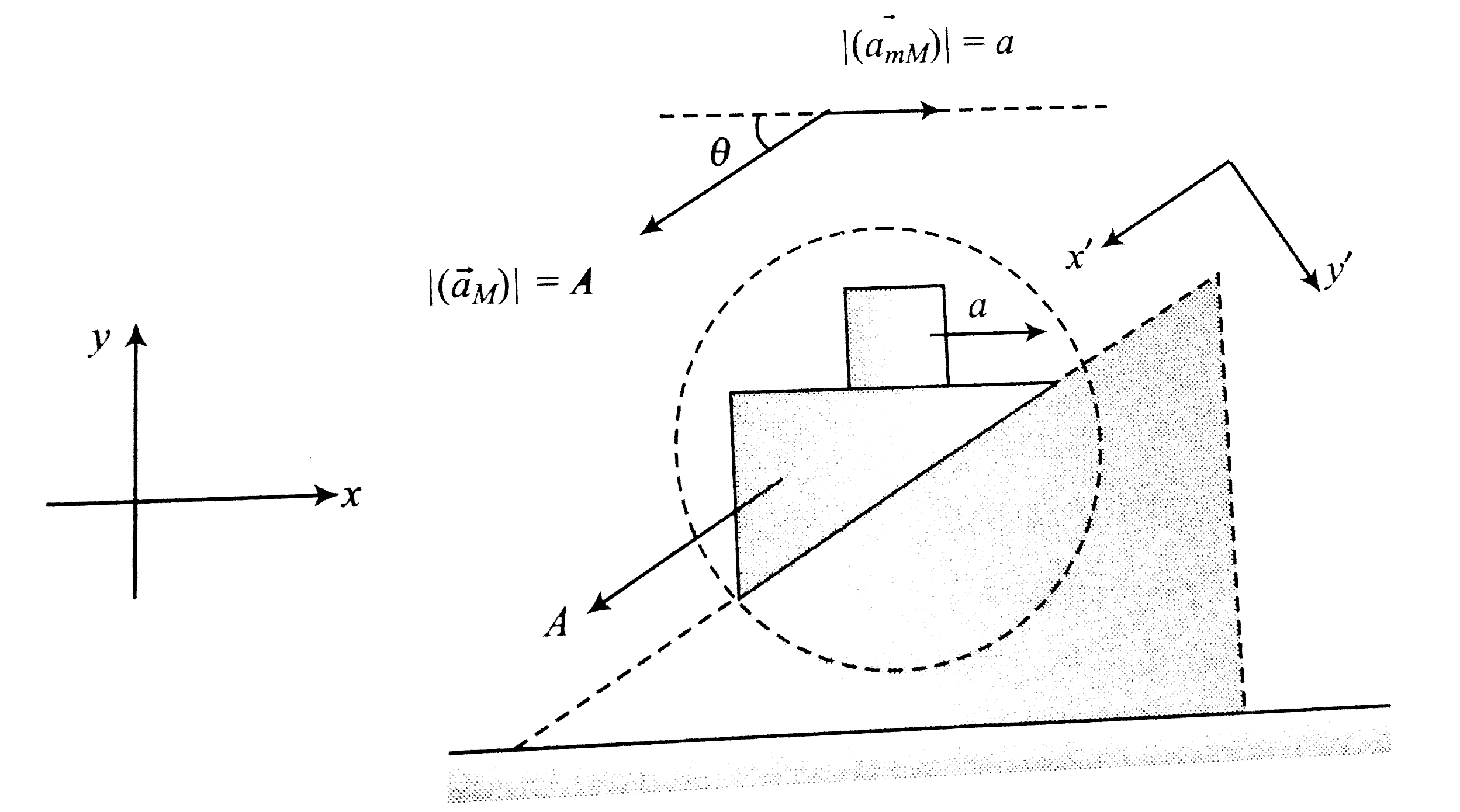
Let a be the acceleration m w.r.t. M directed horizontally towards right.
Let A be the acceleration of M w.r.t. the ground directed along the incline downwards.

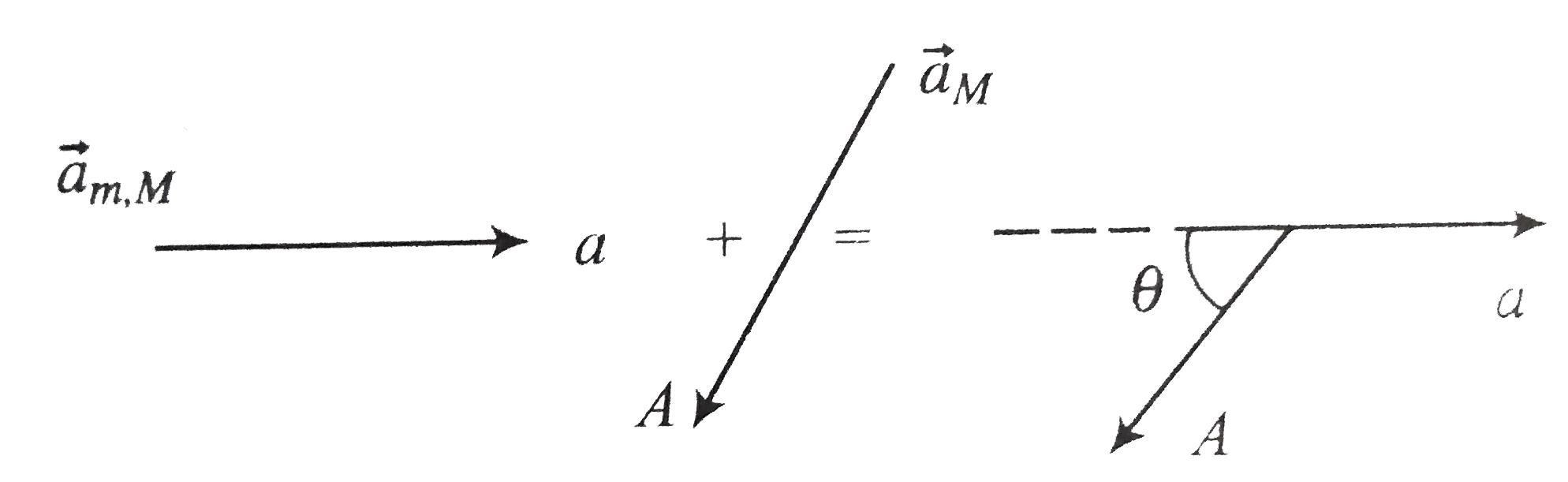
Acceleration of m w.r.t. ground will be the vector sum of the acceleration of m w.r.t. M and the acceleration of M w.r.t. ground.
force equation for m are
`0=m(a-A cos theta)` ..(i)
`mg-N'=m(A sin theta)` ...(ii)
Force equation for M are
`N' sin theta + Mg sin theta = MA` ...(iii)
`N' cos theta+Mg cos theta-N=0` ...(iv)
from (ii),
`N'=mg-mA sin theta`
Subsitituting `N'` in (iii),
`(mg-mA sin theta) sin theta+Mg sin theta =MA`
`implies A=((M+m)g sin theta)/(M+m sin^(2)theta)`
Acceleration of m w.r.t. ground is `A sin theta` (since, `A cos theta-a=0`). Thus, the acceleration of m w.r.t. ground is
`a_(mG)=A sin theta=((M+m)g sin theta)/(M+m sin^(2)theta)`
Method 2: Analysis of motion of m in the non-inertial reference frame attached to M:
Let the acceleration of M w.r.t ground be A along the inclined plane downwards. Consider that ground is an inertiail reference frame, the reference frame attached to M will be non-inertial . For applying Newton's second law of motion to any object w.r.t. on the object which equals mass of the objects times accelerations of M, directed opposite to A.
Force equation for m:

Let the acceleration of m w.r.t. M be a, in the horizontal direction towards right.
The force acting on m are:
`**`weight of m, mg, acting vertically downwards
`**` Normal force on m by M, `N'` , vertically upwards, and
`**` (mA), the inertial force acting along the incline upwards, as the acceleration of M is A along the incline downwards.
`N'+(mA) sin theta=mg` ..(i)
`(mA) cos theta=ma` ..(ii)
Force equation for M:
The force acting on M are
`**` The weight `Mg`
`** N'`, normal force exerted by m
`** N`, normal force exerted by the incline
`Mg sin theta+N' sin theta=MA`..(iii)
(Along the incline)
`Mg cos theta+N' cos theta =N` ...(iv)
(Perpendicular to the incline)
From (i),(iii) and (iv)
`A=((M+m)g sin theta)/(M+m sin^(2)theta)`
Acceleration of m relative to ground.

`vec(a)_(m)=vec(a)_(mM)+vec(a)_(M)`
`=ahat(i)+A cos theta (-hat(i))+A sin theta (-hat(j))`
But `a=A cos theta` [ form(ii)], therefore,
`a_(m)=A sin theta`, vertically downward
`((M+m)g sin^(2) theta)/(M+m sin^(2)theta)`
Method 3: Considering M and m as system

The system has `(M+m)g sin theta` external force parallel to inclined plane.
`vec(F)_(x')=M(vec(a)_(M))_(x')+m(vec(a)_(m))_(x')`
`(vec(a)_(m))_(x') = (vec(a)_(m,M))_(x') + (vec(a)_(M))_(x')`
`=-a cos theta + A =(A-a cos theta)`
`MA+m(A-a cos theta)=(M+m)g sin theta` ...(i)
Considering the motion of block in horizontal direction only and writing equation of motion w.r.t. ground,
`(vec(a)_(m))_(x)=a- A cos theta`
The block is not having any external force in horizontal direction
`Sigma vec(F)_(x) = 0 =m(vec(a)_(m))_(x)=m(a=A cos theta)`
or `a=A cos theta` ...(ii)
From (i) and (ii)
`MA+m[A-(A cos theta) cos theta]=(M+m)g sin theta`
`MA+mA sin^(2)theta=(M+m)g sin theta`
After solving, we get
`A=((M+m)g sin theta)/(M+m sin^(2)theta)`
Promotional Banner

Topper's Solved these Questions

  • NEWTON'S LAWS OF MOTION 1

    CENGAGE PHYSICS ENGLISH|Exercise Exercise 6.1|11 Videos
  • NEWTON'S LAWS OF MOTION 1

    CENGAGE PHYSICS ENGLISH|Exercise Exercise 6.2|35 Videos
  • NEWTON'S LAWS OF MOTION 1

    CENGAGE PHYSICS ENGLISH|Exercise Integer|5 Videos
  • MISCELLANEOUS VOLUME 2

    CENGAGE PHYSICS ENGLISH|Exercise INTEGER_TYPE|10 Videos
  • NEWTON'S LAWS OF MOTION 2

    CENGAGE PHYSICS ENGLISH|Exercise Integer type|1 Videos

Similar Questions

Explore conceptually related problems

A solid sphere of mass m rolls without slipping on an inclined plane of inclination theta . The linear acceleration of the sphere is

A block of mass m is placed on a smooth inclined plane of inclination theta with the horizontal. The force exerted by the plane on the block has a magnitude

A block of mass m is placed on a smooth inclined plane of inclination theta with the horizontal. The force exerted by the plane on the block has a magnitude

A block of mass m is kept on an inclined plane is angle inclination theta ( lt phi), where phi= angle of friction. Then :

A body of mass m is kept on a rough fixed inclined plane of angle of inclination theta=30^(@) . It remains stationary. Then magnitude of force acting on the body by the inclined plane is equal to :

A body is placed on a smooth inclined plane of inclination 1 in x. The horizontal acceleration to be given to the inclined plane so that the body on it remains at rest with respect to inclined plane is

A block of mass m is placed at rest on an inclination theta to the horizontal. If the coefficient of friction between the block and the plane is mu , then the total force the inclined plane exerts on the block is

A block is placed on a smooth inclined plane at an angle 'theta' to the horizontal. The acceleration must the plane be moved horizontally so that the block to fall freely is

In fig. mass m is being pulled on the incline of a wedge of mass M. All the surfaces are smooth. Find the acceleration of the wedge.

A block is kept on a smooth inclined plane of angle of inclination theta that moves wuth a contact acceleration so that the block does not slide relative to the inclined plane. If the inclined plane stops the normal contact force offered by the plane on the block changes by a factor