Home
Class 11
PHYSICS
In the system shown in fig. m(1) gt m(2)...

In the system shown in fig. `m_(1) gt m_(2)` . The system is held at rest by thread BC. Now thread BC is burnt. Answer the following:

Just after burning the thread, what is the acceleration of `m_(2)`?

A

`m_(1)g`

B

`m_(2)g`

C

Zero

D

Cannot say

Text Solution

Verified by Experts

The correct Answer is:
A

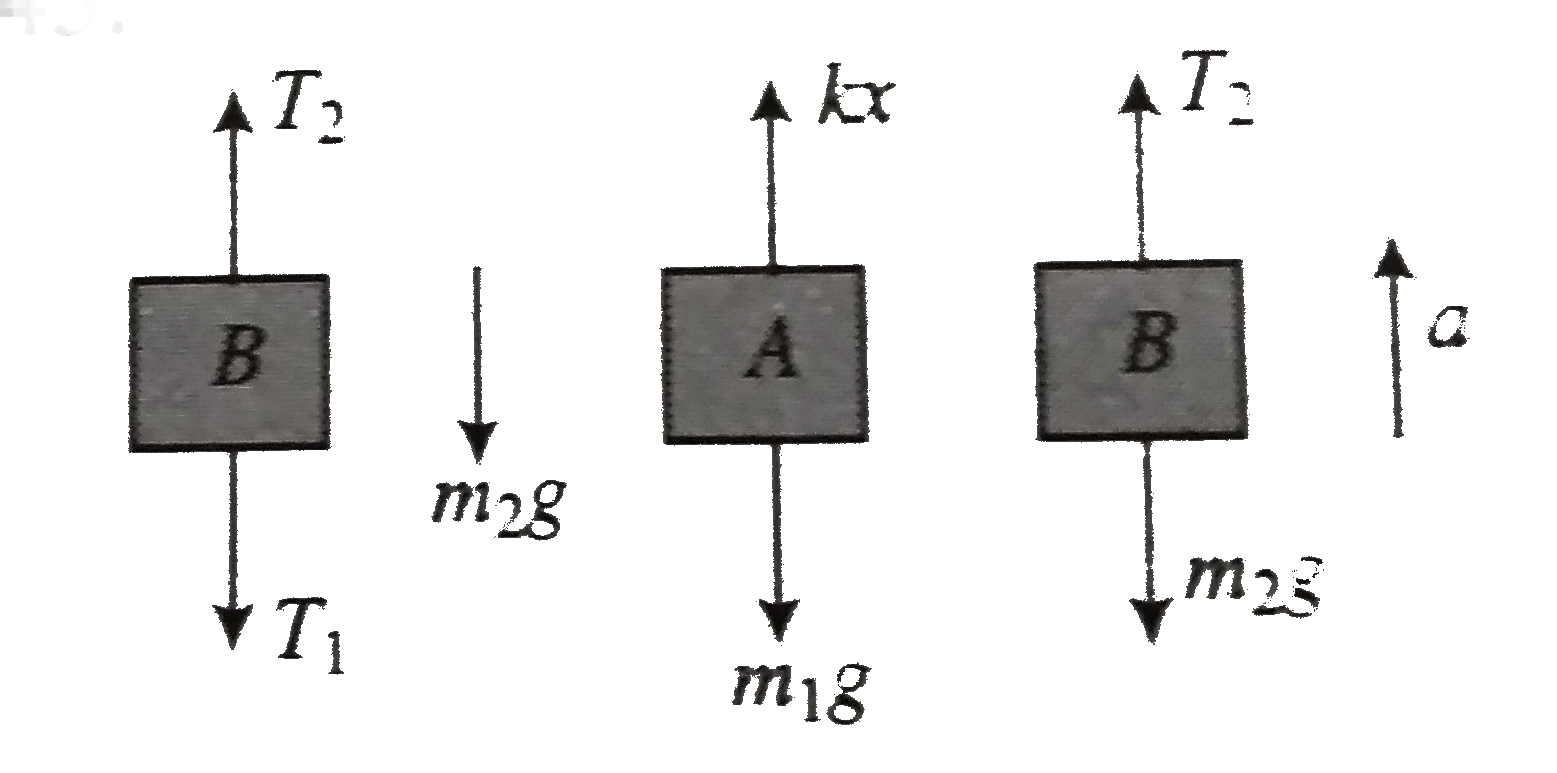
Before Burning BC, the free-body diagram are shown in the fig.

`T_(2)=T_(1)+m_(2)g` …(i)
`kx=T_(2)=m_(1)g`..(ii)
where x is extension in the spring. Just after burning, `T_(1)` will become zero. but `T_(2)` will remain same.
`T_(2)-m_(2)g=m_(2)g implies a = ((m_(1)-m_(2)g))/(m_(2))`
As `T_(2)` remains same, acceleration of block A will still remain zero.
Promotional Banner

Topper's Solved these Questions

  • NEWTON'S LAWS OF MOTION 1

    CENGAGE PHYSICS ENGLISH|Exercise Integer|5 Videos
  • NEWTON'S LAWS OF MOTION 1

    CENGAGE PHYSICS ENGLISH|Exercise Assertion-reasoning|15 Videos
  • MISCELLANEOUS VOLUME 2

    CENGAGE PHYSICS ENGLISH|Exercise INTEGER_TYPE|10 Videos
  • NEWTON'S LAWS OF MOTION 2

    CENGAGE PHYSICS ENGLISH|Exercise Integer type|1 Videos

Similar Questions

Explore conceptually related problems

In the system shown in figure m_(1) gt m_(2) . System is held at rest by thread BC. Just after the thread BC is burnt.

In the system shown in fig. m_(1) gt m_(2) . The system is held at rest by thread BC. Now thread BC is burnt. Answer the following: Before burnig the thread, what are the tensions in spring and thread BC, respectively?

In the system in the figure m_(1)gtm_(2) system is held at rest by thread BC . Just after the thread BC is burnt:

Two blocks of masses m_(1) and m_(2) are connected with a light spring of force constant k and the whole system is kept on a frictionless horizontal surface. The masses are applied forces F_(1) and F_(2) as shown in fig. At any time the blocks have same acceleration a_(0) but in opposite direction. Now answer the following : If F_(2) is removed at this moment, then just after the acceleration of m_(2) is

For the system shown in fog. m_(1) gt m_(2) gtm_(3) gt m_(4) . Initially, the system is at rest in equilibrium condition., if the string joining m_(4) and ground is cut, then just after the string is cut. Statement I: m_(1), m_(2), m_(3) remain stationary. Statement II: The value of acceleration of all the four blocks can be determined. Statement III: Only m_(4) remain stationary. Statement IV: Only m_(4) accelerates.

In the system shown in fig., m_(A)=4m , m_(B)=3m , and m_(c)=8m . Friction is absent everywhere. String is inextensible and light. If the system is released from rest, then Acceleration of Block B is

A mass m_(1) lies on fixed, smooth cylinder . An ideal cord attached to m_(1) passes over the cylinder and is connected to mass m_(2) as shown in the figure. (a) Find the value of theta ( shown in diagram ) for which the system is in equilibrium. (b) Given m_(1)=5 kg, m_(2)=4kg . The system is released from rest when theta =30^(@) . Find the magnitude of acceleration of mass m_(1) just after the system is released.

The system shown in the figure is in equilibrium at rest. The spring and string are massless Now the string is cut. Find the acceleration of the blocks just after the string is cut.

Two small balls of the same size and of mass m_(1) and m_(2) (m_(1) gt m_(2)) are tied by a thin weightless thread and dropped from a ballon. Determine the tension T of the thread during the flight after the motion of the balls has become steady-state.

The pulley of the system shown in Fig is massless and frictionless and thread and thread is inextensible Then horizontal surface over which block C is smooth while for all the remaining surface is mu Calculate minimum acceleration a with which the system should be moved to the right so that suspented block A (mass m ) and B (mass M and M gt m ) can remain stationary relative to C

CENGAGE PHYSICS ENGLISH-NEWTON'S LAWS OF MOTION 1-Linked Comperhension
  1. In the system shown in fig. m(1) gt m(2) . The system is held at rest ...

    Text Solution

    |

  2. In the system shown in fig. m(1) gt m(2) . The system is held at rest ...

    Text Solution

    |

  3. In the system shown in fig. m(1) gt m(2) . The system is held at rest ...

    Text Solution

    |

  4. Two block A and B of masses 1kg and2kg respectively are connected by ...

    Text Solution

    |

  5. Two block A and B of masses 1kg and2kg respectively are connected by ...

    Text Solution

    |

  6. Two block A and B of masses 1kg and2kg respectively are connected by ...

    Text Solution

    |

  7. A ball of mass 0.2 kg travelling in a straight line with a speed of m/...

    Text Solution

    |

  8. A ball of mass 200g is thrown with a speed 20ms^(-1). The ball strikes...

    Text Solution

    |

  9. A ball weighing 10g hits a hard surface vertically with a speed of 5m/...

    Text Solution

    |

  10. A small, light pulley is attached with a block C of mass 4 kg as shown...

    Text Solution

    |

  11. A small, light pulley is attached with a block C of mass 4 kg as shown...

    Text Solution

    |

  12. A small, light pulley is attached with a block C of mass 4 kg as shown...

    Text Solution

    |

  13. A small, light pulley is attached with a block C of mass 4 kg as shown...

    Text Solution

    |

  14. Study the following table

    Text Solution

    |

  15. Study the following table

    Text Solution

    |

  16. Study in fig. and answer the following questions accordingly. Neglect ...

    Text Solution

    |

  17. Three blocks A, B, and C of masses 3M, 2M, and M are suspended vertica...

    Text Solution

    |

  18. Three blocks A, B, and C of masses 3M, 2M, and M are suspended vertica...

    Text Solution

    |

  19. Three blocks A, B, and C of masses 3M, 2M, and M are suspended vertica...

    Text Solution

    |

  20. In fig, all the pulleys and strings are massless and all the surfaces ...

    Text Solution

    |

