Home
Class 11
PHYSICS
A small, light pulley is attached with a...

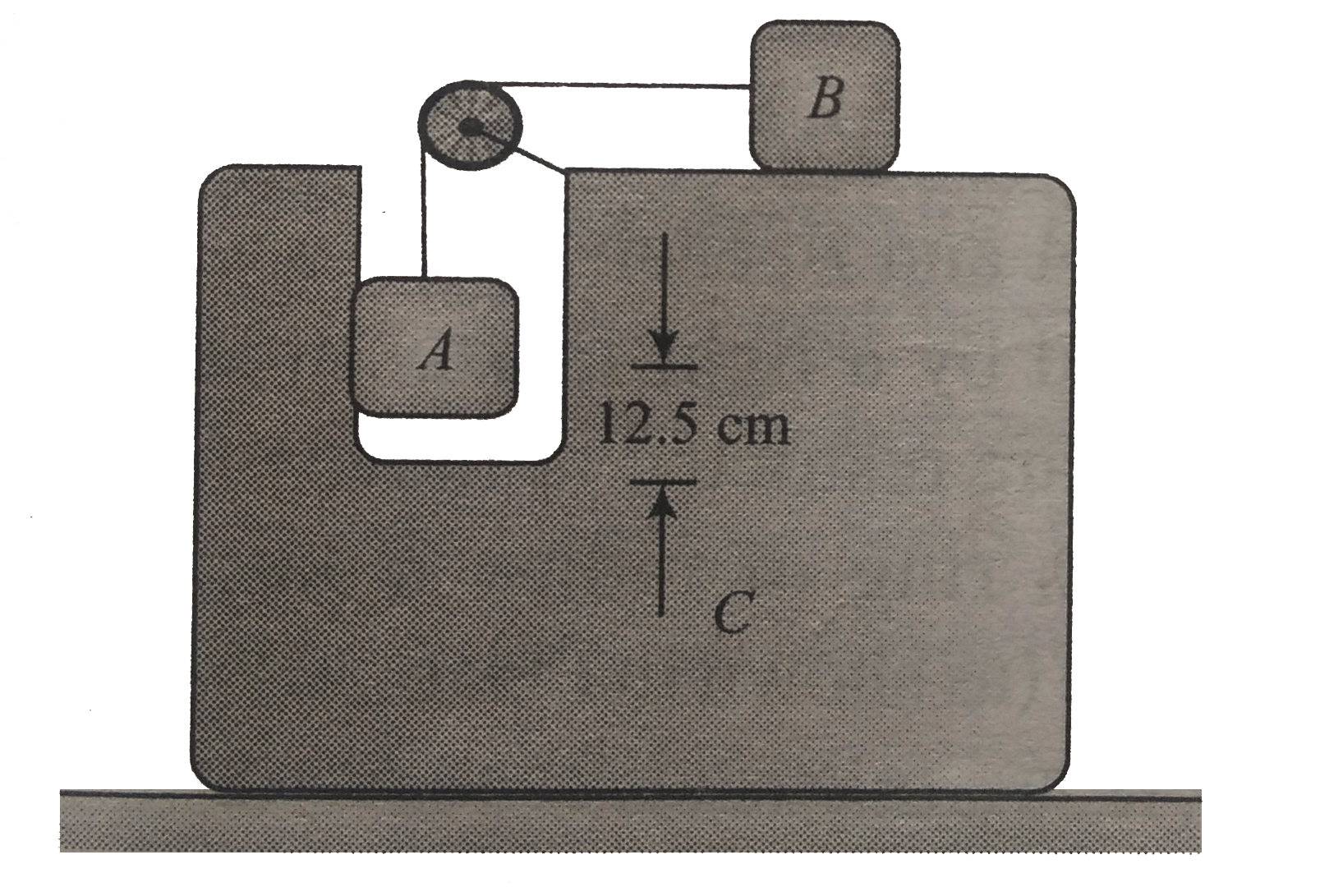
A small, light pulley is attached with a block C of mass 4 kg as shown in fig. Block B of mass 1.5 kg is placed on the top horizontal surface of C. Another block A of mass 2 kg is hanging from a string, attached with B and passing over the pulley. Taking `g=10ms^(-2)` and neglecting friction, calculate the acceleration of each block when the system is released from rest.

A

`20 ms^(-2)`

B

`5 ms^(-2)`

C

`15 ms^(-2)`

D

`10 ms^(-2)`

Text Solution

Verified by Experts

The correct Answer is:
B

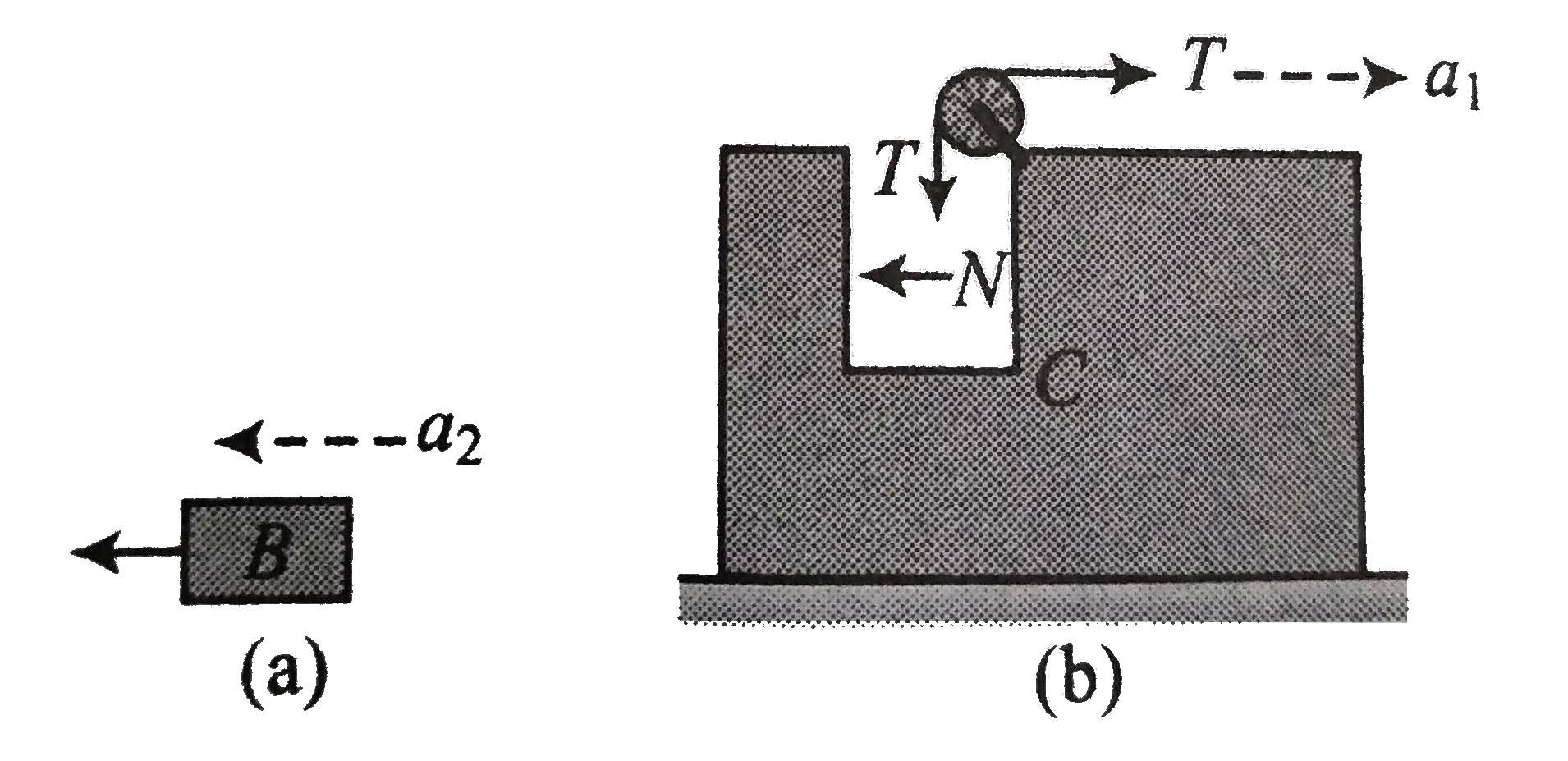
Let acceleration of block C be `a_(1)` (rightwards) and acceleration of block B be `a_(2)` (lefwards).
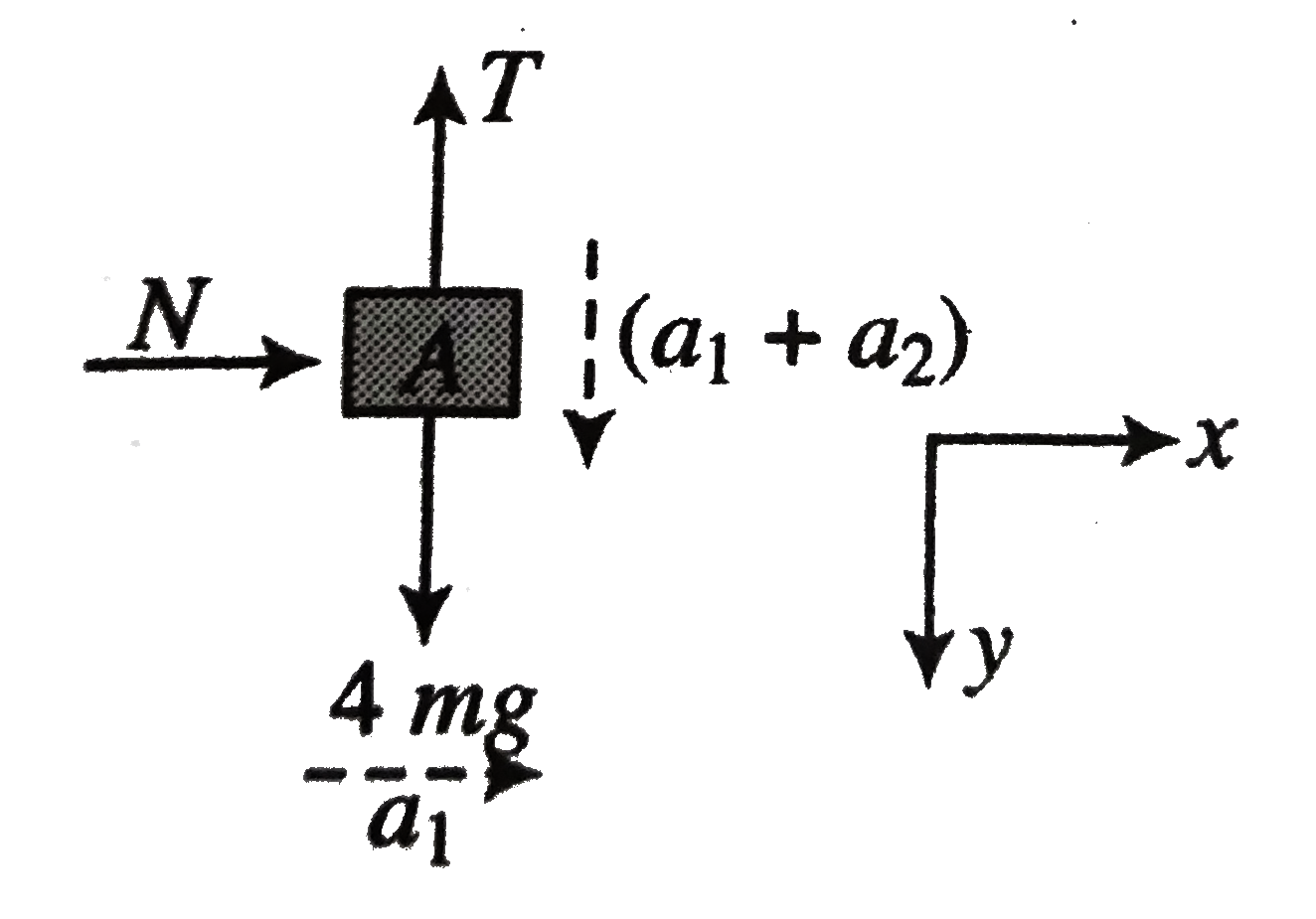
Then acceleration of A will be `(a_(1)+a_(2))` downwards and `a_(1)` rightwards.
Free body diagram of A is shown in fig.

Using `Sigma F_(x)=ma_(x)` and `Sigma F_(y)=ma_(y)`, we get
`N=4m(a_(1))` ..(i)
and `4mg-T=4m(a_(1)+a_(2))` ..(ii)
Free bocy diagram of B (showing horizontal force only) is shown in the figure.

Using `Sigma F_(x)=ma_(x)`, we get
`T=3ma_(2)` ...(iii)
Free body diagram of C (showing horizontal force only) is shown in fig.
Using `Sigma F_(x)=ma_(x)`, we get
`T-N=8ma_(1)`...(iv)
We have four unknowns `T, N, a_(1)`, and `a_(2)`. solving these four equations, we get
`a_(1)=g/8` and `a_(2) = g/2`, `a_(1)+a_(2)=5/8 g`
Thus, acceleration of A is `g//8` in horizontal direction and `5g//8` in vertical direction.
Acceleration of B is `g//2` in horizontal direction (leftwards) and acceleration of C is `g//8 in horizontal direction (rightwards).
Promotional Banner

Topper's Solved these Questions

  • NEWTON'S LAWS OF MOTION 1

    CENGAGE PHYSICS ENGLISH|Exercise Integer|5 Videos
  • NEWTON'S LAWS OF MOTION 1

    CENGAGE PHYSICS ENGLISH|Exercise Assertion-reasoning|15 Videos
  • MISCELLANEOUS VOLUME 2

    CENGAGE PHYSICS ENGLISH|Exercise INTEGER_TYPE|10 Videos
  • NEWTON'S LAWS OF MOTION 2

    CENGAGE PHYSICS ENGLISH|Exercise Integer type|1 Videos

Similar Questions

Explore conceptually related problems

A block of mass m_(1)=2 kg is kept on a smooth horizontal table. Another block of mass m_(2)=1 kg is connected to m_(1) by a light inextensible string passing over a smooth pulley as shown in the figure. If the blocks are released, what will be the (a) acceleration of each block (b) tension in the string?

Two blocks A and B of equal masses are attached to a string passing over a smooth pulley fixed to a wedge as shown in figure. Find the magnitude of acceleration of centre of mass of the two blocks when they are released from rest. Neglect friction.

Two blocks A and B of equal masses are attached to a string passing over a smooth pulley fixed to a wedge as shown in figure. Find the magnitude of acceleration of centre of mass of the two blocks when they are released from rest. Neglect friction.

A block of mass M placed on a frictionless horizontal table is pulled by another block of mass m hanging vertically by a massless string passing over a frictionless pulley. The tension in the string is :

Two blocks of masses 6 kg and 4 kg are attached to the two ends of a massless string passing over a smooth fixed pulley. if the system is released, the acceleration of the centre of mass of the system will be

A block of mass m_1 = 4kg lying on a plane inclined at an angle of 30^(@) , is connected to another freely suspended block of mass m_2 = 6kg with the help of a string passing over a smooth pulley as shown in the figure. The acceleration of each block is (g = 10 m/ s^2 )

Two block of mass 1 kg and 2 kg are connected by a string AB of mass 1 kg . The blocks are placed on a smooth horizontal surface. Block of mass 1 kg is pulled by a horizontal force F of magnitude 8 N . Find the tension in the string at points A and B

A 2kg block lying on smooth table which is connected by a body of mass 1 kg by a string which passes through a pulley. Take 1 kg mass hanging vertically. Find the acceleration of block & tension in string.

A wooden block of mass 0.8 kg is dragged along a level frictionless surface by a hanging block of mass 0.2 kg as shown in the figure. Calculate the tension in the string and the acceleration of blocks.

Figure shows three blocks of mass m each hanging on a string passing over a pulley. Calculate the tension in the string connecting A to B and B to C?

CENGAGE PHYSICS ENGLISH-NEWTON'S LAWS OF MOTION 1-Linked Comperhension
  1. A small, light pulley is attached with a block C of mass 4 kg as shown...

    Text Solution

    |

  2. A small, light pulley is attached with a block C of mass 4 kg as shown...

    Text Solution

    |

  3. A small, light pulley is attached with a block C of mass 4 kg as shown...

    Text Solution

    |

  4. A small, light pulley is attached with a block C of mass 4 kg as shown...

    Text Solution

    |

  5. Study the following table

    Text Solution

    |

  6. Study the following table

    Text Solution

    |

  7. Study in fig. and answer the following questions accordingly. Neglect ...

    Text Solution

    |

  8. Three blocks A, B, and C of masses 3M, 2M, and M are suspended vertica...

    Text Solution

    |

  9. Three blocks A, B, and C of masses 3M, 2M, and M are suspended vertica...

    Text Solution

    |

  10. Three blocks A, B, and C of masses 3M, 2M, and M are suspended vertica...

    Text Solution

    |

  11. In fig, all the pulleys and strings are massless and all the surfaces ...

    Text Solution

    |

  12. In fig, all the pulleys and strings are massless and all the surfaces ...

    Text Solution

    |

  13. In fig, all the pulleys and strings are massless and all the surfaces ...

    Text Solution

    |

  14. In fig. both pulleys and the string are massless and all the surfaces ...

    Text Solution

    |

  15. In fig. both pulleys and the string are massless and all the surfaces ...

    Text Solution

    |

  16. In fig. both pulleys and the string are massless and all the surfaces ...

    Text Solution

    |

  17. In the arrangement shown in fig., all pulleys are smooth and massless....

    Text Solution

    |

  18. In the arrangement shown in fig, pulleys D and E are small and frictio...

    Text Solution

    |

  19. In the arrangement shown in fig., all pulleys are smooth and massless....

    Text Solution

    |

  20. In the arrangement shown in fig., all pulleys are smooth and massless....

    Text Solution

    |