Home
Class 11
PHYSICS
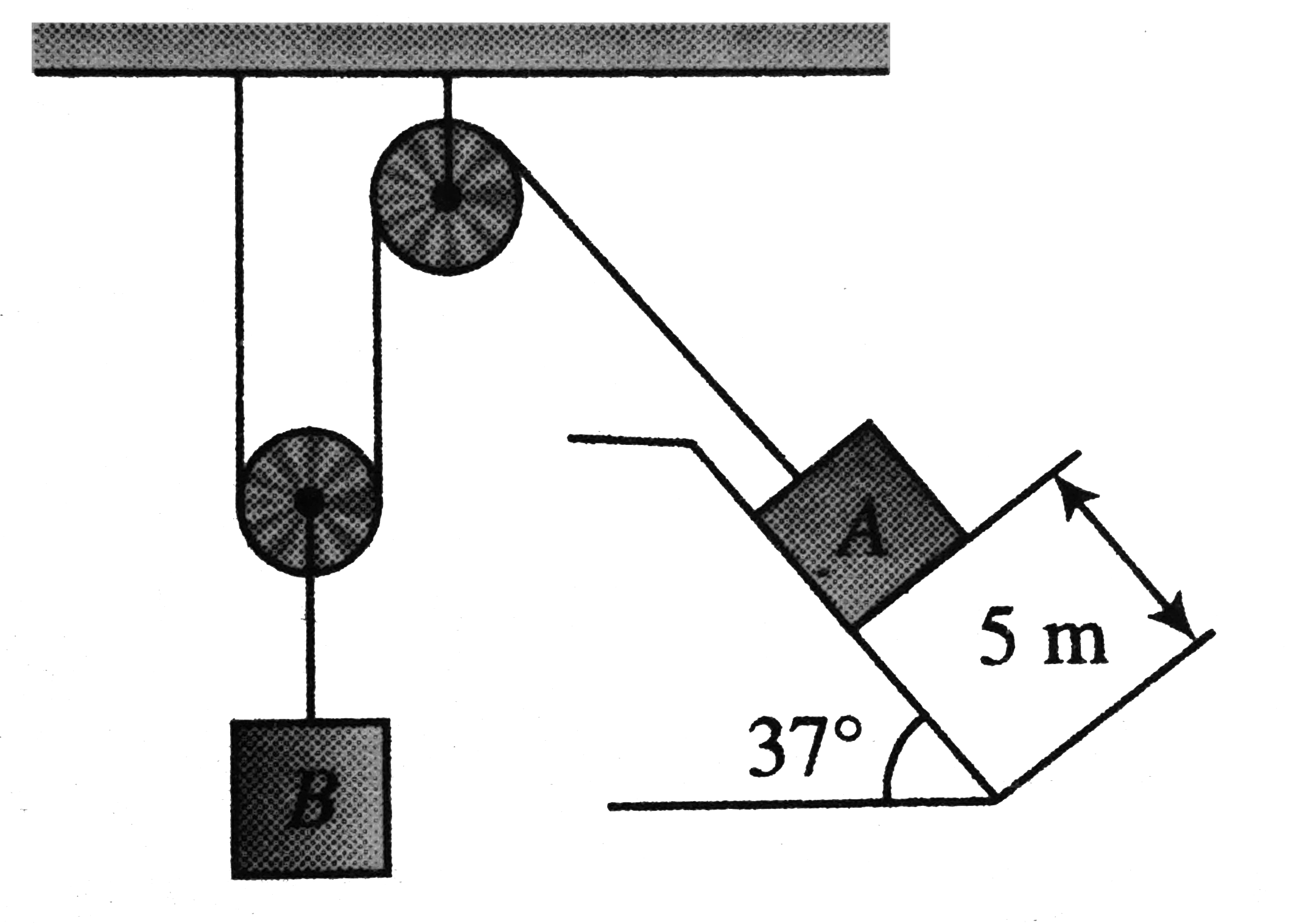
The blocks A and B shown in figure have ...

The blocks A and B shown in figure have masses `M_A=5kg` and `M_B=4kg`. The system is released from rest. The speed of B after A has travelled a distance `1m` along the incline is

A

(a) `sqrt3/2sqrtg`

B

(b) `sqrt3/4sqrtg`

C

(c) `(sqrtg)/(2sqrt3)`

D

(d) `sqrtg/2`

Text Solution

Verified by Experts

The correct Answer is:

C

If A moves down the incline by `1m`, B shall move up by `1/2m`.
If the speed of B is v, then the speed of A will be `2v`.
From conservation of energy,
Gain in KE=loss in PE
`1/2m_A(2v)^2+1/2m_Bv^2=m_Agxx3/5-m_Bgxx1/2`
Solving, we get
`v=1/2sqrt(g/3)`
Promotional Banner

Topper's Solved these Questions

  • WORK, POWER & ENERGY

    CENGAGE PHYSICS ENGLISH|Exercise Multiple Correct|25 Videos
  • WORK, POWER & ENERGY

    CENGAGE PHYSICS ENGLISH|Exercise Linked Comprehension|55 Videos
  • WORK, POWER & ENERGY

    CENGAGE PHYSICS ENGLISH|Exercise Subjective|23 Videos
  • VECTORS

    CENGAGE PHYSICS ENGLISH|Exercise Exercise Multiple Correct|5 Videos

Similar Questions

Explore conceptually related problems

Two blocks A and B are shown in figure have masses 5 kg and 4kg respectively. The system is released from rest. The speed of B after A has travelled the distance 1 m along the incline is (take g= 10m/s^2 ,pulleys and strings are ideal and plane is smooth)

In the arrangement shown in figure m_(A)=4.kg and m_(B)=1.0kg . The system is released from rest and block B is found to have a speed 0.3m//s after it has descended through a distance of 1.m find the coefficient of friction between the block and the table. Neglect friction elsewhere. (Take g=10 m//s^(2) ). .

In the arrangement shown in figure m_(A)=4.kg and m_(B)=1.0kg . The system is released from rest and block B is found to have a speed 0.3m//s after it has descended through a distance of 1.m find the coefficient of friction between the block and the table. Neglect friction elsewhere. (Take g=10 m//s^(2) ). .

Blocks A and B shown in the figure are having equal masses m. The system is released from rest with the spring unstretched. The string between A and ground is cut, when there is maximum extension in the spring. The acceleration of centre of mass of the two blocks at this instant is

A block of mass M is placed on the top of a bigger block of mass 10 M as shown in figure. All the surfaces are frictionless. The system is released from rest, then the distance moved by the bigger block at the instant the smaller block reaches the ground :

Consider the situatioin shown in figure. The system is released from rest and the block of mass 1.0 kg is found to have a speed 0.3 m/s ater it has descended thrugh a distance of 1 m. find the coefficient of kinetic friction between the block and the table.

The system shown in the figure is released from rest. At the instant when mass M has fallen through a distance h, the velocity of m will be

In the figure shown co-efficient of friction between the block B and C is 0.4. There is no friction between the block C and hte surface on which it is placed. The system of blocks is released from rest in the shown situation. Find the distance moved by the block C when block A descends through a distance 2m. Given masses of the blocks are m_(A)=3 kg, m_(B)=5 kg and m_(C)=10 kg .

Two block A and B are arrenged as shown in figure (m_(A) = 5 kg and m_(B) = 10 kg) Find the acceleration of blocks if F = 40 N

A smooth block of mass m is held stationary on a smooth wedge of mass M and inclination theta as shown in figure .If the system is released from rest , then the normal reaction between the block and the wedge is

CENGAGE PHYSICS ENGLISH-WORK, POWER & ENERGY-Single Correct
  1. A man places a chain (of mass m and length l) on a table slowly. Initi...

    Text Solution

    |

  2. The potential energy of a particle of mass m is given by U=(1)/(2)kx^(...

    Text Solution

    |

  3. The blocks A and B shown in figure have masses MA=5kg and MB=4kg. The ...

    Text Solution

    |

  4. A collar B of mass 2kg is constrained to move along horizontal smooth ...

    Text Solution

    |

  5. A block attached to a spring, pulled by a constant horizontal force, i...

    Text Solution

    |

  6. A particle is projected along a horizontal field whose coefficient of ...

    Text Solution

    |

  7. Two identical blocks A and B are placed on two inclined planes as show...

    Text Solution

    |

  8. A block of mass m is being pulled up a rough incline by an agent deliv...

    Text Solution

    |

  9. The given plot shows the variation of U, the potential energy of inter...

    Text Solution

    |

  10. One end of an unstretched vertical spring is attached to the ceiling a...

    Text Solution

    |

  11. The potential energy function associated with the force vecF=4xyhati+2...

    Text Solution

    |

  12. The potential energy for a force filed vecF is given by U(x,y)=cos(x+y...

    Text Solution

    |

  13. A particle is projected with a velocity u making an angle theta with t...

    Text Solution

    |

  14. A block of mass m is attached with a massless spring of force constant...

    Text Solution

    |

  15. In the above question, the average power delivered by gravity is

    Text Solution

    |

  16. A particle A of mass 10//7kg is moving in the positive direction of x-...

    Text Solution

    |

  17. A particle is projected vertically upwards with a speed of 16ms^-1. Af...

    Text Solution

    |

  18. An engine can pull four coaches at a maximum speed of 20ms^-1. The mas...

    Text Solution

    |

  19. In figure, the variation of potential energy of a particle of mass m=2...

    Text Solution

    |

  20. Block A is hanging from vertical spring of spring constant K and is re...

    Text Solution

    |
