Home
Class 11
PHYSICS
A block attached to a spring, pulled by ...

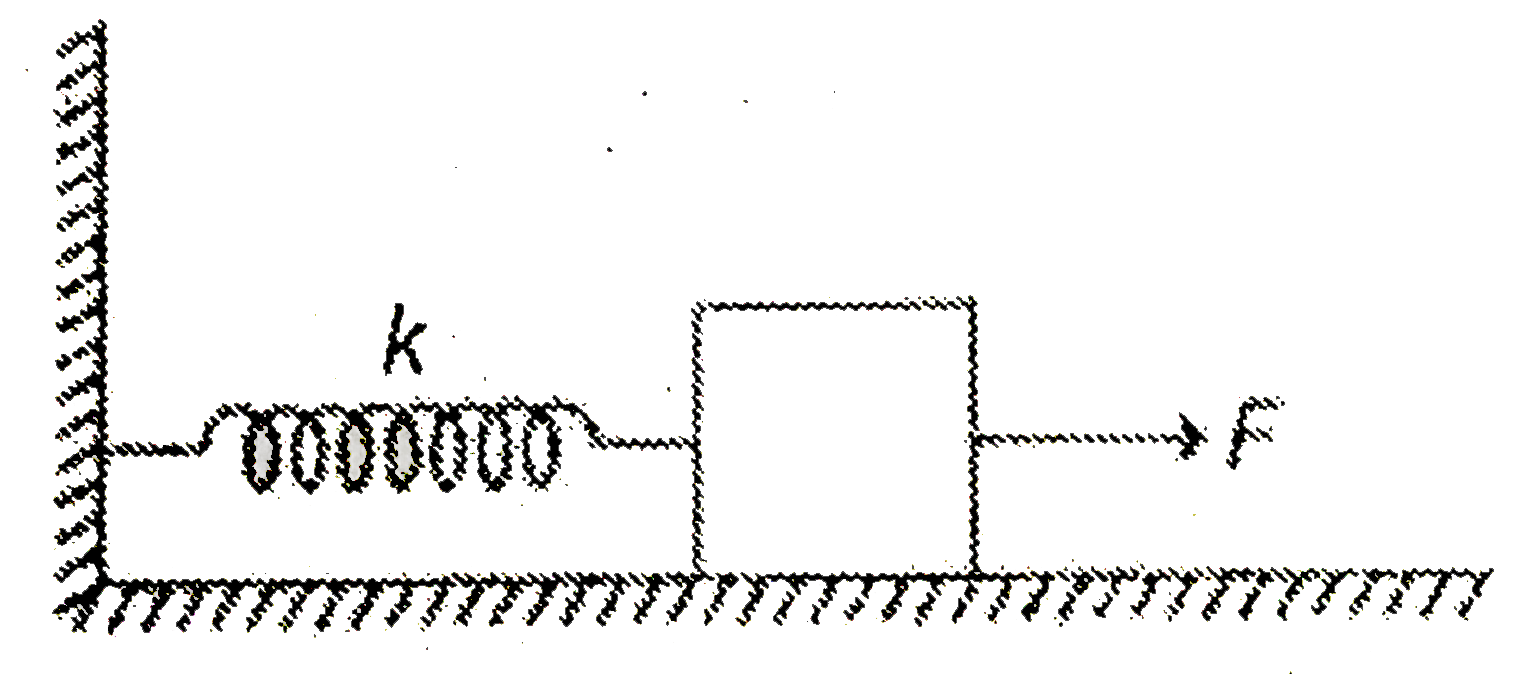
A block attached to a spring, pulled by a constant horizontal force, is kept on a smooth surface as shown in the figure. Initially, the spring is in the natural state. Then the maximum positive work that the applied force F can do is [Given that spring does not break]

A

(a) `F^2/k`

B

(b) `(2F^2)/(k)`

C

(c) `oo`

D

(d) `(F^2)/(2k)`

Text Solution

Verified by Experts

The correct Answer is:
B

Applying work-energy theorem on the block, we get
`Fl-1/2kt^2=0`
`l=(2F)/(k)` or work done `=Fl=(2F^2)/(k)`
Promotional Banner

Topper's Solved these Questions

  • WORK, POWER & ENERGY

    CENGAGE PHYSICS ENGLISH|Exercise Multiple Correct|25 Videos
  • WORK, POWER & ENERGY

    CENGAGE PHYSICS ENGLISH|Exercise Linked Comprehension|55 Videos
  • WORK, POWER & ENERGY

    CENGAGE PHYSICS ENGLISH|Exercise Subjective|23 Videos
  • VECTORS

    CENGAGE PHYSICS ENGLISH|Exercise Exercise Multiple Correct|5 Videos

Similar Questions

Explore conceptually related problems

A block attached to a spring, pulled by a constant horizontal force, is kept on a smooth surface as shown in figure. Initially, the spring is in the natural length state. Then the maximum positive work that the applied force F can do is (give that string does not break)

A block attached to a spring, pulled by a constant horizontal force, is kept on a smooth surface as shown in figure. Initially, the spring is in the natural length state. Then the maximum positive work that the applied force F can do is (give that string does not break)

A block of mass m is attached to a spring of force constant k whose other end is fixed to a horizontal surface. Initially the spring is in its natural length and the block is released from rest. The average force acting on the surface by the spring till the instant when the block has zero acceleration for the first time is

A block of mass m is attached with a spring in vertical plane as shown in the figure. If initially spring is in its natural length and the block is released from rest, then maximum extension in the spring will be

A dumbbell consists of two balls A and B of mass m=1 kg and connected by a spring. The whole system is placed on a smooth horizontal surface as shown in the figure. Initially the spring is at its natural length, the ball B is imparted a velocity v_(0)=8/(sqrt(7))m//s in the direction shown. The spring constant of the spring is adjusted so that the length of the spring at maximum elongation is twice that of the natural, length of the spring. Find the maximum potential energy stored (in Joule) in the spring during the motion.

A block attached with an ideal spring is kept on a smooth horizontal surface. Now the free end of the spring is pulled with a constant velocity u horizontally. Then the maximum energy stored in the spring and bock system during subsequent motion is :

A block of mass m having charge q is attached to a spring of spring constant k . This arrangement is placed in uniform electric field E on smooth horizontal surface as shown in the figure. Initially spring in unstretched. Find the extension of spring in equilibrium position and maximum extension of spring.

Two blocks having masses 8kg and 16kg are connected to the two ends of a light spring. The system is placed on a smooth horizontal floor. An inextensible string also connects B with ceiling as shown in the figure at the final moment. Initially the spring has its natural length. A constant horizontal force F is applied to the heavier block as shown. What is the maximum possible value of F so the lighter block doesn't loose contact with ground?

a block of mass 0.1 kg attached to a spring of spring constant 400 N/m pulled horizontally from x=0 to x_1 =10 mm. Find the work done by the spring force

A block of mass m, lying on a smooth horizontal surface, is attached to a spring (of negligible mass) of spring constant k. The other end of the spring is fixed, as shown in the figure. The block is initally at rest in its equilibrium position. If now the block is pulled withe a constant force F, the maximum speed of the block is :

CENGAGE PHYSICS ENGLISH-WORK, POWER & ENERGY-Single Correct
  1. The blocks A and B shown in figure have masses MA=5kg and MB=4kg. The ...

    Text Solution

    |

  2. A collar B of mass 2kg is constrained to move along horizontal smooth ...

    Text Solution

    |

  3. A block attached to a spring, pulled by a constant horizontal force, i...

    Text Solution

    |

  4. A particle is projected along a horizontal field whose coefficient of ...

    Text Solution

    |

  5. Two identical blocks A and B are placed on two inclined planes as show...

    Text Solution

    |

  6. A block of mass m is being pulled up a rough incline by an agent deliv...

    Text Solution

    |

  7. The given plot shows the variation of U, the potential energy of inter...

    Text Solution

    |

  8. One end of an unstretched vertical spring is attached to the ceiling a...

    Text Solution

    |

  9. The potential energy function associated with the force vecF=4xyhati+2...

    Text Solution

    |

  10. The potential energy for a force filed vecF is given by U(x,y)=cos(x+y...

    Text Solution

    |

  11. A particle is projected with a velocity u making an angle theta with t...

    Text Solution

    |

  12. A block of mass m is attached with a massless spring of force constant...

    Text Solution

    |

  13. In the above question, the average power delivered by gravity is

    Text Solution

    |

  14. A particle A of mass 10//7kg is moving in the positive direction of x-...

    Text Solution

    |

  15. A particle is projected vertically upwards with a speed of 16ms^-1. Af...

    Text Solution

    |

  16. An engine can pull four coaches at a maximum speed of 20ms^-1. The mas...

    Text Solution

    |

  17. In figure, the variation of potential energy of a particle of mass m=2...

    Text Solution

    |

  18. Block A is hanging from vertical spring of spring constant K and is re...

    Text Solution

    |

  19. A machine delivers power to a body which is proportional to velocity o...

    Text Solution

    |

  20. The kinetic energy acquired by a mass m travelling a certain distance ...

    Text Solution

    |

