Home
Class 11
PHYSICS
Given vecF=(xy^2)hati+(x^2y)hatjN. The w...

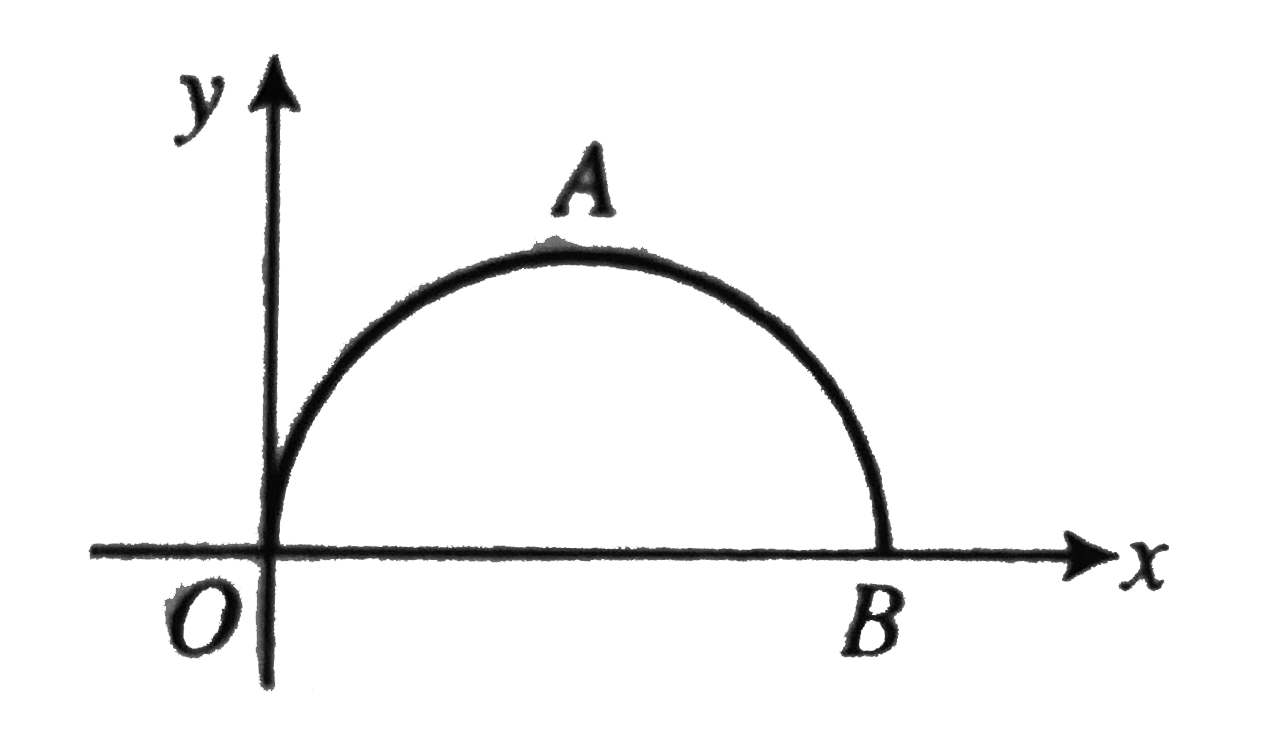
Given `vecF=(xy^2)hati+(x^2y)hatjN`. The work done by `vecF` when a particle is taken along the semicircular path OAB where the coordinates of B are `(4,0)` is

A

(a) `65/3J`

B

(b) `75/2J`

C

(c) `73/4J`

D

(d) Zero

Text Solution

Verified by Experts

The correct Answer is:

D

Given `vecF=(xy)^2hati(x^2y)hatj`
`W=int F_xdx+intF_ydy`
`=intxy^2dx+intx^2ydy`
`=1/2int d(x^2y^2)=[(x^2y^2)/(2)]_(0,0)^(4,0)=0`
Promotional Banner

Topper's Solved these Questions

  • WORK, POWER & ENERGY

    CENGAGE PHYSICS ENGLISH|Exercise Multiple Correct|25 Videos
  • WORK, POWER & ENERGY

    CENGAGE PHYSICS ENGLISH|Exercise Linked Comprehension|55 Videos
  • WORK, POWER & ENERGY

    CENGAGE PHYSICS ENGLISH|Exercise Subjective|23 Videos
  • VECTORS

    CENGAGE PHYSICS ENGLISH|Exercise Exercise Multiple Correct|5 Videos

Similar Questions

Explore conceptually related problems

Force acting on a pasrticle is vecF = (alpha y hati +beta xy hatj) . Find the work done by this force, when pasrticle is moved alolng the line 2x = 3y from origin to the point (3,2) {take quantities in SI units and alpha = 1, beta = 1 }

A force acting on a particle moving in the x-y plane is given by vecF=(2yhati+x^2hatj)N , where x and y are in meters. The particle moves from the origin to a final position having coordinates x=5.00m as shown in figure. Calculate the work done by vecF on the particle as it moves along (a) OAC, (b) OBC, and (c) OC. (d) Is vecF conservative or non-conservative? Explain.

A force vecF = ( 3hati + 4hatj) N is acting on a particle. Work done by the force is zero, when particle is moving on the line 2y + Px = 2 , the value of P is

The work done by the forces vecF = 2hati - hatj -hatk in moving an object along the vectors 3hati + 2hatj - 5hatk is:

A force vecF=(3xN)hati+(4N)hatj , with x in meter, acts on a particle, changing only the kinetic energy of the particle. How mcuh work is done on the particle as it moves from coordinates (2m, 3m, 5m) to (3m, 0m, 6m) ? Does the speed of the particle increase, decrease, or remain the same?

A force vecF=(3xy-5z)hatj+4zhatk is applied on a particle. The work done by the force when the particle moves from point (0, 0, 0) to point (2, 4, 0) as shown in figure.

A particle moves in x-y plane under action of a path dependent force F=yhati+xhatj. The work done by the force as it moves in x-y plane can be evaluated by solving the integral intvecF.vecdr, where vec(dr)=dxhati+dyhatj. The position coordinates x and y will vary according to some constraint determined by teh path followed by the particle. For example, if particle moves along a straight line from one position to other, then an possible rarticle. For example, if particle moves along a straight line from one position to other, then a possible relation is y=mx+c. NOw. try to solve the following questions. 1. The particel moves along a straight line from origin to (a ,a) . The work done by the force on the particle is (1) a^(2)" "(2)2s" "(3)(a^(2))/(2)" "(4) Zero 2. The particle moves from (0,0) to (a,0) and then from, (a,0) to (a,a), in straight line paths. The work done by the force on the particle is (1)a^(2)" "(2)2a" "(3)(a^(2))/(2)" "(4) Zero 3. The differential work by the given force over an elementary displacement is given as dW=vecF.vec(dr)=ydx+xdy This can be expressed as dW=d(xy). From this, it can be inferred that the work done by the force (1) Depends only on initial and final values of x and y (2) Depends on initial and final values and on the path followed (3) Is zero for any values of x and y (4) Is zero when object returns to original position after following any path

A body is subjected to a constant force given by vecF(N)=-hati+2hatj+3hatk What is the work done by this force in moving the body through a distance of 4 m along the z=axis and then 3 m along the y-axis?

Particle moves from point A to point B along the line shown in figure under the action of force. VecF = - x hati + y hatj . Determine the work done on the particle by vec F in moving the particle from point A to point B.

A force given by vecF=f_(x)hati+f_(y)hatj+f_(z)hatk acts on a particle which moves from (a, b, c) to (d, e, f). The work done by the force F is : (Here A_(1), A_(2), A_(3) are magntitude of area bounded )

CENGAGE PHYSICS ENGLISH-WORK, POWER & ENERGY-Single Correct
  1. A projectile is fired with some velocity making certain angle with the...

    Text Solution

    |

  2. Two constant forces vecF1 and vecF2 act on a body of mass 8kg. These f...

    Text Solution

    |

  3. Given vecF=(xy^2)hati+(x^2y)hatjN. The work done by vecF when a partic...

    Text Solution

    |

  4. A force vecF=(3xy-5z)hatj+4zhatk is applied on a particle. The work do...

    Text Solution

    |

  5. The potential energy of a particle is determined by the expression U=a...

    Text Solution

    |

  6. In the position shown in figure, the spring is at its natural length. ...

    Text Solution

    |

  7. In the figure shown, a spring of spring constant K is fixed at on end...

    Text Solution

    |

  8. Let r be the distance of a particle from a fixed point to which it is ...

    Text Solution

    |

  9. A mass m starting from A reaches B of a frictionless track. On reachin...

    Text Solution

    |

  10. A particle of mass m slides along a curved-flat-curved track. The curv...

    Text Solution

    |

  11. A block of mass m has initial velocity u having direction towards +x a...

    Text Solution

    |

  12. A moving railway compartment has a spring of constant k fixed to its f...

    Text Solution

    |

  13. A rope ladder of length L is attached to a balloon of mass M. As the m...

    Text Solution

    |

  14. A block of mass m is lying at rest at point P of a wedge having a smoo...

    Text Solution

    |

  15. Figure shows a smooth vertical circular track AB of radius R. A block ...

    Text Solution

    |

  16. A bead of mass m is released from rest at A to move along the fixed sm...

    Text Solution

    |

  17. A simple pendulum consisting of a mass M attached to a string of lengt...

    Text Solution

    |

  18. Two bodies of masses m and 4m are attached to a light string as shown ...

    Text Solution

    |

  19. A 500-kg car, moving with a velocity of 36kmh^-1 on a straight road un...

    Text Solution

    |

  20. Two spring P and Q having stiffness constants k1 and k2(ltk1), respect...

    Text Solution

    |
