Home
Class 11
PHYSICS
Two identical blocks, each having mass M...

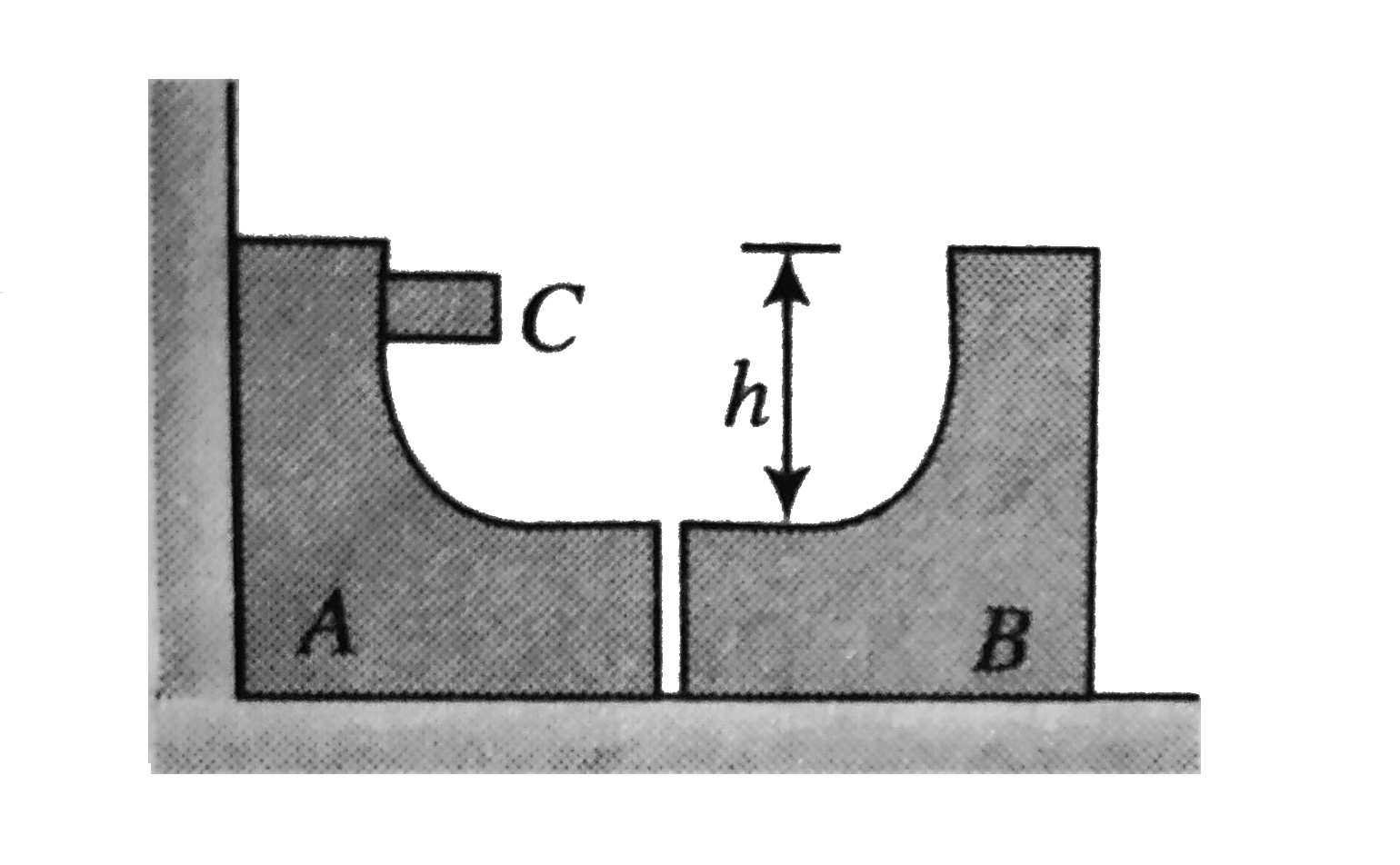
Two identical blocks, each having mass M, are placed as shown in figure. These two blocks A and B are smoothly conjugated, so that when another block C of mass m passes from A to B there is no jerk. All the surfaces are frictionless, and all three blocks are free to move. Block C is released from rest, then

A

(a) Block C will move for a very small duration.

B

(b) Block A will move for a very small duration.

C

(c) Block B will acquire maximum speed when C is at the lowest point on B and moving towards left

D

(d) Block B will acquire maximum speed when C is at the topmost point of B

Text Solution

Verified by Experts

The correct Answer is:

C

When block C is released from rest, it slides down on A, pushing it against the wall (because of a component of normal force between A and C), as on left of A a wall is there, it does not move. The kinetic energy of block C increases and it becomes `mgh` when it is just going to pass on B.
When block C comes in contact with B, due to horizontal component of normal force between C and B, B starts moving towards right and kinetic energy of C gets converted into kinetic energy of B and potential energy of C, so block C is not able to reach the topmost point of B. Then block C starts sliding down B, but velocity of B will still be increasing and becomes maximum when C reaches its bottom-most point and is moving left.
Promotional Banner

Topper's Solved these Questions

  • WORK, POWER & ENERGY

    CENGAGE PHYSICS ENGLISH|Exercise Multiple Correct|25 Videos
  • WORK, POWER & ENERGY

    CENGAGE PHYSICS ENGLISH|Exercise Linked Comprehension|55 Videos
  • WORK, POWER & ENERGY

    CENGAGE PHYSICS ENGLISH|Exercise Subjective|23 Videos
  • VECTORS

    CENGAGE PHYSICS ENGLISH|Exercise Exercise Multiple Correct|5 Videos

Similar Questions

Explore conceptually related problems

Find the acceleration of the block of mass M in the situation shown in figure. All the surfaces are frictionless.

Find the acceleration of the block of mass M in the situation shown in figure. All the surfaces are frictionless.

find the acceleration of the block of mass M in the situation shown in figure. All the surfaces are frictionless and the pulleys and the string are light.

Assuming all the surfaces to be frictionless accelration of the block c shown in the figure is

Two blocks of masses m_1 and m_2 are connected as shown in the figure. The acceleration of the block m_2 is :

Two identical ladders, each of mass M and length L are resting on the rough horizontal surface as shown in the figure. A block of mass m hangs from P. if the system is in equilibrium, find the magnitude and the direction of frictional force at A and B.

A small block B of mass m_2 is placed on another block A of mass m_1 A constant horizontal force F is applied to the block A. All the surfaces are assumed to be frictionless. Find the acceleration of center of mass of the system

Three blocks A,B and C are suspended as shown in the figure. Mass of each block A and C is m. if the system is in equilibrium and mass of B is M, then

Three blocks A,B, and C are suspended as shown in fig. Mass of each of blocks A and B is m. If the system is in equilibrium, and mass of C is M then

In the adjoining figure, block A is of mass (m) and block B is of mass2 m. The spring has force constant k. All the surfaces are smooth and the system is released form rest with spring unstretched. .

CENGAGE PHYSICS ENGLISH-WORK, POWER & ENERGY-Single Correct
  1. Figure shows a smooth vertical circular track AB of radius R. A block ...

    Text Solution

    |

  2. A bead of mass m is released from rest at A to move along the fixed sm...

    Text Solution

    |

  3. A simple pendulum consisting of a mass M attached to a string of lengt...

    Text Solution

    |

  4. Two bodies of masses m and 4m are attached to a light string as shown ...

    Text Solution

    |

  5. A 500-kg car, moving with a velocity of 36kmh^-1 on a straight road un...

    Text Solution

    |

  6. Two spring P and Q having stiffness constants k1 and k2(ltk1), respect...

    Text Solution

    |

  7. In the above question, if equal forces are applied on two springs, the...

    Text Solution

    |

  8. Water is drawn from a well in a 5kg drum of capacity 55L by two ropes ...

    Text Solution

    |

  9. A bead of mass 1/2 kg starts from rest from A to move in a vertical pl...

    Text Solution

    |

  10. A block of mass m is connected to a spring of spring constant k as sho...

    Text Solution

    |

  11. Figure shows a plot of the potential energy as a function of x for a p...

    Text Solution

    |

  12. A 20-kg block attached to a spring of spring constant 5Nm^-1 is releas...

    Text Solution

    |

  13. Two identical blocks, each having mass M, are placed as shown in figur...

    Text Solution

    |

  14. A 1kg stone at the end of 1m long string is whirled in a vertical circ...

    Text Solution

    |

  15. A 1 kg stone at the end of 1 m long string is whirled in a vertical ci...

    Text Solution

    |

  16. Ball A of mass m, after sliding from an inclined plane, strikes elasti...

    Text Solution

    |

  17. A ball of mass m is released from A inside a smooth wedge of mass m as...

    Text Solution

    |

  18. A small sphere is given vertical velocity of magnitude v0=5ms^-1 and i...

    Text Solution

    |

  19. In the figure, block A is released from rest when the spring is its na...

    Text Solution

    |

  20. A block of mass 5.0kg slides down from the top of an inclined plane of...

    Text Solution

    |
