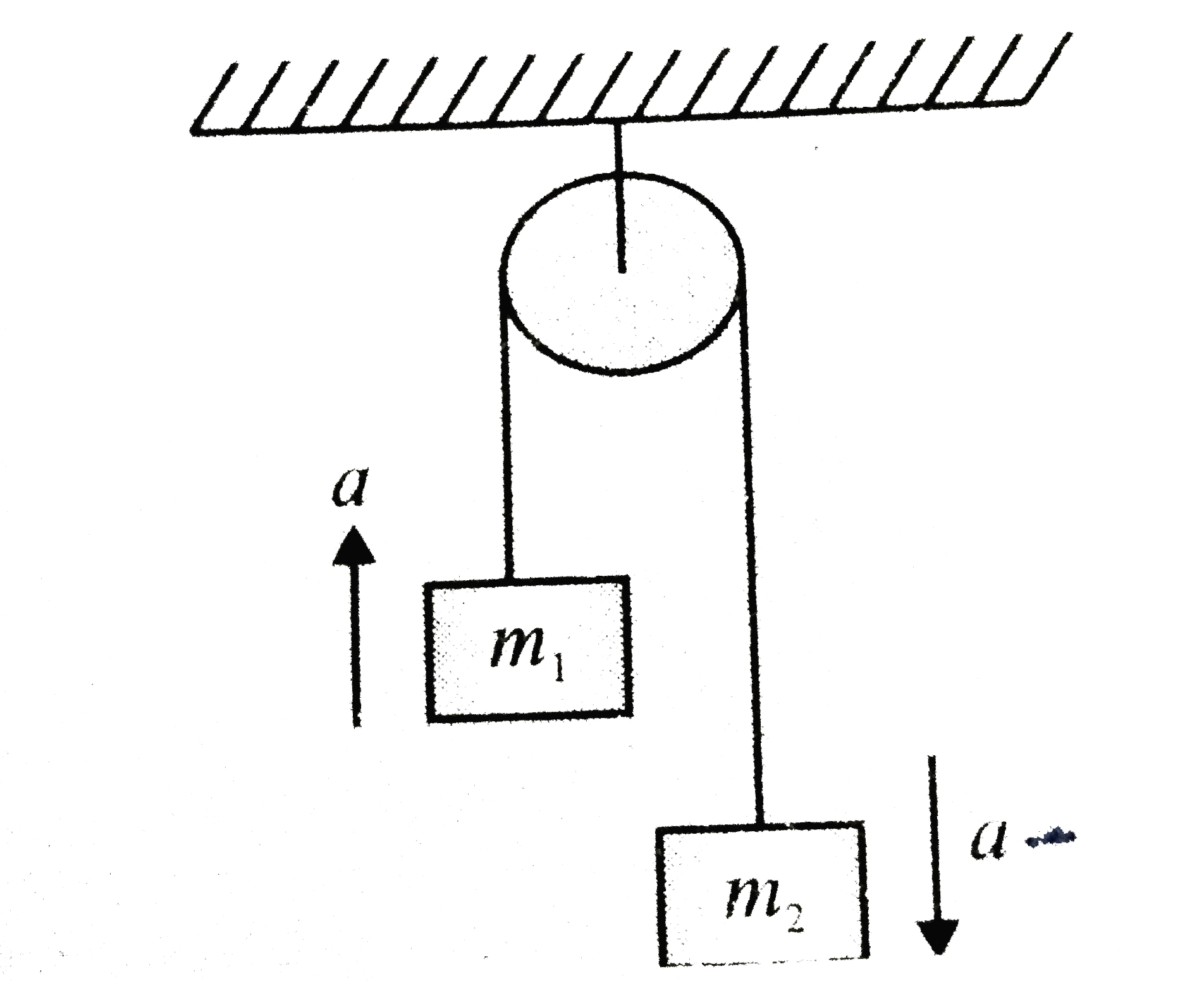
A pulley fixed to the ceiling carried a thread with bodies of masses `m_(1)` and `m_(2)` attached to its ends. The mases of the pulley and the thread are negligible and friction is absent. Find the acceleration of the centre of mass of this system.
Text Solution
Verified by Experts
Let us assume that `m_(2)gtm_(1)`. We can see that the masses have equal and opposite acceleration of the same magnitude. `a=(m_(2)-m_(1))/(m_(2)+m_(1))g` and tension in string is `T=(2m_(1)m_(2)g)/(m_(2)+m_(1))` Taking downward direction as positive `a_(1)=-,a_(2)=+a` `a_(CM)=(m_(1)a_(1)+m_(2)a_(2))/(m_(1)+m_(2))=((m_(2)-m_(1))a)/(m_(2)+m_(1))` substituting for the value of a we have `a_(CM)=((m_(2)-m_(1))/(m_(2)+m_(1)))^(2) g` Alternative method: `a_(CM)=F_(ext)/(m_(1)+m_(2))=((m_(1)g+m_(2)g)-2T)/(m_(1)+m_(2))=g-(2T)/(m_(1)+m_(2))` `=g-(4m_(1)m_(2)g)/((m_(2)+m_(1))^(2))=((m_(2)-m_(1))/(m_(2)+m_(1)))^(2)g` (downwards)
A pulley fixed to the ceiling carries a string with blocks of mass m and 3m attached to its ends. The masses of string and pulley are negligible .When the system is released, its center of mass moves with what acceleration
Two bodies with masses m_1 and m_2(m_1gtm_2) are joined by a string passing over fixed pulley. Assume masses of the pulley and thread negligible. Then the acceleration of the centre of mass of the system (m_1+m_2) is
A block of mass m is arranged on the wedge as shown in figure . The wedge angle is theta . If the masses of pulley and thread and negligible and friction is absent , find the acceleration of the wedge
Two blocks of masses 6 kg and 4 kg are attached to the two ends of a massless string passing over a smooth fixed pulley. if the system is released, the acceleration of the centre of mass of the system will be
A pulley fixed to the ceiling of an elevator car carries a thread whose ends are attached to the masses m_(1) and m_(2) . The car starts going up with an acceleration a_(0) . Assuming the masses of the pulley and the thread as well as the friction to be negligible, find: (a) the acceleration of the load m_(1) relative to the elevator shaft and relative to the car (b) the force exerted by the pulley on the ceiling of the car. Given m_(1) gt m_(2) .
A rope thrown over a pulley has a on one of its ends and a counterbalancing mass M on its other end. The man whose mass is m , climbs upwards by vec/_\r relative to the ladder and then stops. Ignoring masses of the pulley and the rope, as well as the friction the pulley axis, find the displacement of the centre of mass of this system.
Blocks of mass M_(1) and M_(2) are connected by a cord which passes over the pulleys P_(1) and P_(2) as shown in the figure. If there is no friction, the acceleration of the block of mass M_(2) will be
In the arrangement shown in figure the masses of the wedge M and the body m are known. The appreciable friction exists only between the wedge and the body m , the friction coefficient being equal to k . The masses of the pulley and the thread are negligible. Find the acceleration of the body m relative to the horizontal surface on which the wedge slides.
In the arrangement shown in figure the mass of the uniform solid cylindrical pulley of radius R is equal to m and the masses of two bodies are equal to m_(1) and m_(2) . The thread slipping and the friction in the axle of the pulley are supposed to be absent. Find the angular acceleration of the cylinder and the ratio of tensions (T_(1))/(T_(2)) of the vertical sections of the thread in the process of motion.
A rope thrown over a pulley has a ladder with a man of mass m on one of its ends and a counter balancing mass M on its other end. The man climbs with a velocity v_r relative to ladder. Ignoring the masses of the pulley and the rope as well as the friction on the pulley axis, the velocity of the centre of mass of this system is:
CENGAGE PHYSICS ENGLISH-CENTRE OF MASS-INTEGER_TYPE