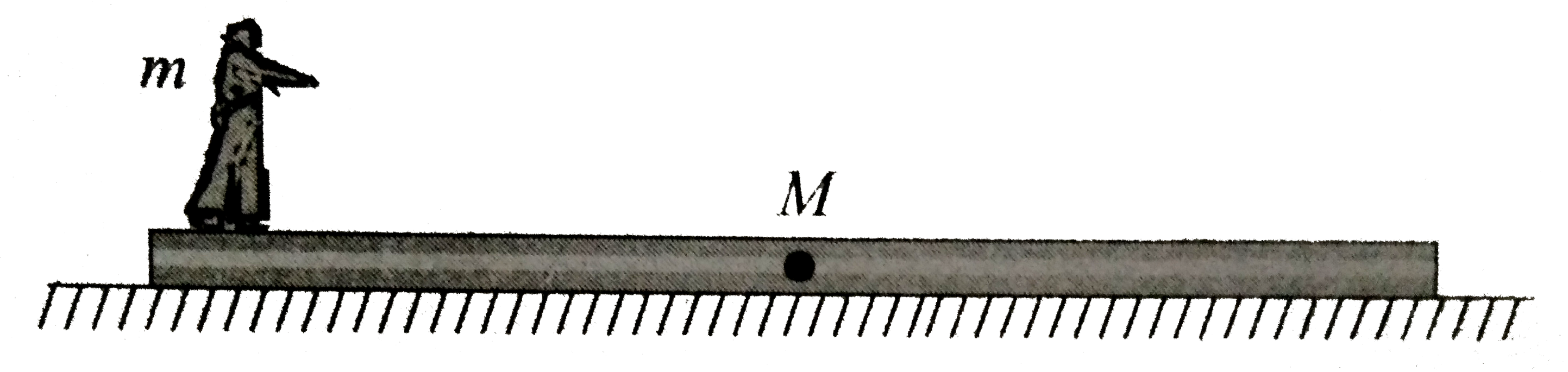
Method 1: The corresponding situation can be better explained with the help of figure. Consider the man and the plank as a system of which no external force ia acting. The centre of mass of the system must remain stationary. The only interaction force between the man and the plank is the friction as shown in figure, due to which of the man walks along the plank and the friction on plank would be in opposite direction, due to which pland moves towards left, such that the centre of mass of the plank plus man remains at rest. just before the motion started, the initial distance of the centre of mass from the centre of the plank is `x_(c)=(mxxL/2+Mxx0)/(m+M)=(mxxL/2)/(m+M)`
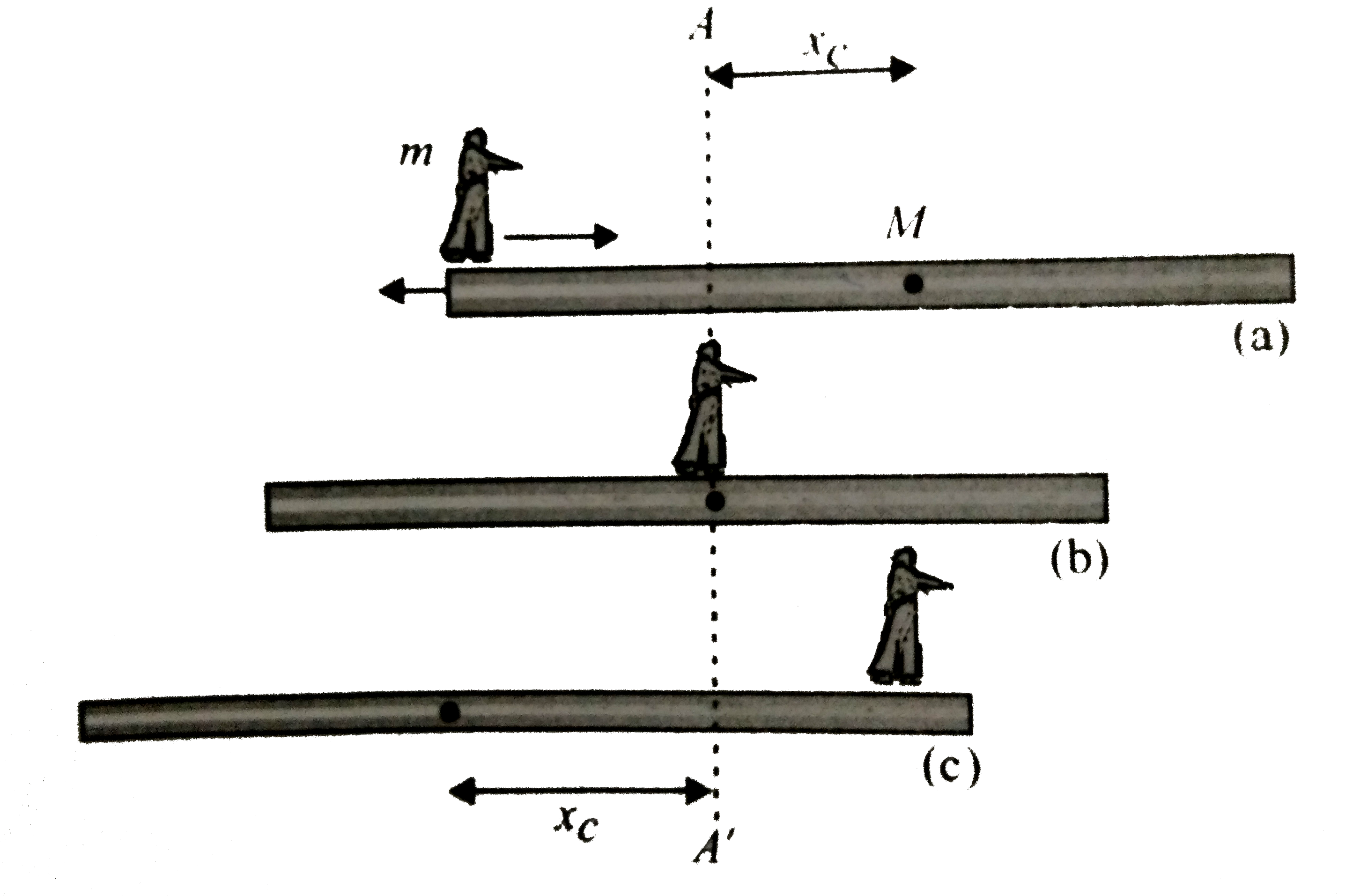
initially the centre of mass of the system is on line `"AA"'` as shown in figure. During motion of the man, this centre of mass must remain at this line only . As the man moves towares ramains on `"AA"'`. Thus, when the man reaches the centre of the plank, the plank's centre must also reach the same point so that the centre of mass is the same position. Up to this instant the plank moves by a distance `x_(c)`. Similarly, when the man reaches the other end, plank has to move towards left further by `x_(c)` to maintain the position of centre of mass.
As there is no external force on the system (`"man" +"plank"`) and the system is initially at rest, there should not be movement of centre of mass of the system during the motion of the man.
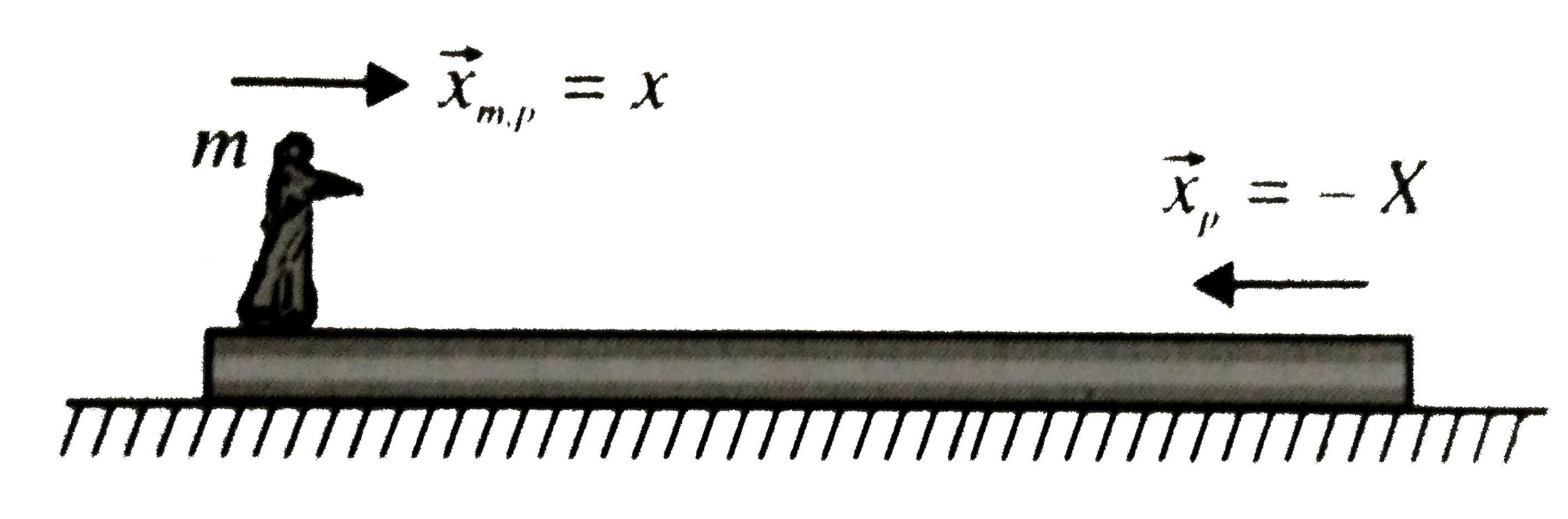
The displacement of centre of mass is `/_\x_(CM)` and is given by
`/_\x_(CM)=(m/_\vecx_m+M/_\vecx_(p))/(m+M)`............i
`implies /_\vecx_(m)=/_\vecx_(m,p)+/_\vecx_(p)=(x-X)` where `/_\vecx_(p)=-X`
(towards left)
As` /_\vecx_(CM)=0`, from eqn i
`0=(m(x-X)-MX)/(m+M)impliesX=(mx)/(m+M)`
a When `x=L/2` displacement of block `X=(mL/2)/(m+M)`
b. when `x=L`, displacement of block `X=(mL)/(m+M)`