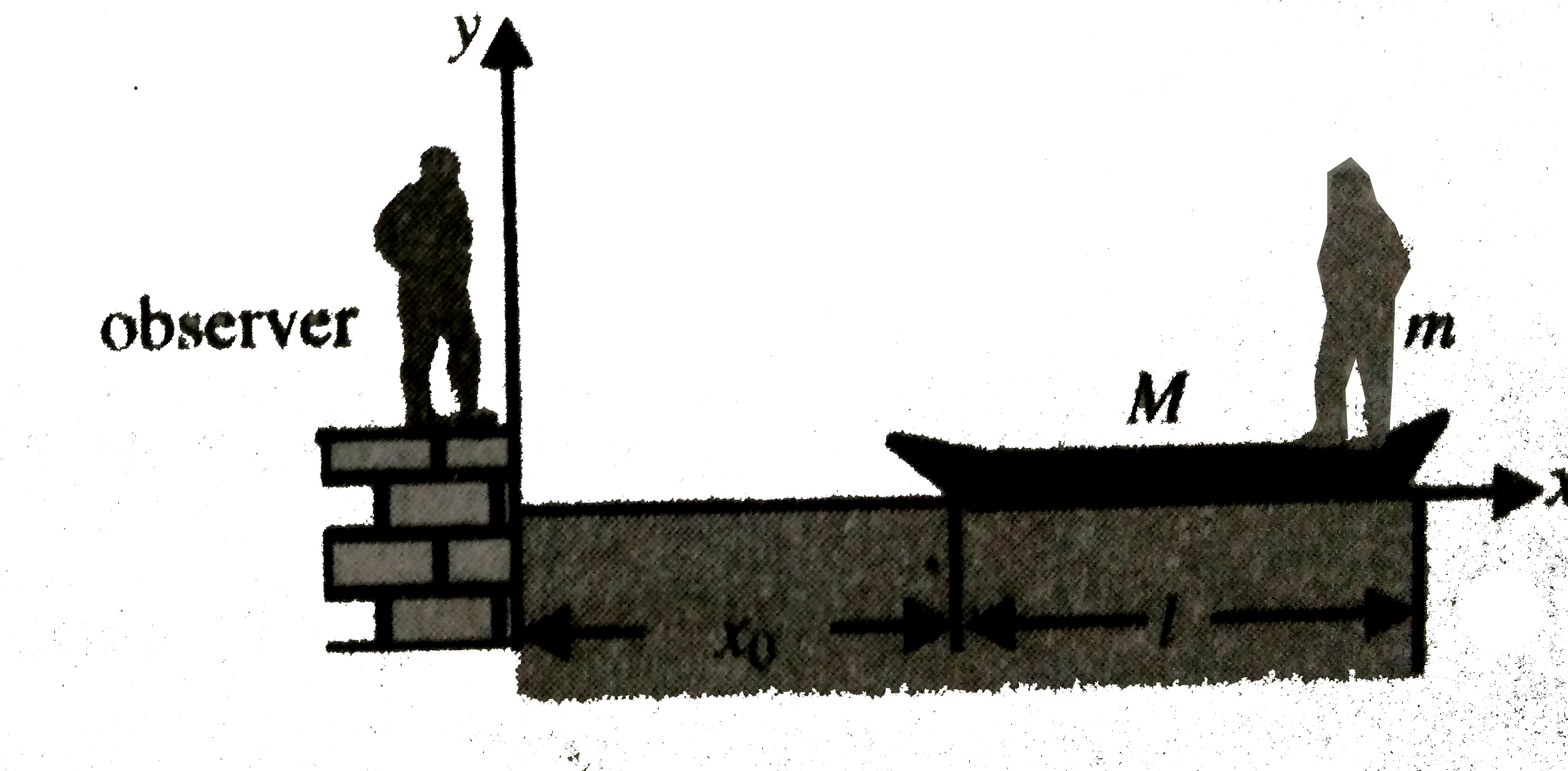
A man of mass `m` runs without sliding from rest from one end of a boat of mass `M` and length `l` with an acceleration a relative to the boat. If the friction between water and boat is neglected find the
a. acceleration of CM of the system `(M+m)`
b. acceleration of the man and boat
c. position of man at the time when he reaches to other end of the boat
d. frictional force
e. work done by friction on boat.
f. total work done by friction.
g. velocities of man and boat when the man reaches other end of the boat.
h. work down by man
A man of mass `m` runs without sliding from rest from one end of a boat of mass `M` and length `l` with an acceleration a relative to the boat. If the friction between water and boat is neglected find the
a. acceleration of CM of the system `(M+m)`
b. acceleration of the man and boat
c. position of man at the time when he reaches to other end of the boat
d. frictional force
e. work done by friction on boat.
f. total work done by friction.
g. velocities of man and boat when the man reaches other end of the boat.
h. work down by man
a. acceleration of CM of the system `(M+m)`
b. acceleration of the man and boat
c. position of man at the time when he reaches to other end of the boat
d. frictional force
e. work done by friction on boat.
f. total work done by friction.
g. velocities of man and boat when the man reaches other end of the boat.
h. work down by man
Text Solution
Verified by Experts
Consider 'boat and man' a system. No external force acts on the system in horizontal direction and initially the system is at rest i.e., the centre of mass is at rest. The acceleration of centre of mass will be zero.
There will to be an displacement of centre of mass.
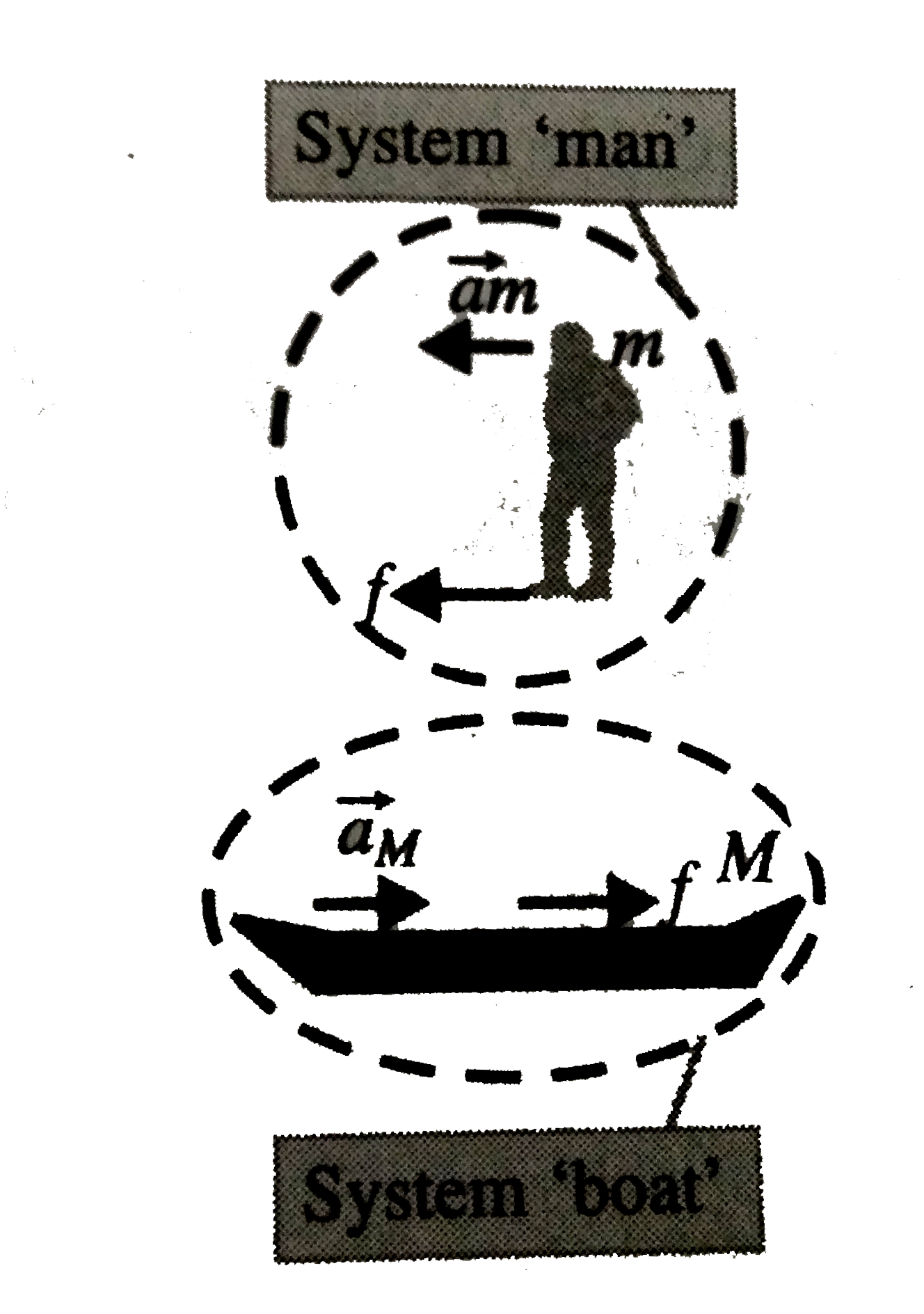
b. Considering the FBD of man and boat. If we consider man and boat separately, the static friction between man and boat will be responsible for the motion of man and boat but as a whole the friction will be an internal force and will not move centre of mass of system
Let the acceleration and displacement of man be `veca_(m) and vecx_(m)` and that for boat be `veca_(M) and vecx_(M)`.
`veca_(m)=veca_(m,M)+veca_(M)=-ahati+a_(M)hati`
`=(a_(M)-a)hati`
But `veca_(cm)=(mveca_(m)+Mveca_(M))/((m+M))`
or `0=(m(a_(M)-a)hati+Ma_(M)hati)/((m+M))`
`impliesveca_(M)=(ma)/((m+M))(hati)` (towards right)
Hence `a_(m)=(ma)/((m+M))-a`
`impliesveca_(m)=(Ma)/((m+M)(-hati)` (towards left)
c. We know the displacement of CM
`vecx_(CM)=(mvecx_(M)+Mvecx_(M))/((m+M))`
Here `vecxm=vecx_(m,M)+vecxM=(-lhati+x_(M)hati)`
`impliesvecx_(m)=(x_(M)-l)hati`
Hence `x_(cm)=O=(m(x_(M)-l)hati+Mx_(M)hati)/((m+M))`
`impliesvec_(M)=-(ml)/((m+M)(hati)`[towards right]
and `vecx_(m)=-(Ml)/((m+M))(hati)` [towards left]
position of man from observer at the time when the man reaches to other end of the boat.
`vecx=(x_(0)+l)hati+vecx_(m)`
`=(x_(0)+l)hati-(Ml)/((m+M))hati=(x_(0)+(ml)/((m+M)))hati`
d. From FBD of man friction force acting on the man,
` f=ma_(m)=m((ma)/((m+m)))=(Mma)/((m+M)`
e. Work done by friction force on boat
`(W_(f))_("boat")=vecfvecx_(m)=[(Mma)/((m+M))][(ml)/((m+M))]`
`implies (W_(f))_(boat)=(Mm^(2)al)/((m+M)^(2))`
f. As friction between man and boat in static nature and total work done by static friction force on the system should be zero
g. For finding the velocity of man when he reaches other end of the boat, we can use kinematics
Using `v_(m)^(2)=u_(m)^(2)+2a_(m)x_(m)=0+2((Ma)/((m+M)))((Ml)/((m+M)))`
`implies v_(m)^(2)=(M/(m+M))^(2).2al`
Hence velocity of man `v_(M)=(M/(m+M))sqrt(2al)`
Similarly velocity of boat `v_(M)=(m/(m+M))sqrt(2al)`
h. if we consider man `+` boat on system, friction will do no work on system as it in static nature. but we can se the kinetic energy of the system will increase. the question a rises here who does work to increase the kinetic energy of system. the answer is man. the man does this work through his internal energy to increase the kinetic energy of the system.
Using work energy theorem on the system we get
`W_("man")+W_("friction")=/_\K=K-K_(f)-K_(i)`
We know `W_("friction")=0`
`W_("man")+0=(1/2mv_(m)^(2)+1/2MV_(m)^(2))-0`
`V_("man")=1/2m[(M/(m+M))^(2)2al]+1/2M[(m/(m+M)^(2)2al]-0`
`impliesW_("man")=(mMal)/((m+M))`
There will to be an displacement of centre of mass.
b. Considering the FBD of man and boat. If we consider man and boat separately, the static friction between man and boat will be responsible for the motion of man and boat but as a whole the friction will be an internal force and will not move centre of mass of system
Let the acceleration and displacement of man be `veca_(m) and vecx_(m)` and that for boat be `veca_(M) and vecx_(M)`.
`veca_(m)=veca_(m,M)+veca_(M)=-ahati+a_(M)hati`
`=(a_(M)-a)hati`
But `veca_(cm)=(mveca_(m)+Mveca_(M))/((m+M))`
or `0=(m(a_(M)-a)hati+Ma_(M)hati)/((m+M))`
`impliesveca_(M)=(ma)/((m+M))(hati)` (towards right)
Hence `a_(m)=(ma)/((m+M))-a`
`impliesveca_(m)=(Ma)/((m+M)(-hati)` (towards left)
c. We know the displacement of CM
`vecx_(CM)=(mvecx_(M)+Mvecx_(M))/((m+M))`
Here `vecxm=vecx_(m,M)+vecxM=(-lhati+x_(M)hati)`
`impliesvecx_(m)=(x_(M)-l)hati`
Hence `x_(cm)=O=(m(x_(M)-l)hati+Mx_(M)hati)/((m+M))`
`impliesvec_(M)=-(ml)/((m+M)(hati)`[towards right]
and `vecx_(m)=-(Ml)/((m+M))(hati)` [towards left]
position of man from observer at the time when the man reaches to other end of the boat.
`vecx=(x_(0)+l)hati+vecx_(m)`
`=(x_(0)+l)hati-(Ml)/((m+M))hati=(x_(0)+(ml)/((m+M)))hati`
d. From FBD of man friction force acting on the man,
` f=ma_(m)=m((ma)/((m+m)))=(Mma)/((m+M)`
e. Work done by friction force on boat
`(W_(f))_("boat")=vecfvecx_(m)=[(Mma)/((m+M))][(ml)/((m+M))]`
`implies (W_(f))_(boat)=(Mm^(2)al)/((m+M)^(2))`
f. As friction between man and boat in static nature and total work done by static friction force on the system should be zero
g. For finding the velocity of man when he reaches other end of the boat, we can use kinematics
Using `v_(m)^(2)=u_(m)^(2)+2a_(m)x_(m)=0+2((Ma)/((m+M)))((Ml)/((m+M)))`
`implies v_(m)^(2)=(M/(m+M))^(2).2al`
Hence velocity of man `v_(M)=(M/(m+M))sqrt(2al)`
Similarly velocity of boat `v_(M)=(m/(m+M))sqrt(2al)`
h. if we consider man `+` boat on system, friction will do no work on system as it in static nature. but we can se the kinetic energy of the system will increase. the question a rises here who does work to increase the kinetic energy of system. the answer is man. the man does this work through his internal energy to increase the kinetic energy of the system.
Using work energy theorem on the system we get
`W_("man")+W_("friction")=/_\K=K-K_(f)-K_(i)`
We know `W_("friction")=0`
`W_("man")+0=(1/2mv_(m)^(2)+1/2MV_(m)^(2))-0`
`V_("man")=1/2m[(M/(m+M))^(2)2al]+1/2M[(m/(m+M)^(2)2al]-0`
`impliesW_("man")=(mMal)/((m+M))`



Topper's Solved these Questions
Similar Questions
Explore conceptually related problems
A man of mass m walks from end A to the other end B of a boat of mass M and length l. The coefficient of friction between the man and the boat is mu an neglect any resistive force between the boat and the water.
A plank of mass m rests symmetrically on two wedges B and C of mass M. What is the acceleration of the plank? Neglect friction between all the contact surfaces.
A man of 80 kg attempts to jump from the small boat of mass 40 kg on to the shore. He can generate a relative velocity of 6 m/s between him and boat. His velocity towards shore is
Starting from rest at s=0,a boat travels in a straight line with an acceleration on as shown by the a-s graph. Determine the boat's speed at s=40,90 .
Two men of masses 40 kg and 20 kg are standing on a boat of mass 100 kg. Length of boat is 20m. Neglect the friction between water and boat. Find the displacement of the boat when both the persons reach at middle of boat.
A man of mass m moves with a constant speed on a plank of mass M and length l kept initially at rest on a frictionless horizontal surface, from one end to the other in time t. The speed of the plank relative to grounud while man is moving, is
A man of mass m moves with a constant speed on a plank of mass M and length l kept initially at rest on a frictionless horizontal surface, from one end to the other in time t. The speed of the plank relative to grounud while man is moving, is
A ring of mass m connected through a string of length L with a block of mass M. If the ring is moving up with acceleration a_(m) and a_(M) is the acceleration of block. The relation between a_(m) and a_(M) is.
A man slides down on a telegraphic pole with an acceleration equal to one-fourth of acceleration due to gravity.The frictional force between man and pole is equal to (in terms of man's weight W )
A man of mass m is standing at one end of of a plank of mass M. The length of the plank is L and it rests on a frictionless horizontal ground. The man walks to the other end of the plank. Find displacement of the plank and man relative to the ground.