Home
Class 11
PHYSICS
Two small discs of masses m(1) and m(2) ...

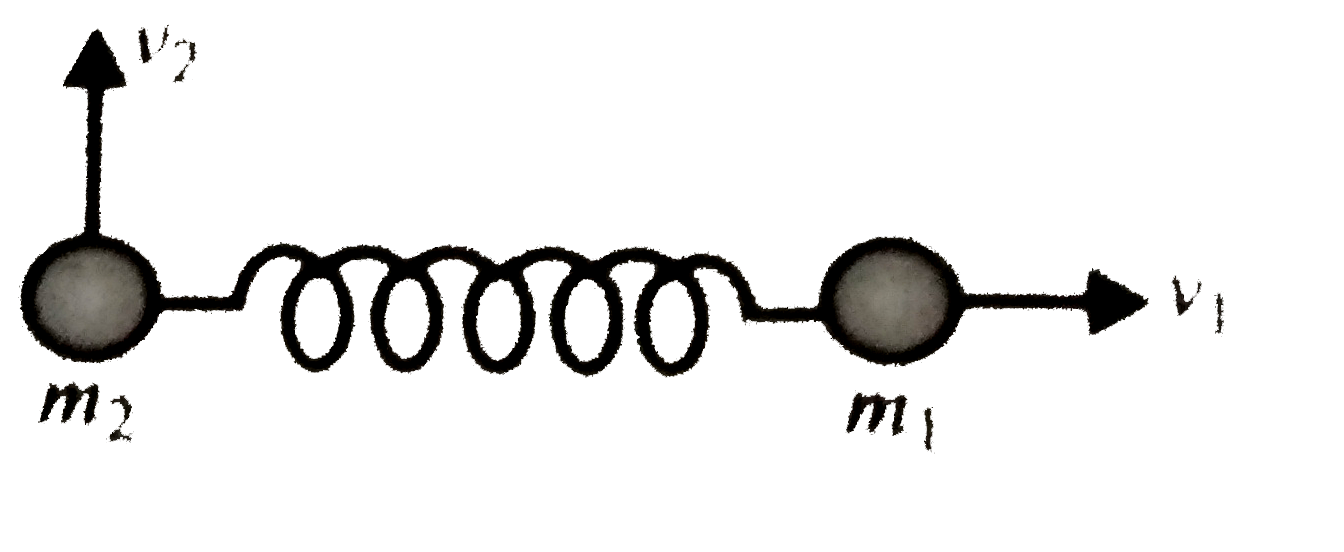
Two small discs of masses `m_(1)` and `m_(2)` are connected by a weightless spring resting on a smooth horizontal plance. The discs are set in motion with initial velocities `v_(1) and v_(2)` whose directions are mutually perpendicular and in the same horizontal plane. Find the total energy `E` of the system with reference to the frame fixed to the centre of mass.

Text Solution

Verified by Experts

Let `vecv_(cm)` be the velocity of the centre of mass. Velcoity of `m_(1)` relative to thecentre of mas is `(vecv_(1)-vecv_(cm))` and that of `m_(2)` relative to the centre of mass is `(vecv_(2)-vecv_(1))`
Velocity of centre of mass `vecv_(cm)=(m_(1)vecv_(1)m_(2)vecv_(2))/(m_(1)+m_(2))`
`(vecv_(1)-vecv_(cm))=m_(2)/(m_(1)+m_(2))(vecv_(1)-vecv_(2))`
Hence `|vecv_(1)-vecv_(cm)|=m_(2)/(m_(1)+m_(2)(v_(1)^(2)+v_(2)^(2))^(1//2)`
and `vecv_(2)-vecv_(cm)=m_(1)/(m_(1)+m_(2))(vecv_(2)-vecv_(1))`
Hence `|vecv_(2)-vecv_(cm)|=m_(1)/(m_(1)+m_(2))(v_(1)^(2)+v_(2)^(2))^(1//2)`
total energy with respect to the centre of mass,
`E=1/2m_(1)|vecv_(1)-vecv_(cm)|^(2)1/2m_(1)|vecv_(2)-vecv_(cm)|^(2)`
`=1/2((m_(1)m_(2))/(m_(1)+m_(2)))(v_(1)^(2)+v_(2)^(2))`
where `mu=(m_(1)m_(2))/(m_(1)+m_(2))` is called reduced mass.
Promotional Banner

Topper's Solved these Questions

  • CENTRE OF MASS

    CENGAGE PHYSICS ENGLISH|Exercise Solved Examples|13 Videos
  • CENTRE OF MASS

    CENGAGE PHYSICS ENGLISH|Exercise Exercise 1.1|20 Videos
  • CALORIMETRY

    CENGAGE PHYSICS ENGLISH|Exercise Solved Example|13 Videos
  • DIMENSIONS & MEASUREMENT

    CENGAGE PHYSICS ENGLISH|Exercise Integer|2 Videos

Similar Questions

Explore conceptually related problems

Two blocks of masses m_(1) and m_(2) are connected by a massless spring and placed on smooth surface. The spring initially stretched and released. Then :

Two blocks of masses m_(1) and m_(2) , connected by a weightless spring of stiffness k rest on a smooth horizontal plane as shown in Fig. Block 2 is shifted a small distance x to the left and then released. Find the velocity of centre of mass of the system after block 1 breaks off the wall.

Two bars of masses m_1 and m_2 connected by a weightless spring of stiffness k , rest on a smooth horizontal plane. Bar 2 is shifted by a small distance x_0 to the left and released. The veloicyt of the centre of mass of the system when bar 1 breaks off the wall is

Two block of masses m_(1) and m_(2) connected by a light spring rest on a horizontal plane. The coefficient of friction between the block and the surface is equal to mu . What minimum constant force has to be applied in the horizontal direction to the block of mass m_(1) in order to shift the other block?

Two smooth blocks of mases m_(1) and m_(2) attached with an ideal spring of stiffness k and kept on hrozontal surface. If m_(1) is projected with a horizontal velocity v_(0) . Find the maximum compression of the spring.

At t=0 , a force F=at^(2) is applied to a small body of mass m at an angle alpha resting on a smooth horizontal plane

Two blocks of masses m_1 =1kg and m_2 = 2kg are connected by a spring of spring constant k = 24 N/m and placed on a frictionless horizontal surface. The block m_(1) is imparted an initial velocity v_(0) = 12cm/s to the right. The amplitude of oscillation is

Two masses, m_(1) and m_(2) , are moving with velocities v_(1) and v_(2) . Find their total kinetic energy in the reference frame of centre of mass.

Choose the correct option: Two bars of masses m_1 and m_2 connected by a weightless spring of stiffness k , rest on a smooth horizontal plane. Bar 2 is shifted by a small distance x_0 to the left and released. The velocity of the centre of mass of the system when bar 1 breaks off the wall is

Two blocks of mass m_(1) and m_(2) (m_(1) lt m_(2)) are connected with an ideal spring on a smooth horizontal surface as shown in figure. At t = 0 m_(1) is at rest and m_(2) is given a velocity v towards right. At this moment, spring is in its natural length. Then choose the correct alternative :
