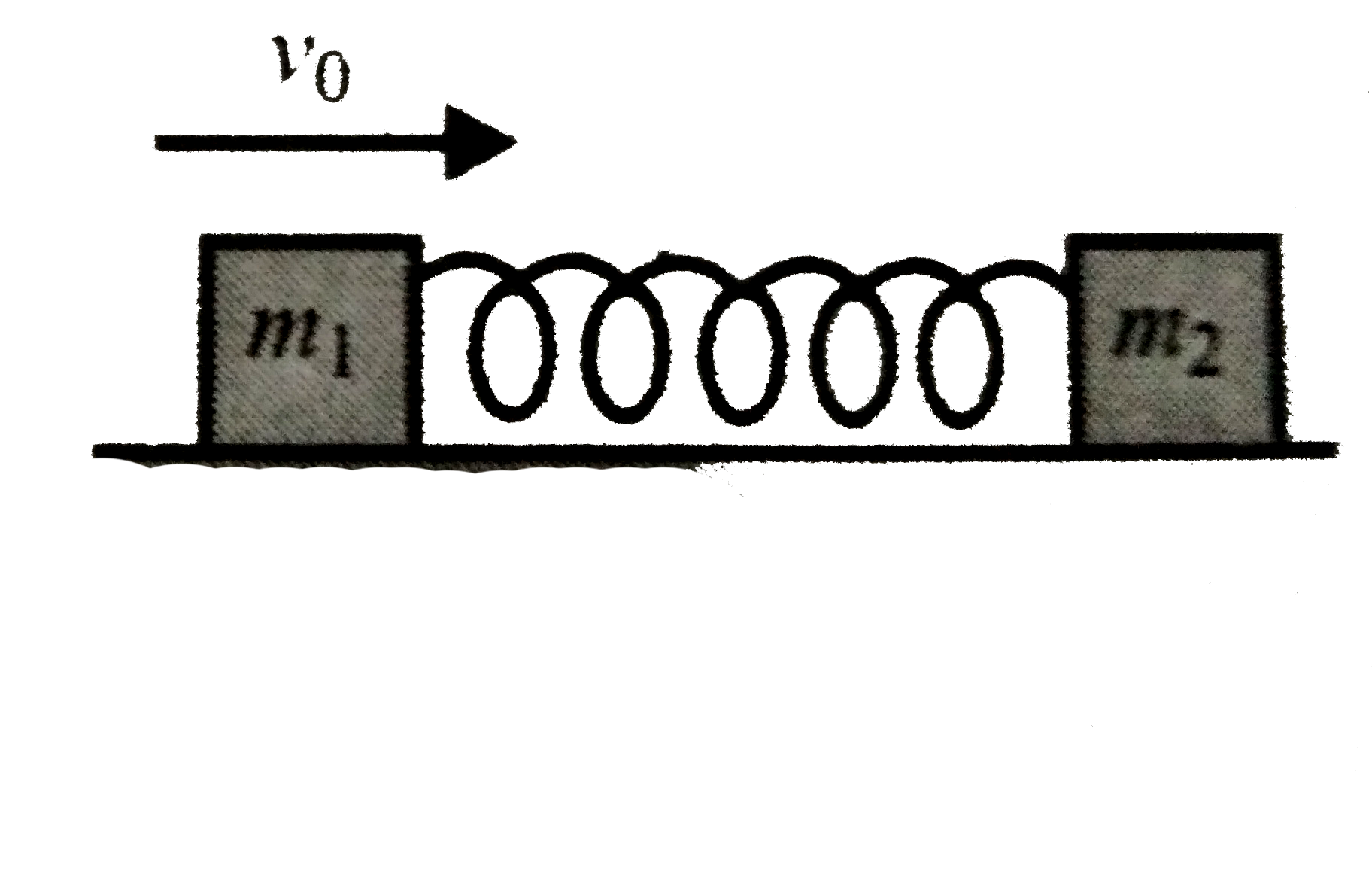
Two smooth blocks of mases `m_(1) and m_(2)` attached with an ideal spring of stiffness `k` and kept on hrozontal surface. If `m_(1)` is projected with a horizontal velocity `v_(0)`. Find the maximum compression of the spring.
Text Solution
Verified by Experts
Method 1 (using ground frame method) Decide system: Blocks and spring Observation: no external force acting on system in horizontal direction. Conclusion: linear momentum as well as mechanical energy of system will be move with common velocity. Problem solving: Using conservation of linear momentum at initial time and at time of maximum compression of spring. Let the common velocity of system be `V`. `p_(i)=m_(1)v_(0)+0` and `p_(f)=(m_(1)+m_(2))V` As `p_(i)=p_(f)implies m_(1)v_(0)=(m_(1)+m_(2))V`.............i Now using conservation of mechanical energy. `/_\K+/_\U=0` `(K_f-Ki)+/_\U_("spring")=0` `[1/2(m_(1)+m_(2))V^(2)-1/2m_(1)v_(0)^(2)]+1/2kx^(2)=0`...........i From i and ii we get `x=[sqrt((m_(1)m_(2))/((m_(1)_m_(2))k))]v_(0)` Method 2: (work energy theorem from centre of mass frame) The linear momentum of system from CM frame is zero and no external force is acting on the system. We can apply work energy theorem from CM frame `W_(ext)+W_(int)=/_\K_(cm)=(K_(f)-K_(i))_cm` .............iii Initial kinetic energy of system w.r.t CM `(K_(i))_(cm)=1/2((m_(1)m_(2))/(m_(1)+m_(2)))v_0^(2)` Final kinetic energy of system w.r.t CM `(K_(f))_(cm)=1/2mu(v_("net"))^(2)_("final")=0` as both the blocks move with common velocity hence `(v_("net"))_("final")=0` which gives `(K_(f))_(cm)=0` Hence from 1 `0+(-1/2kx^(2))0-1/2((m_(1)m_(2))/(m_(1)+m_(2)))v_(0)^(2)` `impliesx=[sqrt((m_(1)m_(2))/((m_(1)+m_(2)))k)]v_(0)`
Two blocks m_(1) and m_(2) are pulled on a smooth horizontal surface, and are joined together with a spring of stiffness k as shown in Fig. Suddenly, block m_(2) receives a horizontal velocity v_(0) , then the maximum extension x_(m) in the spring is
Two blocks of masses m_(1) and m_(2) interconnect with a spring of stiffness K , are kept on as smooth horizontal surface. Find out the ratio of velocity, displacement, kinetic energy and acceleration block with mass m_(1) of block with mass m_(2) .
Two blocks of masses m_1 =1kg and m_2 = 2kg are connected by a spring of spring constant k = 24 N/m and placed on a frictionless horizontal surface. The block m_(1) is imparted an initial velocity v_(0) = 12cm/s to the right. The amplitude of oscillation is
Two blocks of masses m_(1) and m_(2) being connected with a light spring of stiffness k are driven with forces F_(1) and F_(2) on a smooth plane .find the value of spring force .
Two blocks of masses m and M connected by a light spring of stiffness k, are kept on a smooth horizontal surface as shown in figure. What should be the initial compression of the spring so that the system will be about to break off the surface, after releasing the block m_1 ?
A block of mass m is relesed from rest from a height h onto a smooth surface of mass M fitted with an ideal spring of stiffness k . find the maximum compression in the spring.
Two blocks of mass m_(1) and m_(2) (m_(1) lt m_(2)) are connected with an ideal spring on a smooth horizontal surface as shown in figure. At t = 0 m_(1) is at rest and m_(2) is given a velocity v towards right. At this moment, spring is in its natural length. Then choose the correct alternative :
Two blocks of mass m_(1) and m_(2) (m_(1) lt m_(2)) are connected with an ideal spring on a smooth horizontal surface as shown in figure. At t = 0 m_(1) is at rest and m_(2) is given a velocity v towards right. At this moment, spring is in its natural length. Then choose the correct alternative :
A block attached with an ideal spring is kept on a smooth horizontal surface. Now the free end of the spring is pulled with a constant velocity u horizontally. Then the maximum energy stored in the spring and bock system during subsequent motion is :
Two blocks of masses m_(1) and m_(2) are connected by a massless spring and placed on smooth surface. The spring initially stretched and released. Then :
CENGAGE PHYSICS ENGLISH-CENTRE OF MASS-INTEGER_TYPE