Home
Class 11
PHYSICS
Two particles of masses m(1) and m(2) a...

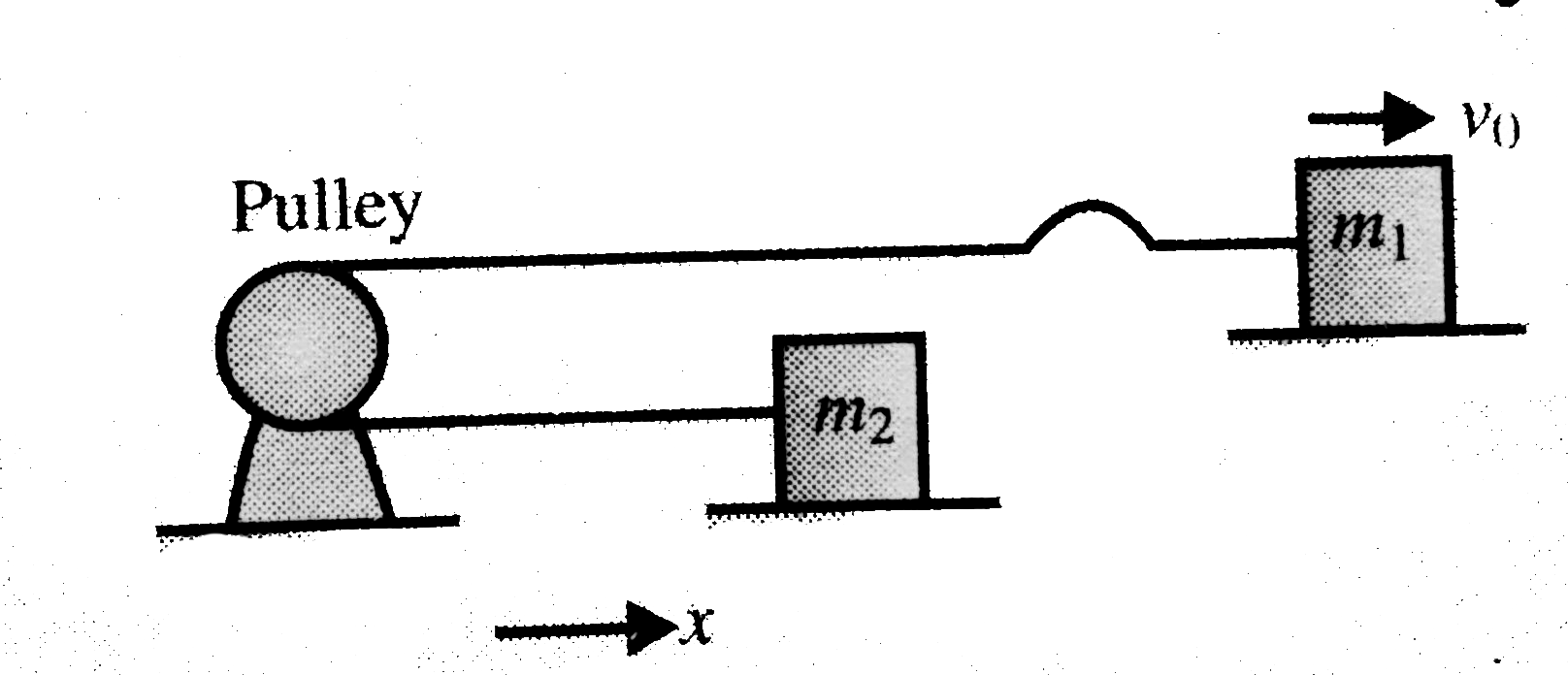
Two particles of masses `m_(1)` and `m_(2)` are connected by a light and inextensible string which passes over a fixed pulley. Initially, the particle `m_(1)` moves with velocity `v_(0)` when the string is not taut. Neglecting fricting in all contacting surface, find the velocities of the particles `m_(1)` and `m_(2)` just after the string is taut.

Text Solution

Verified by Experts

During the impact a large tension develops. The impulse of tension `T_(1)` is equal to the change of momentum of `m_(1)` which is given as
`m_(1)v_(0)-J=m_(1)v`
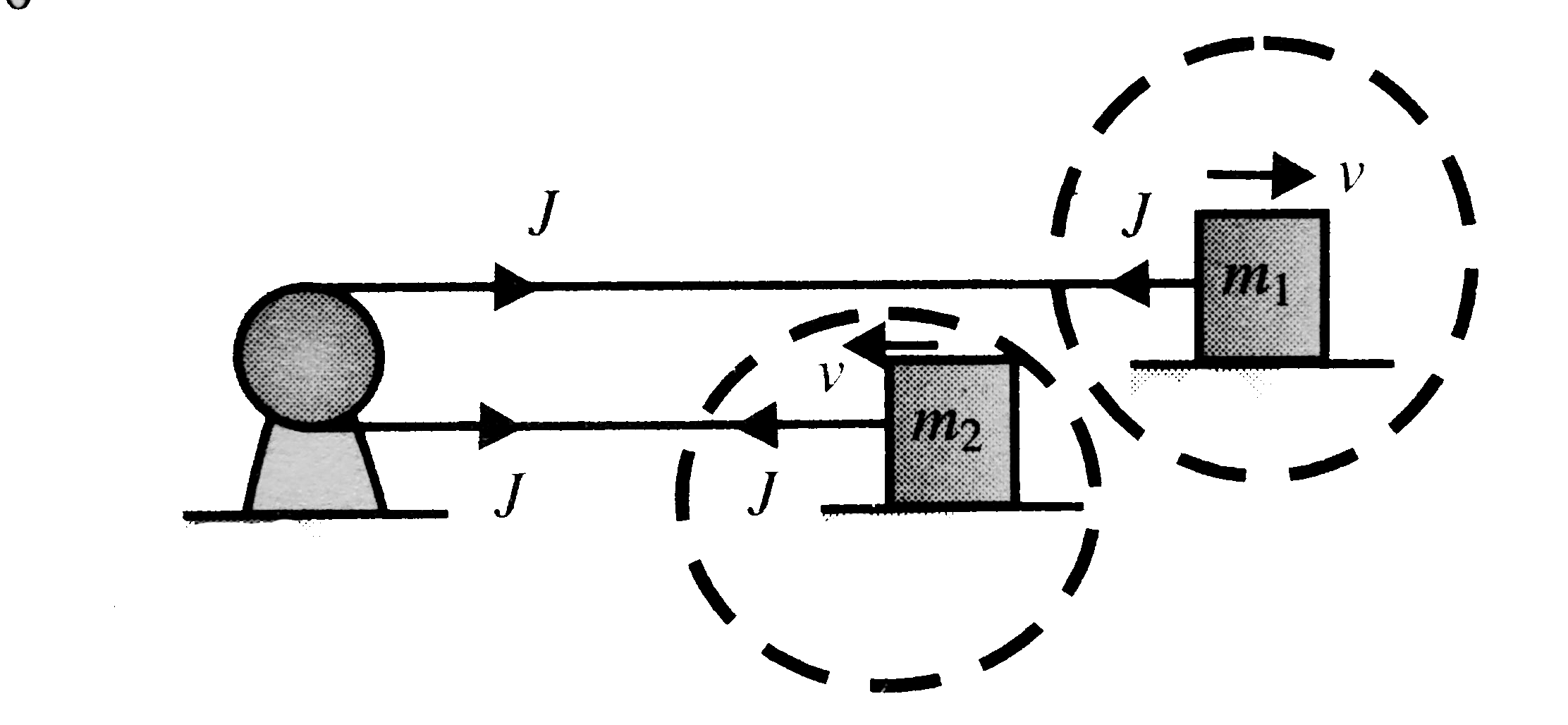
Similarly the impulse of tension `T_(2)` is equal to the change in momentum of `m_(2)` which is given as
`J=m_(2)v`......ii
from eqn i and ii we have
`m_(1)(v_(0)-v)=m_(2)v`
This gives `v=(m_(1)v_(0))/(m_(1)+m_(2))`
Promotional Banner

Topper's Solved these Questions

  • CENTRE OF MASS

    CENGAGE PHYSICS ENGLISH|Exercise Solved Examples|13 Videos
  • CENTRE OF MASS

    CENGAGE PHYSICS ENGLISH|Exercise Exercise 1.1|20 Videos
  • CALORIMETRY

    CENGAGE PHYSICS ENGLISH|Exercise Solved Example|13 Videos
  • DIMENSIONS & MEASUREMENT

    CENGAGE PHYSICS ENGLISH|Exercise Integer|2 Videos

Similar Questions

Explore conceptually related problems

Two bodies of masses m_(1) " and " m_(2) are connected a light string which passes over a frictionless massless pulley. If the pulley is moving upward with uniform acceleration (g)/(2) , then tension in the string will be

Two bodies of masses m_(1)(m_(2) gt m_(1)) are connected by a light inextensible string which passes through a smooth fixed pulley. What is the instantaneous power delivered by an external agent to pull m_(1) with constant velocity vec(V) ?

Two masses M and m are connected by a light inextensible string which passes over a small pulley as shown in the diagram. If the mass m is moving downward with a velocity v when the string makes an angle of 45^(@) with the horizontal, find the total K.E. of the two masses. AsSigmae that the mass M moves horizontally.

Two blocks of masses m_(1) and m_(2)(m_(1) gt m_(2)) connected by a massless string passing over a frictionless pulley Magnitude of acceleration of blocks would be

Two particles of masses m and M(Mgtm) are connected by a cord that passes over a massless, frictionless pulley. The tension T in the string and the acceleration a of the particles is

Two particles of masses m_1 and m_2 are connected to a string and the system is rotated in a horizontal plane with 'P' as center. The ratio of tension in the two parts of string is

Two blocks of masses m_(1) and m_(2) are connected by a string of negligible mass which pass over a frictionless pulley fixed on the top of an inclined plane as shown in figure. The coefficient of friction between m_(1) and plane is mu .

Two blocks of masses m and 3m are connected by an inextensible string and the string passes over a fixed pulley which is massless and frictionless. A bullet of mass m moving with a velocity 'u' hits the hanging block of mass 'm' and gets exbedded in it. Find the height through which block A rises after the collision.

Two masses m and M(m lt M) are joined by a light string passing over a smooth and light pulley (as shown)

Two masses M and M/ 2 are joint together by means of a light inextensible string passes over a frictionless pulley as shown in figure. When bigger mass is released the small one will ascend with an acceleration of

