The only vetical force on the ball is `mg` throughtout its motion because during impact it experience a horizontal force from the wall. We can use
`u_(y)t-1/2gt^(2)=v_(y)`
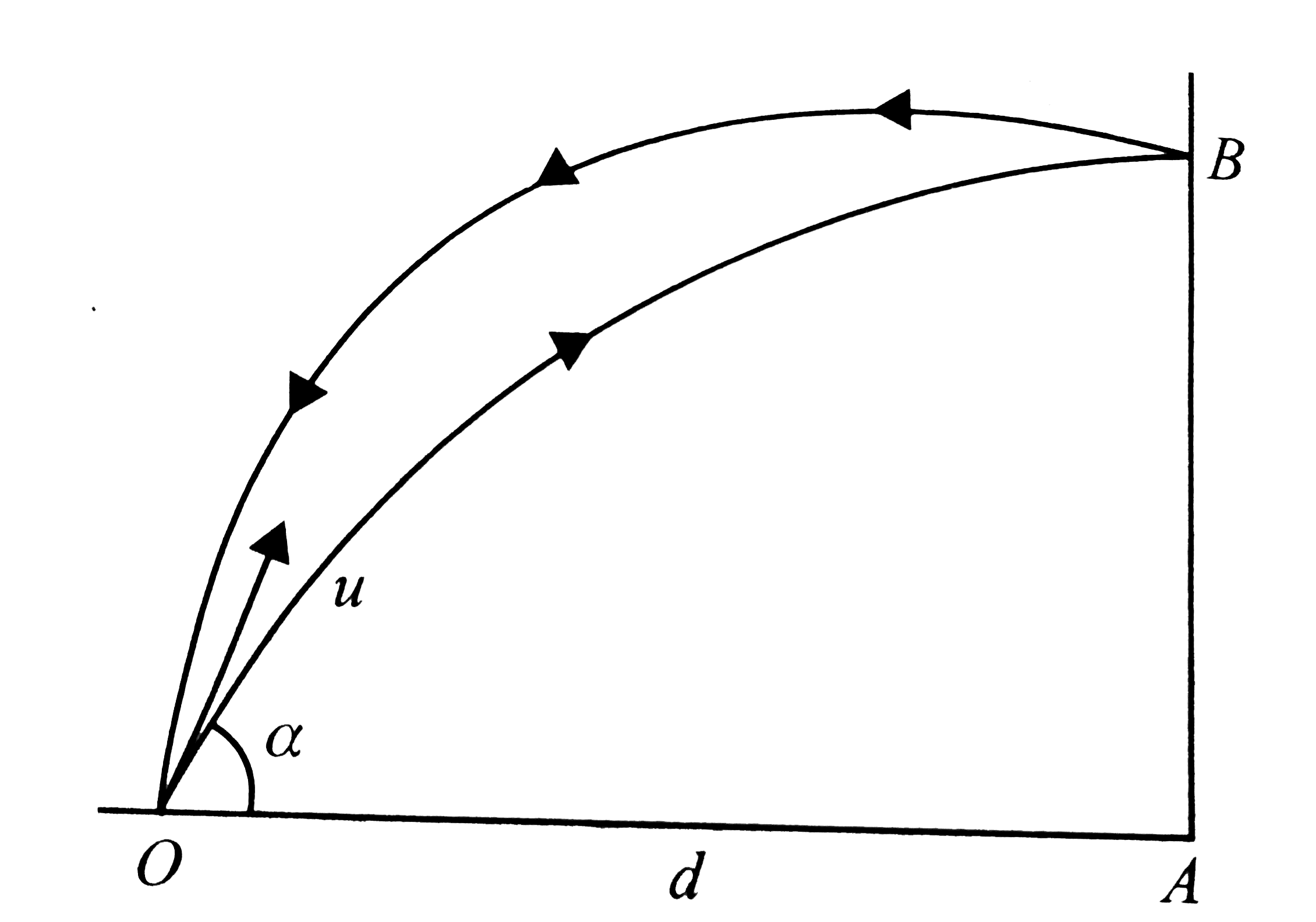
let `t` be the total time of flight.
`:.0=usinalphat - 1/2 "gt"^(2)`
`implies t=(2usinalpha)/g`
Due to impact with the wall at `B` the normal component (i.e., horizontal component ) of velocity is reversed and becomes `e` times. Horizontal velocity before impact `=ucosalpha`
and horizontal velocity after impact `=eucosalpha`
Time take to reach the wall `t_(1)=d/(ucosalpha)`
and time taken to come back to `O` from `B`.
`t_(2)=d/(eucosalpha)` we have `t_(1)+t_(2)=t`
`impliesd/(ucosalpha)+d/(eucosalpha)=(2usinalpha)/gimpliesu^(2)sin2alphagd[1+1/e]`
As `sin2alphale1`
`(gd)/u^(2)[1+1/e]le1impliesdle(eu^(2))/(g(1+e))`


