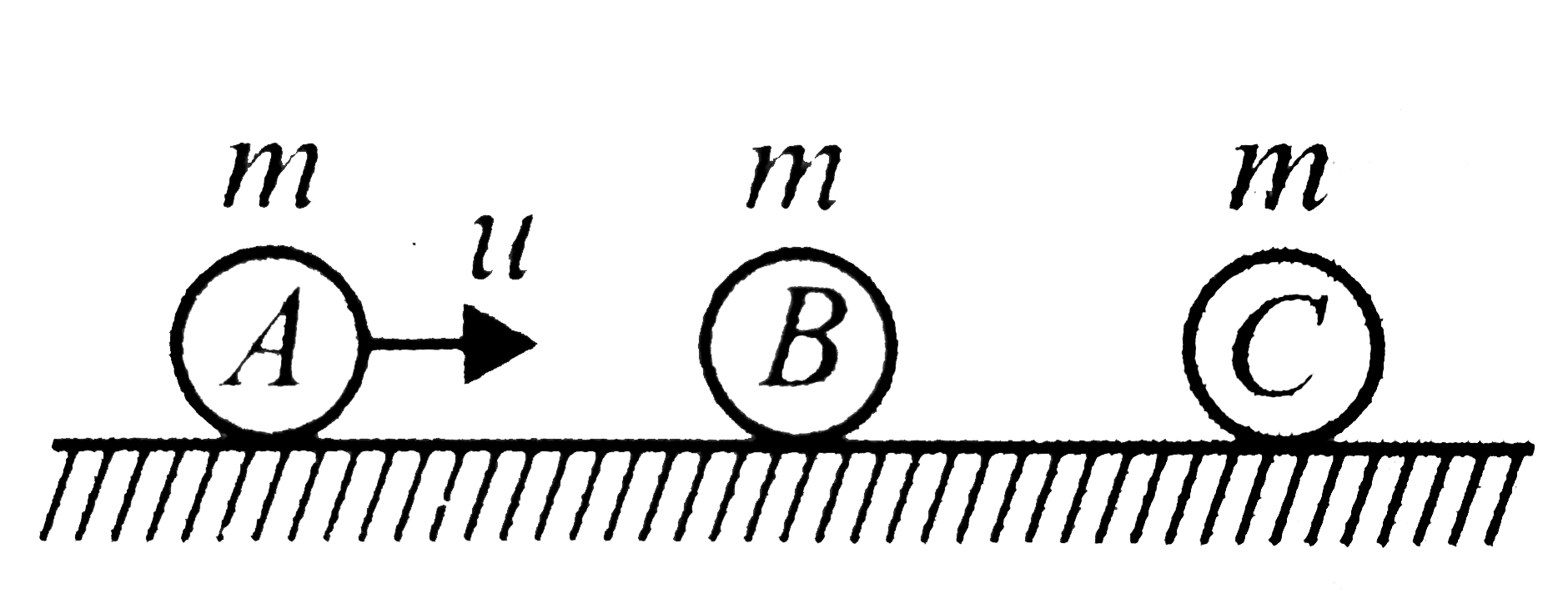
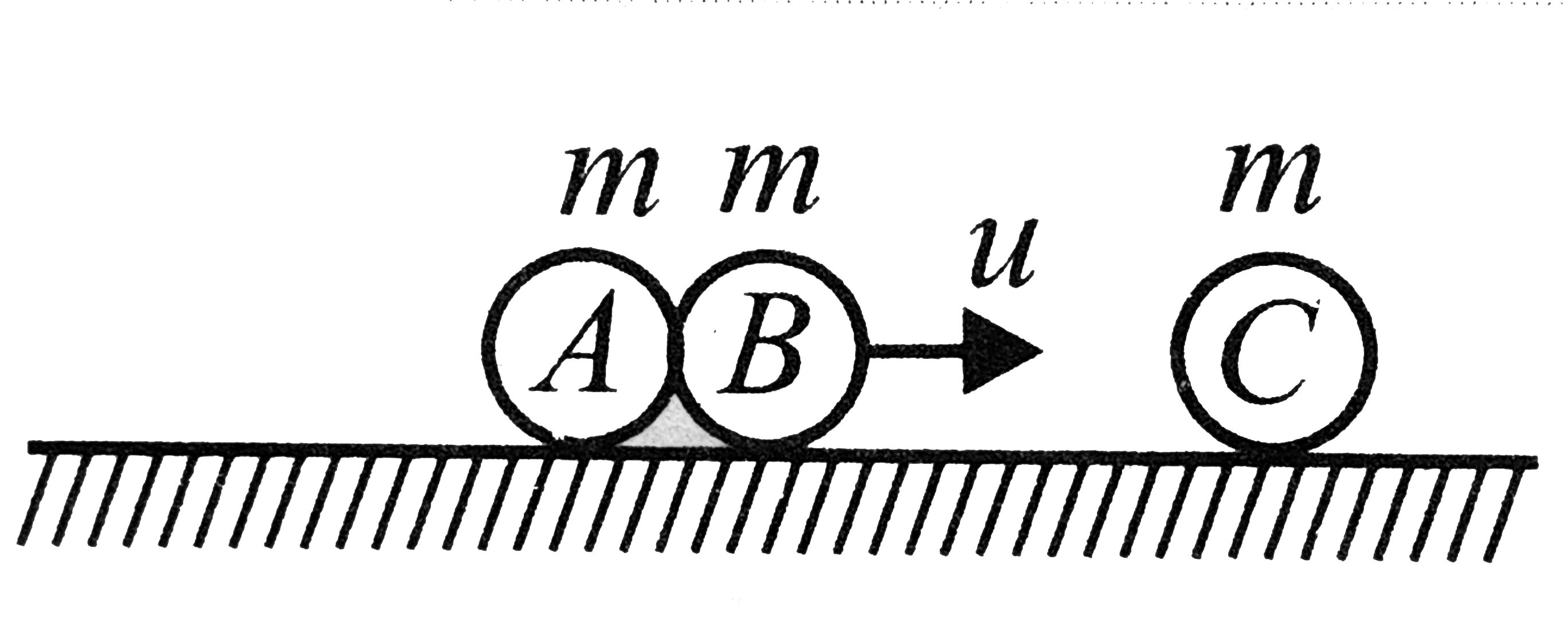
Three balls `A, B` and `C` of same mass `m` are placed on a frictionless horizontal plane in a straight line as shown. Ball `A` is moved with velocity `u` towards the middle ball `B`. If all the collisions are elastic, find the final velocities of all the balls.
Text Solution
Verified by Experts
A collides elastically with `B` and comes to rest but `B` starts moving with velocity `u`. After a while `B` collides elastically with `C` and comes to rest but `C` starts moving with velocity `u`. Therefore, final velocities, `V_(A)=0, V_(B)=0` and `V_(C)=u`.
Four identical balls A,B, C and D are placed in a line on frictionless horizontal surface. A and D are moed with the same speed u towards the middle as shown. Assuming elastic collisions, find the final velocities.
A ping-pong ball strikes a wall with a velocity of 10 ms^(-1) . If the collision is perfectly elastic, find the velocity if ball after impact
Two balls marked 1 and 2 of the same mass m and a third ball marked 3 of mass M are arranged over a smooth horizontal surface as shown in the figure. Ball 1 moves with a velocity v_(1) towards ball 2. All collisions are assumed to be elastic. If Mltm , the number of collisions between the balls will be.
Two balls marked 1 and 2 of the same mass m and a third ball marked 3 of mass M are arranged over a smooth horizontal surface as shown in the figure. Ball 1 moves with a velocity v_(1) towards ball 2. All collisions are assumed to be elastic. If Mltm , the number of collisions between the balls will be.
Three balls A, B and C are placed on a smooth horizontal surface. Given that m_A=m_C=4m_B . Ball B collides with ball C with an initial velocity v as shown in figure. Find the total number of collisions between the balls. All collisions are elastic.
The figure below shows three identical balls A , B and C. Initially , the baiis B and C are at rest and the ball A while moving with a veiocity v, collides with ball B. if the collision is perfectiy elastic , then after the collision
Three balls A, B and C of masses 2 kg, 4 kg and 8 kg , respectively, move along the same straight line and in the same direction, with velocities 4m//s,1m//s, 3/4m//s . If A collides with B and subse-quently B collides with C , find the velocity of ball A and ball B after collision, taking the coefficient of restitution as unity.
Three balls A, B and C(m_(A)=m_(C)=4m_(B)) are placed onn a smooth horizontal surface. Ball B collides with ball C with an initial velocity v as shown in figure. Find the total number of collision betwenent the balls (all collisions are elastic).
Three balls A, B and C(m_(A)=m_(C)=4m_(B)) are placed onn a smooth horizontal surface. Ball B collides with ball C with an initial velocity v as shown in figure. Find the total number of collision betwenent the balls (all collisions are elastic).
A ball is moving with velocity 2m//s towards a heavy wall moving towards the ball with speed 1m//s as shown in figure. Assuming collision to be elastic, find the velocity of ball immediately after the collision.
CENGAGE PHYSICS ENGLISH-CENTRE OF MASS-INTEGER_TYPE