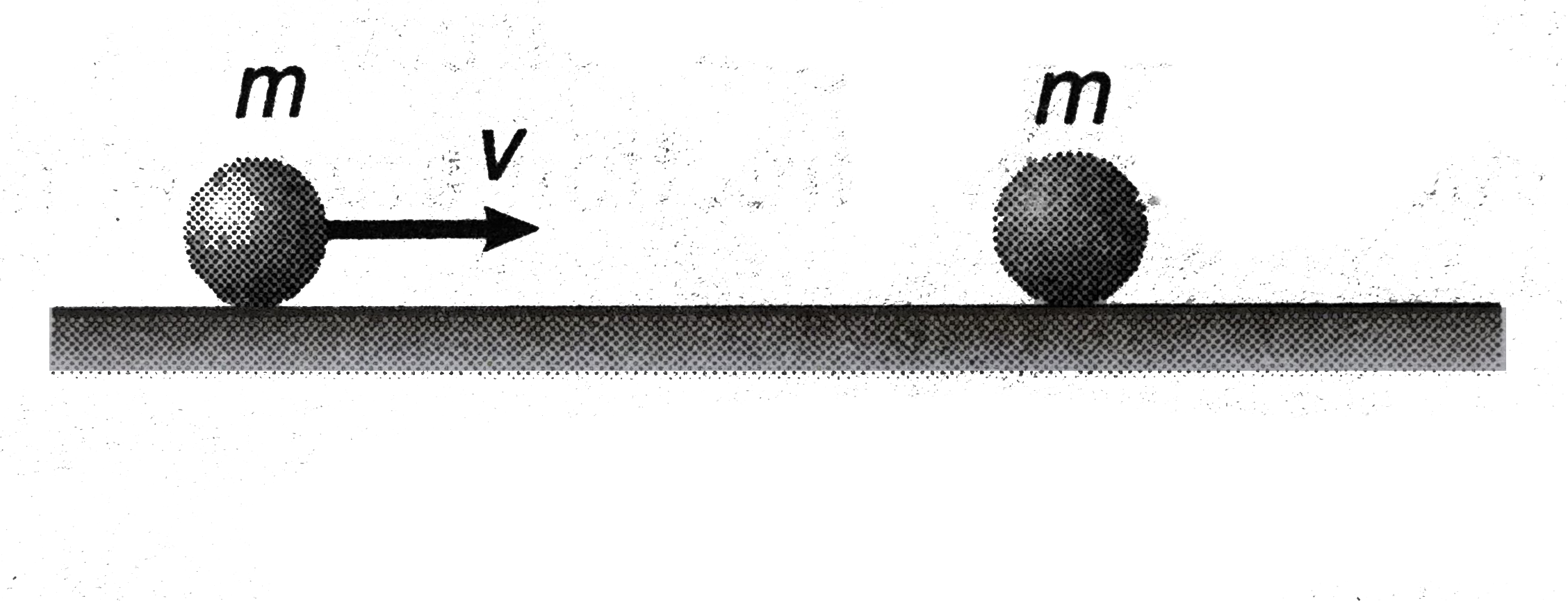
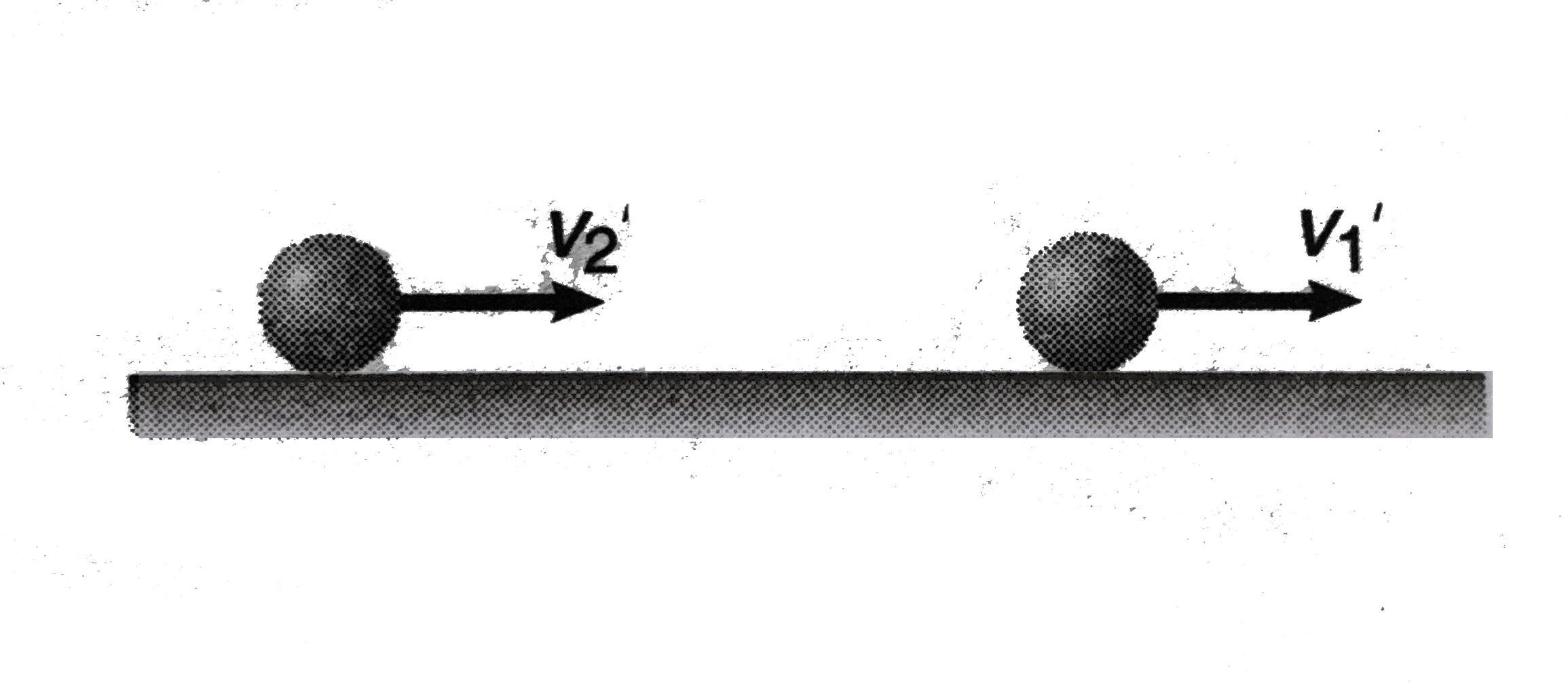
A ball of mass m moving at a speed v makes a head on inelastic collision with an identical ball at rest. The kinetic energy of the balls after the collision is `3/4th` of the original. Find the coefficient of restitution.
Text Solution
Verified by Experts
As we have seen in the above discussion that under the given conditions: `v_(1)=((1+e)/2)v` and `v_(2)=((1-e)/2)v` given that `K_(f)=3/4K_(i)` or `1/2mv_(1)^(2)+1/2mv_(2)^(2)=3/4(1/2mv^(2))` Substituting the values we get `((1+e)/2)^(2)+((1-e)/2)^(2)=3/4` or `(1+e)^(2)+(1+e)^(2)=3` or `2+2e^(2)=3` or `e^(2)=1/2 ` or `e=1/(sqrt(2))`
A ball of mass m moving at a speed v makes a head-on collision with an identical ball at rest. The kinetic energy of the balls after the collision is three fourths of the original. Find the coefficient of restitution.
A particle moving with kinetic energy E makes a head on elastic collision with an identical particle at rest. During the collision
A particle moving with kinetic energy K makes a head on elastic collision with an identical particle at rest. Find the maximum elastic potential energy of the system during collision.
A ball of mass m moving with velocity v collides head on elastically with another identical ball moving with velocity - V. After collision
A ball of mass 'm' moving with speed 'u' undergoes a head-on elastic collision with a ball of mass 'nm' initially at rest. Find the fraction of the incident energy transferred to the second ball.
A body of mass m_(1) moving at a constant speed undergoes an elastic head on collision with a body of mass m_(2) initially at rest. The ratio of the kinetic energy of mass m_(1) after the collision to that before the collision is -
A ball of mass m moving with a speed 2v_0 collides head-on with an identical ball at rest. If e is the coefficient of restitution, then what will be the ratio of velocity of two balls after collision?
A ball of mass m moving with a speed 2v_0 collides head-on with an identical ball at rest. If e is the coefficient of restitution, then what will be the ratio of velocity of two balls after collision?
A ball of mass 4 kg moving on a smooth horizontal surface makes an elastic collision with another ball of mass m at rest in the line of motion of first ball. If after collision first ball moves in the same direction with one fourth of its velocity before collision, then mass of second ball is
A ball of mass M moving with speed v collides perfectly inelastically with another ball of mass m at rest. The magnitude of impulse imparted to the first ball is
CENGAGE PHYSICS ENGLISH-CENTRE OF MASS-INTEGER_TYPE