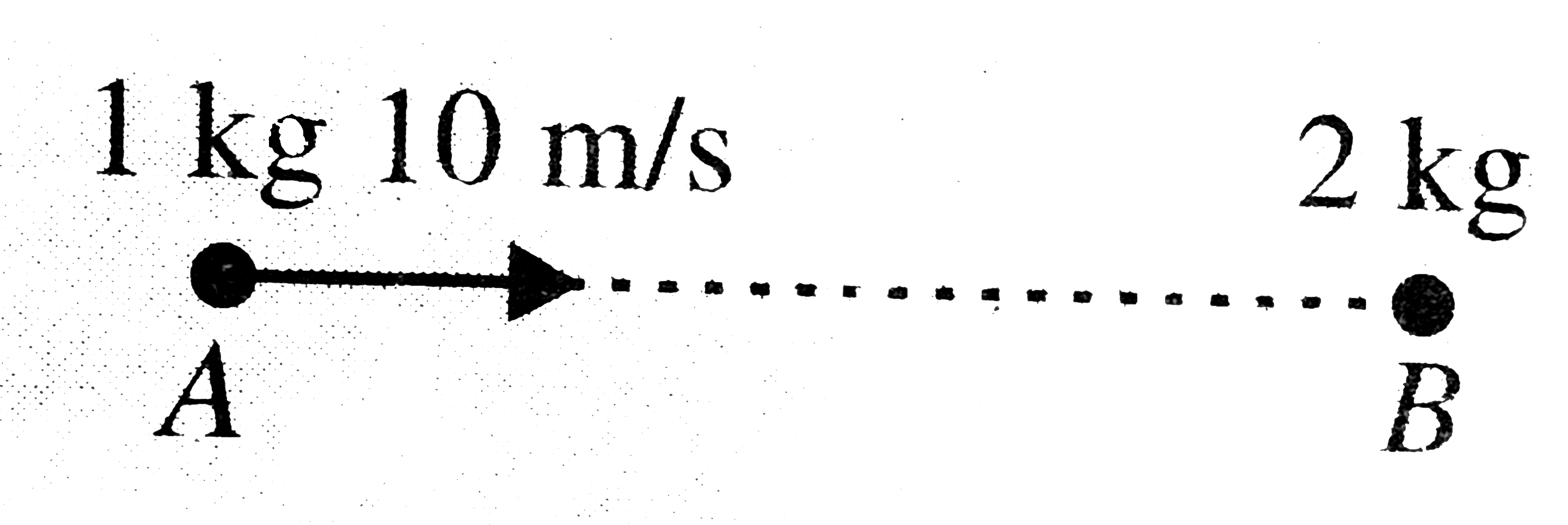
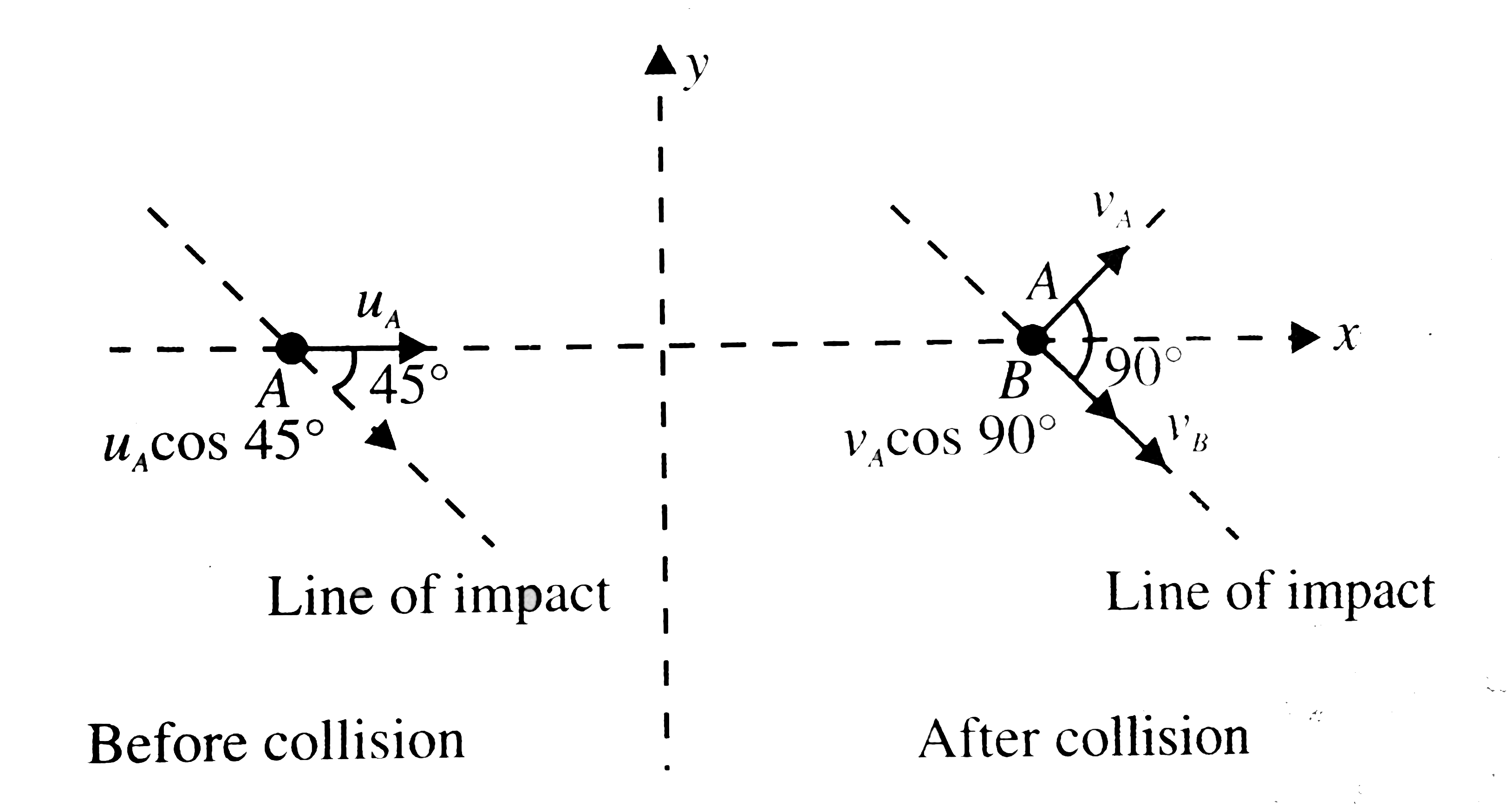
The very first step to solve such problems is to find the line of impact which is along the direction of force applied by `A` on `B`, resulting the stationary particle `B` to move. Thus, by watching the direction of motion of `B`, line of impact can be determined. in this case, the line of impact is along the direction of motion of `B` i.e. `45^(@)` with the initial diretion of motion of `A`.
a. Let us apply the principle of conservation of momentum.
Along `x-`direction:
`m_(A)u_(A)=m_(A)v_(A)cos45^(@)m_(B)v_(B)cos45^(@)`
or `1(10)=1(v_(A)cos45^(@))+2(v_(B)cos45^(@))`
or `v_(A)+2v_(B)=10sqrt(2))` ..........i
Along `y` direction
`0=m_(A)v_(A)sin45^(@)-m_(B)v_(B)sin45^(@)`
or `0=1(v_(A)sin45^(@))-2(v_(B)sin45^(@))`
or `v_(A)=2v_(B)`
Solving the two equation `v_(A)=10/(sqrt(2))m//s` and `v_(B)=5/(sqrt(2))m//s`
b. coefficient of restitution
`e=("velocity of separation along line of impact")/("velocity of approach along line of impact")`
`=(v_(B)-v_(A)cos90^(@))/(u_(A)cos45^(@))=(5/sqrt(2)-0)/(10/sqrt(2))=1/2`
hence, `P` is constant.