Home
Class 11
PHYSICS
A ball of mass m is pushed with a horizo...

A ball of mass `m` is pushed with a horizontal velocity `v_(0)` from one end of a sledge of mass `M` and length `l`. if the ball stops after is first collision with the sledge, find the speeds of the ball ad sledge after the second collision of the ball with the sledge.

Text Solution

Verified by Experts
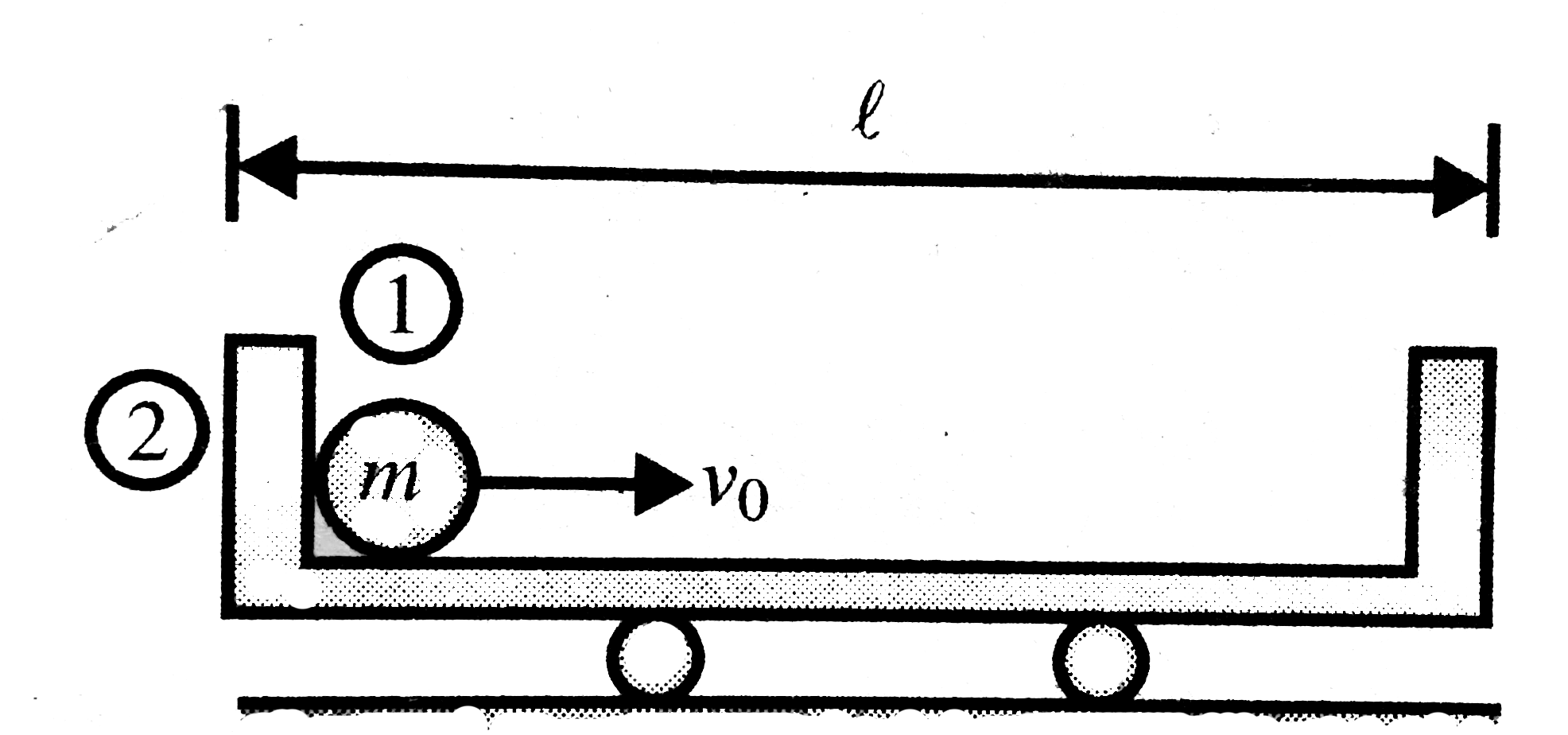
a. Using C.O.L.M, `Mv_(2)=mv_(0)` ………..i
Using Newton's restitution equation

`v_(2)-0=ev_(0)`
Here `m/Mv_(0)=ev_(0)`
which gives `e=m/M` ……….ii
Now the 2nd collisiion left wall the sledge and ball C.O.L.M.
`0+Mv_(2)=mv_(1)+MV_(2)^(')`
`M(m/Mv_(0))=mv_(1)+Mv_(2)^(')`
`implies mv_(1)+Mv_(2)^(')=mv_(0)`

Again using Newton's restitution law
`v_(2)^(')-v_(1)=e(0-m/Mv_(0))`
`v_(2)^(')-v_(1)=m/M(-m/Mv_(0))`
`v_(1)-v_(2)^(')=(m/M)v_(0)`..........iv
From eqn iii and iv we get
`v_(1)=(2v_(0))/((M+m))` and `v_(2)^(')=(mv_(0))/M((M-m)/(M+m))`
Promotional Banner

Topper's Solved these Questions

  • CENTRE OF MASS

    CENGAGE PHYSICS ENGLISH|Exercise Exercise 1.1|20 Videos
  • CENTRE OF MASS

    CENGAGE PHYSICS ENGLISH|Exercise Exercise 1.2|23 Videos
  • CENTRE OF MASS

    CENGAGE PHYSICS ENGLISH|Exercise INTEGER_TYPE|1 Videos
  • CALORIMETRY

    CENGAGE PHYSICS ENGLISH|Exercise Solved Example|13 Videos
  • DIMENSIONS & MEASUREMENT

    CENGAGE PHYSICS ENGLISH|Exercise Integer|2 Videos

Similar Questions

Explore conceptually related problems

The first ball of mass m moving with the velocity upsilon collides head on with the second ball of mass m at rest. If the coefficient of restitution is e , then the ratio of the velocities of the first and the second ball after the collision is

Velocity of the ball A after collision with the ball B as shown in the figure is (Assume perfectly inelastic and head - on collision)

A ball is projected on a very long floor. There may be two conditions (i) floor is smooth & (ii) the collision is elastic If both the considered then the path of ball is as follows. Now if collision is inelastic and surface is rough then the path is as follows. Successive range is decreasing . Roughness of surface decreases the horizontal component of ball during collision and inelastic nature of collision decreases the vertical component of velocity of ball. In first case both components remain unchanged in magnitude and in second case both the components of the velocity will change. Let us consider a third case here surface is rough but the collision of ball with floor is elastic. A ball is projected withe speed u at an angle 30^(@) with horizontal and it is known that after collision with the floor its speed becomes (u)/(sqrt(3)) . Then answer the following questions. If the ball after first collision with the floor has rebounded vertically then the speed of the ball just after the collision with the floor would have been :

A ball is moving with velocity 2m//s towards a heavy wall moving towards the ball with speed 1m//s as shown in figure. Assuming collision to be elastic, find the velocity of ball immediately after the collision.

A ball is moving with velocity 2m//s towards a heavy wall moving towards the ball with speed 1m//s as shown in figure. Assuming collision to be elastic, find the velocity of ball immediately after the collision.

A ball of mass M//2 filled with a gas ( whose mass is M//2 ) is kept on a frictionless table . A bullet of mass m = M//4 and velocity v_(0)hat(i) penetrates the ball , and rests inside at t=0. Assume that the amount of gas emitted during the collision can be neglected. The compressed gas is emitted at a contant velocity v_(0)//2 relative to the ball and at an even rate k ( k is a positive constant ) . (a) What is the velocity of the ball after the collision with the bullet ? (b) Find the velocity of the ball v(t) as a function of time. Assume that the emission of gas starts at t=0. What is the final velocity of the ball ?

A ball of mass 'm' moving with a horizontal velocity 'v' strikes the bob of mass 'm' of a pendulum at rest. During this collision, the ball sticks with the bob of the pendulum. The height to which the combined mass raises is (g = acceleration due to gravity).

A ball of mass m moving with velocity v collides head-on which the second ball of mass m at rest. I the coefficient of restitution is e and velocity of first ball after collision is v_(1) and velocity of second ball after collision is v_(2) then

A ball of mass m moving with velocity u collides head-on which the second ball of mass m at rest. If the coefficient of restitution is e and velocity of first ball after collision is v_(1) and velocity of second ball after collision is v_(2) then

A ball of mass 'm is released from the top of a smooth movable wedge of mass 'm'. When the ball collides with the floor, velocity is 'v'. Then the maximum height attained by the ball after an elastic collision with the floor is : (Nelect any edge at the lower end of the wedge)