Home
Class 11
PHYSICS
Two spherical bodies of mass m(1) and m(...

Two spherical bodies of mass `m_(1)` and `m_(2)` fall freely through a distance `h`. before the body `m_(2)` collides with the ground. If the coefficient of restitution of all collisions is `e`, find the velocity of `m_(1)` just after it collides with `m_(2)`

Text Solution

Verified by Experts
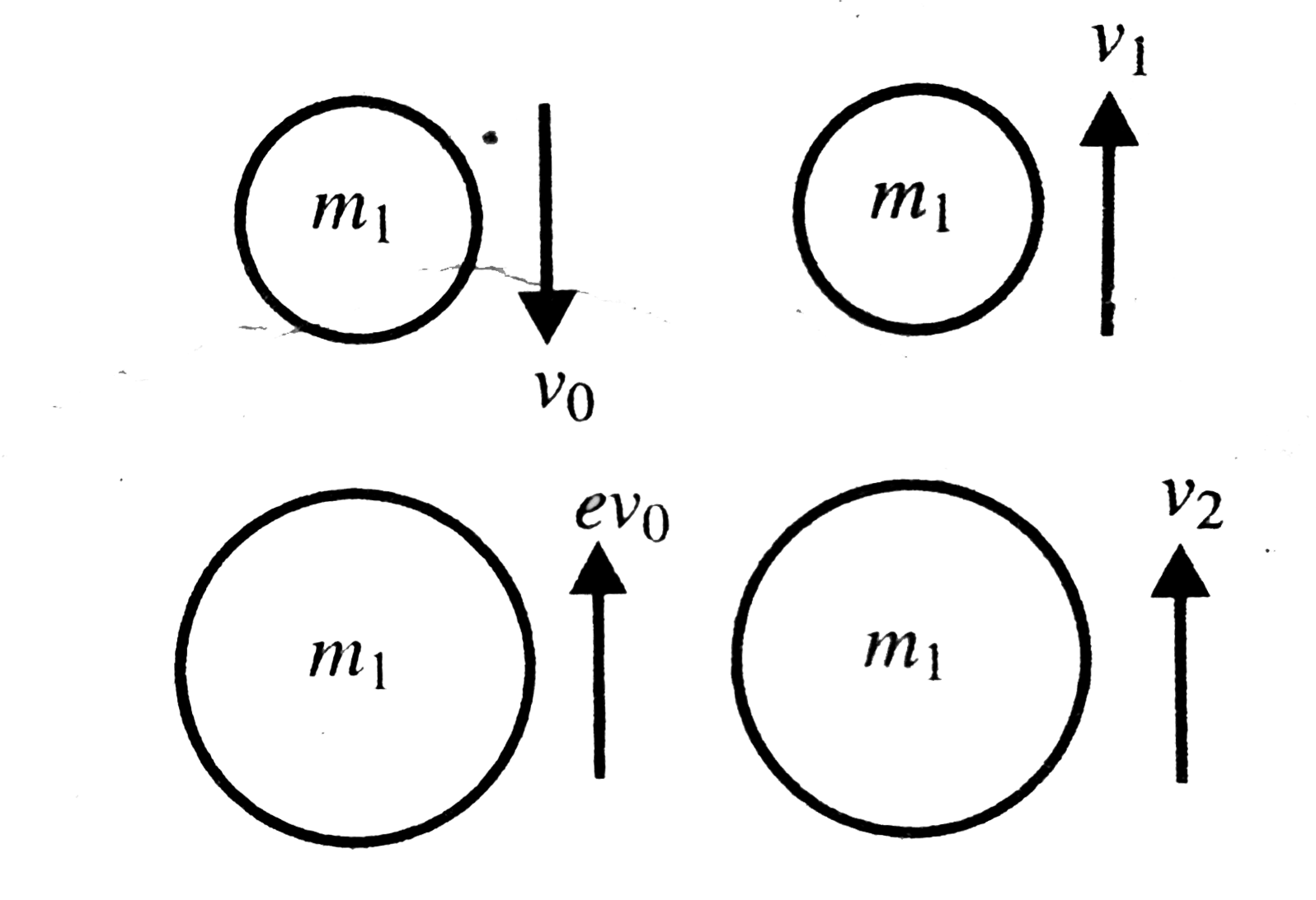
As the bodies `m_(1)` and `m_(2)` fall freely through a distance `h`, `m_(2)` collides with ground with velocity `v_(0)=sqrt(2gh)`. Hence `m_(2)` bounces up with a velocity `ev_(0)` just after the collision with the ground.
Hence `m_(2)` bounces up with a velocity `ev_(0)` just after the collision with the ground. then it collides with the freely falling body `m_(1)`. Just after the collision, let us assume that `v_(1)` and `v_(2)` are the velocities of `m_(1)` and `m_(2)` respectively.
ignoring the impulses due to the weights of the bodies during the period of collision. Let us conserve the momentum of the system `(m_(1)+m_(2))`.
Conservation of linear momentum
`P=-m_(1)v_(0)+m_(2)ev_(0)=m_(1)v_(1)+m_(2)v_(2)`.......i

Newton's impact formula `-e[u_(1)-u_(2)]=v_1-v_(2)`
where `u_(1)=-v_(0 )` and `u_(2) =ev_(0)`
Then `-e[(-v_(0))-(ev_(0))]=v_(1)-v_(2)`.............ii
Solving eqn i and ii we have
`v_(1)=(-(m_(1)-em_(2)))/(m_(1)+m_(2))v_(0)+((1+e)m_(2))/(m_(1)+m_(2)) ev_(0)`
Putting `m_(1)=m_(2), e=1/2` and `v_(0)=sqrt(2gh)` we have `v_(1)=sqrt((gh)/32)uarr`
Promotional Banner

Topper's Solved these Questions

  • CENTRE OF MASS

    CENGAGE PHYSICS ENGLISH|Exercise Exercise 1.1|20 Videos
  • CENTRE OF MASS

    CENGAGE PHYSICS ENGLISH|Exercise Exercise 1.2|23 Videos
  • CENTRE OF MASS

    CENGAGE PHYSICS ENGLISH|Exercise INTEGER_TYPE|1 Videos
  • CALORIMETRY

    CENGAGE PHYSICS ENGLISH|Exercise Solved Example|13 Videos
  • DIMENSIONS & MEASUREMENT

    CENGAGE PHYSICS ENGLISH|Exercise Integer|2 Videos

Similar Questions

Explore conceptually related problems

Two bodies of masses m_1 and m_2(

A glass ball collides with an identical ball at rest with v_(0)=2 m/sec. If the coefficient of restitution of collision is e = 0.5, find the velocities of the glass balls just after the collision.

A block of mass m moving at a velocity upsilon collides head on with another block of mass 2m at rest. If the coefficient of restitution is 1/2, find the velocities of the blocks after the collision.

Two bodies of masses m _(1) and m _(2) fall from heights h _(1) and h _(2) respectively. The ratio of their velocities when the hit the ground is

A ball of mass m moving with velocity v collides head-on which the second ball of mass m at rest. I the coefficient of restitution is e and velocity of first ball after collision is v_(1) and velocity of second ball after collision is v_(2) then

A ball of mass m moving with velocity u collides head-on which the second ball of mass m at rest. If the coefficient of restitution is e and velocity of first ball after collision is v_(1) and velocity of second ball after collision is v_(2) then

Two blocks A and B of mass m and 2m respectively are moving towards a massive ( "mass" gt gt 2m ) cliff with velocities 2v and v respectively. The cliff moves with a velocity v . If the coefficient of restitution of collision at the surface of the cliff is e = 1//2 , find the: a. velocity of the block B just after colliding with the cliff. b. work done by the cliff during collision. c. maximum compression of the spring of stiffness k which is fitted with the block B .

A body of mass m falls from height h, on the ground, If e is the coefficient of restitution between body and the ground, then the height upto which it rises after ten collisions is

A ball of mass m moving with a speed 2v_0 collides head-on with an identical ball at rest. If e is the coefficient of restitution, then what will be the ratio of velocity of two balls after collision?

A ball of mass m moving with a speed 2v_0 collides head-on with an identical ball at rest. If e is the coefficient of restitution, then what will be the ratio of velocity of two balls after collision?

