Home
Class 11
PHYSICS
Two identical buggies 1 and 2 with one m...

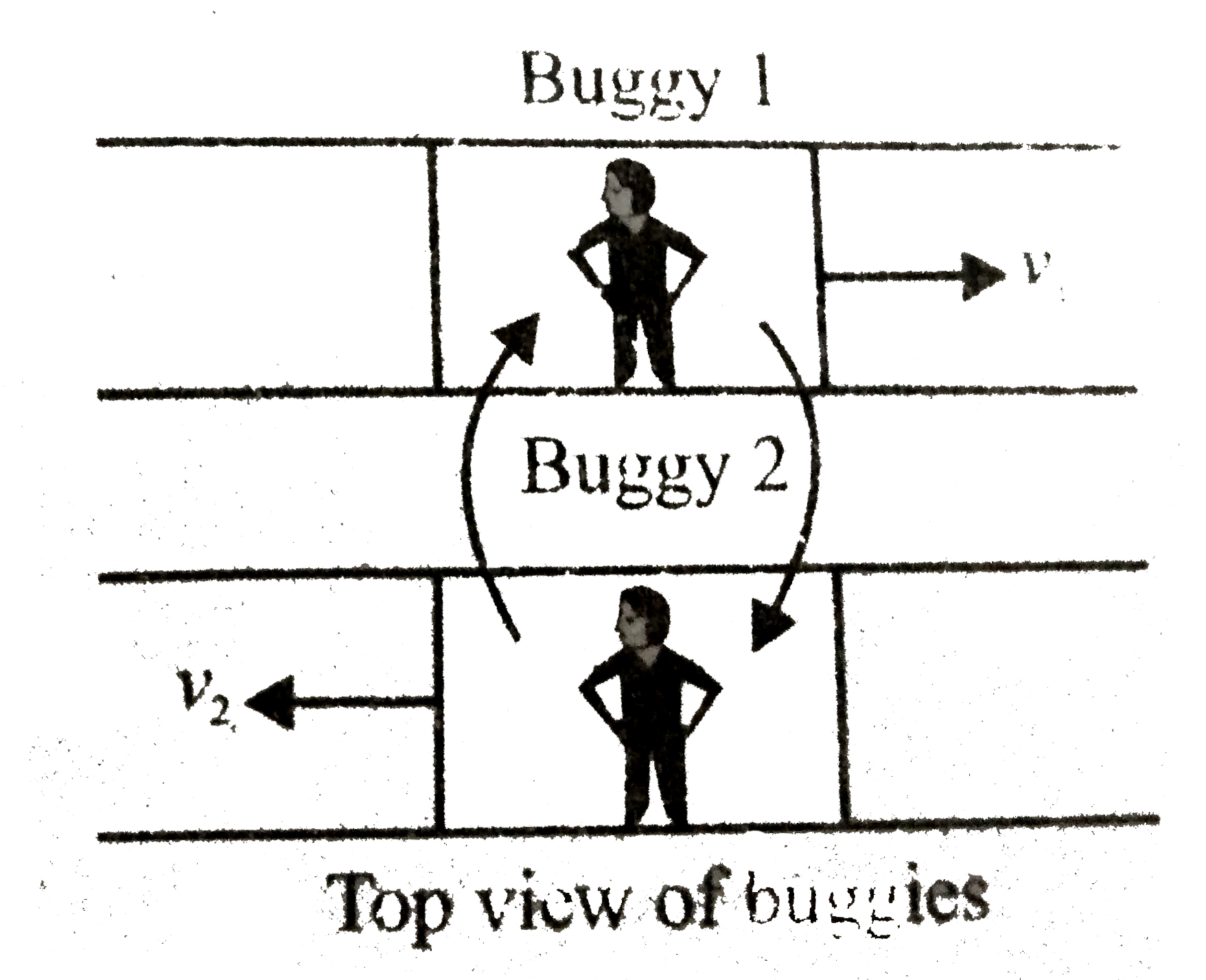
Two identical buggies `1` and `2` with one man in each move along parallel rails. When the buggies are opposite to each other, the men jump in a direction perpendicular to the direction of motion of buggies, so as to exchange their places. As a consequence, buggy `1` stops and buggy `2` keeps moving in the same direction with its final velocity `v`. Find the initial velocities `v_(1)` and `v_(2)` of buggies. Mass of each buggy (without man) equals `M` mass of each man is ignore frictional effects anywhere and the buggies are constrained to move along the rails only.

Text Solution

Verified by Experts
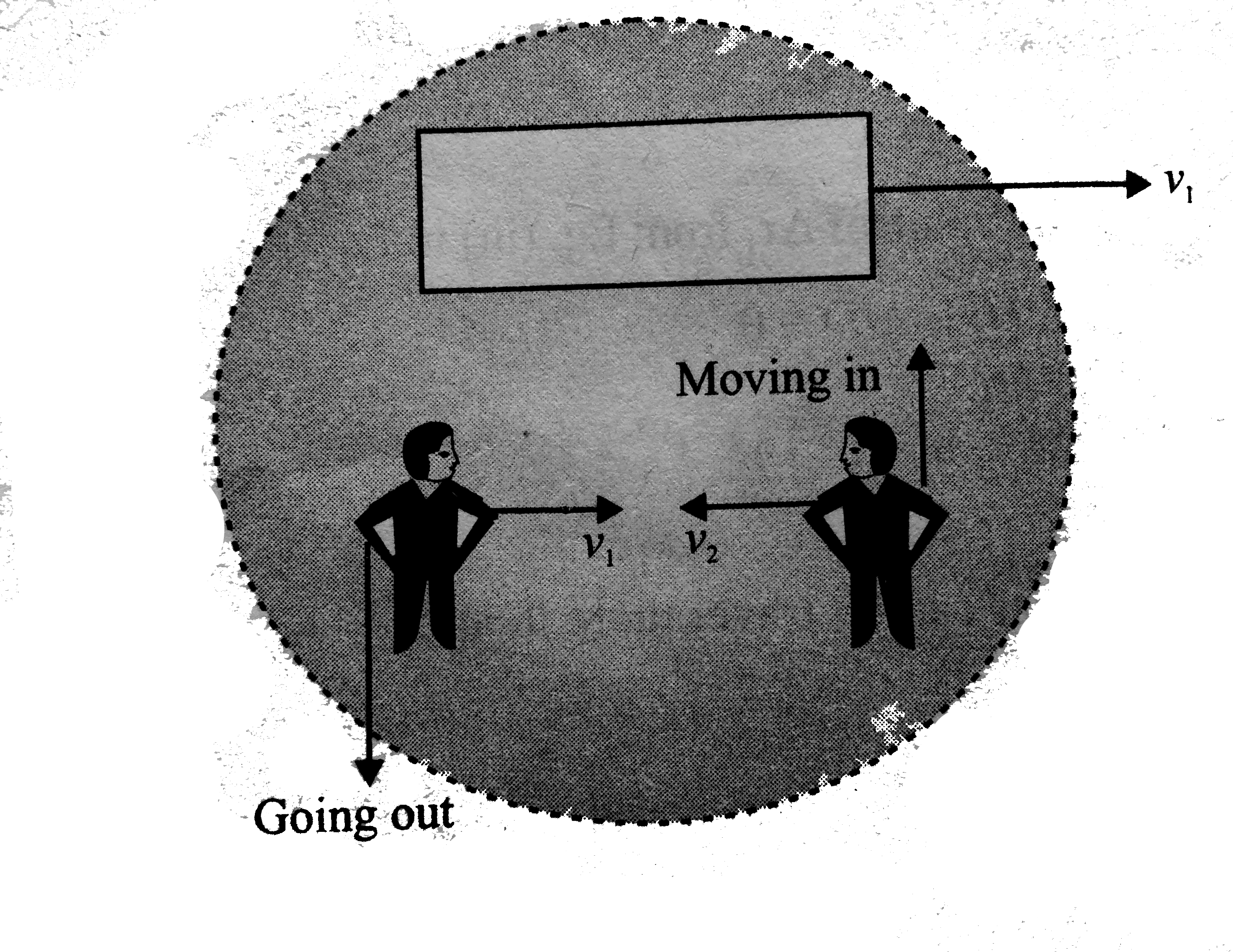
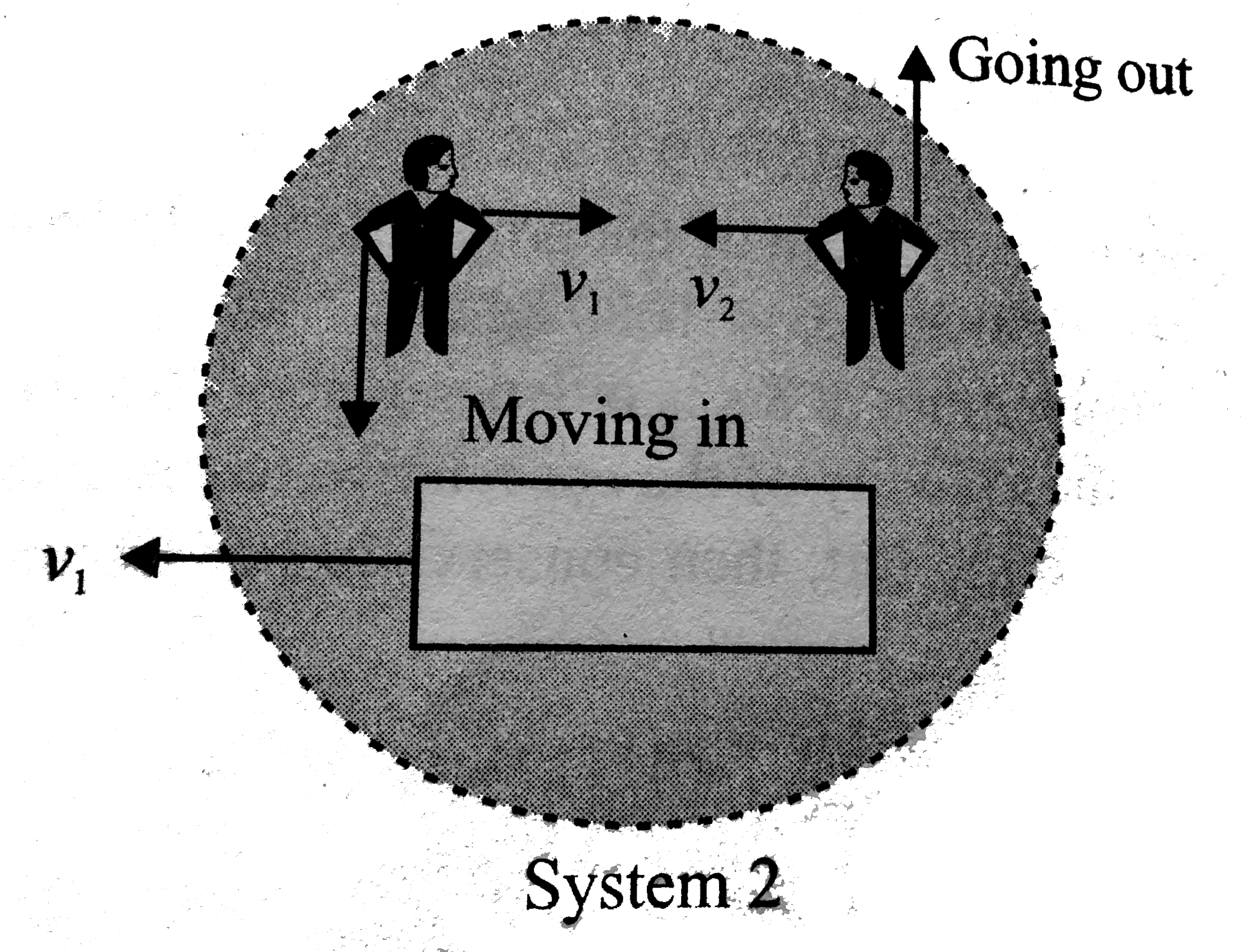
In the problems involving mass ejection and mass addtions, the ejected and added mass both are part of a system. When the men jump they push on the floor of the bugy (action), the same force acts on them as well (reaction).
This action reaction pair is intenal force for the system of man and buggy. similarly, when men jump in, there is an action reaction force between them and the buggy.
Let buggy 1 moves to the right and buggy 2 to the left, when the men jump. Man in 1 brings momentum `mv_(1)` directed towards right in buggy 2.
similarly, the main 2 brings momentum `mv_(2)` in `2` directed towards left.
for system 1:
`P_(i)(M+m)v_(1)-mv_(1)-v_(2)=Mv_(1)-mv_(2)`
`P_(f)=0`
Form law of conservation of momentum.

`P_(1)=P_(f)`
`Mv_(1)=mv_(2)=0.............i`
For system 2:
`P_(i)=(M+m)v_(2)-mv_(1)-mv_(2)`
`P_(f)=(M+m)v`
`P_(i)=P_(f)`.............ii
`(M_(m))v_(2)-mv_(1)-mv_(2)=(M+m)v`..........ii

On solving eqn i and ii simultaneouysly we obtain `v_(1)=(mv)/((M-m)), v_(2)=(Mv)/((M-m))`
Promotional Banner

Topper's Solved these Questions

  • CENTRE OF MASS

    CENGAGE PHYSICS ENGLISH|Exercise Exercise 1.3|24 Videos
  • CENTRE OF MASS

    CENGAGE PHYSICS ENGLISH|Exercise Subjective|23 Videos
  • CENTRE OF MASS

    CENGAGE PHYSICS ENGLISH|Exercise Exercise 1.1|20 Videos
  • CALORIMETRY

    CENGAGE PHYSICS ENGLISH|Exercise Solved Example|13 Videos
  • DIMENSIONS & MEASUREMENT

    CENGAGE PHYSICS ENGLISH|Exercise Integer|2 Videos

Similar Questions

Explore conceptually related problems

If two steams of proton move parallel to each other in the same direction, then they

Two streams of electrons are moving parallel to each other in the same direction. They

Two particles of masses m and 2m moving in opposite directions collide elastically with velocity 2v and v , respectiely. Find their velocities after collision.

Two balls of masses m and 2m moving in opposite directions collide head on elastically with velocities v and 2v . Find their velocities after collision.

Two balls of masses m and 2m moving in opposite directions collide head on elastically with velocities v and 2v . Find their velocities after collision.

A mass m moves with a velocity v and collides inelastically with another identical mass. After collision the 1st mass moves with velocity v/(sqrt3) in a direction perpendicular to the initial direction of motion. Find the speed of the second mass after collision

Shows a wire sliding on two parallel, conducting rails placed at a separaton l. A magnetic feld B exists in a direction perpendicular to the plane of the rails. What force is necessary to keep the wire moving at a constatn velocity v ?

The given construction as shown in Fig. 2 (HT) .3, consists of two rhombus with the ratio 3: 2 , The vertex A_2 moves In the horizontal direction with a velocity v . Find the velocity of A_1 .

Figure shows a wire sliding on two parallel, conducting rails placed at a separation L . A magnetic field B exists in a direction perpendicular to the plane of the rails. What force is necessary to keep the wire moving at a constant velocity V ?

A sphere of mass m moves with a velocity 2v and collides inelastically with another identical sphere of mass m. After collision the first mass moves with velocity v in a direction perpendicular to the initial direction of motion . Find the speed of the second sphere after collision .

CENGAGE PHYSICS ENGLISH-CENTRE OF MASS-Exercise 1.2
  1. Discuss the possibility of conservation of linear momentum of a block ...

    Text Solution

    |

  2. A shell is fired from a cannon with a speed of 100 m//s at an angle 30...

    Text Solution

    |

  3. Figure shows a block A of mass 6 m having a smooth semicircular groove...

    Text Solution

    |

  4. Two friends A and B (each weighing 40 kg) are sitting on a frictionles...

    Text Solution

    |

  5. A smooth wedge of mass M rests on a smooth horizontal surface. A block...

    Text Solution

    |

  6. Two identical buggies 1 and 2 with one man in each move along parallel...

    Text Solution

    |

  7. In Fig. a man stands on a boat floating in still water. The mass of t...

    Text Solution

    |

  8. Two blocks of masses m(1) = 2 kg and m(2) = 5 kg are moving in the sam...

    Text Solution

    |

  9. An 80 kg boy and his 40 kg sister, both wearing roller blades, face ea...

    Text Solution

    |

  10. Two blocks of masses M and 3M are placed on a horizontal, frictionless...

    Text Solution

    |

  11. A pendulum bob os mass 10^(-2) kg is raised to a height 5 xx 10^(-2)m ...

    Text Solution

    |

  12. A rifle man, who together with his rifle has a mass of 100 kg, stands ...

    Text Solution

    |

  13. A projectile of mass 50 kg is shot vertically upwards with an initial ...

    Text Solution

    |

  14. a. A rail road flat car of mass M can roll without friction along a st...

    Text Solution

    |

  15. a. A rail road car of mass M is moving without friction on a straight ...

    Text Solution

    |

  16. A shell of mass 2 kg moving at a rate of 4 m//s suddenly explodes into...

    Text Solution

    |

  17. A mud ball at rest explodes into three fragmennts of masses in the rag...

    Text Solution

    |

  18. A hemisphere of radius R and mass 4 m is free to slide with its base o...

    Text Solution

    |

  19. A gun (mass=M) fires a bullet (mass=m) with speed vr relative to barr...

    Text Solution

    |

  20. Two trolleys A and B are free to move on a level frictionless track, a...

    Text Solution

    |