Home
Class 11
PHYSICS
A man is standing on a plank which is pl...

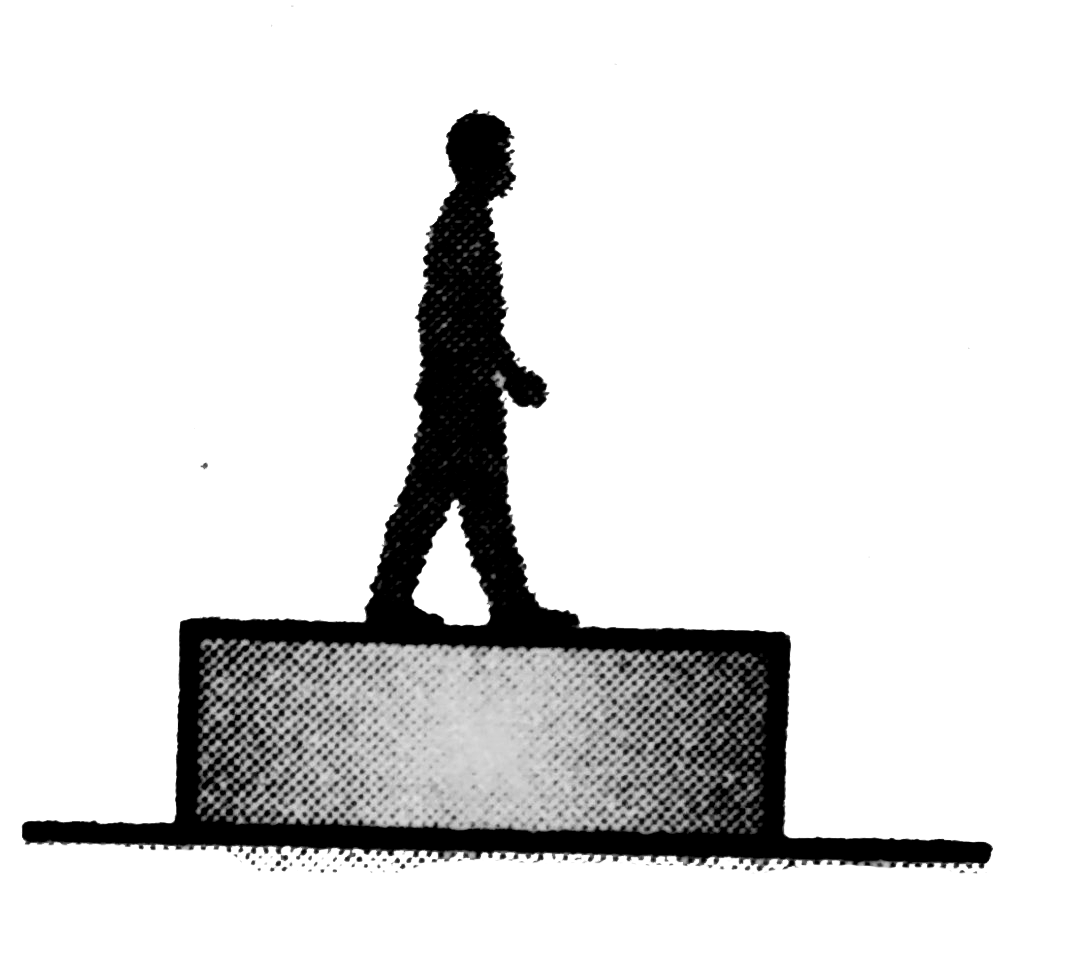
A man is standing on a plank which is placed on smooth horizontal surface. There is sufficient friction between feet of man and plank. Now man starts running over plank, correct statement is/are

A

Work done by friction on man with respect to ground is negative.

B

Work done by friction on man with respect to ground is positive

C

Work done by friction on plank with respect to ground

D

Work done by friction on man with respect to plank is zero.

Text Solution

Verified by Experts

The correct Answer is:
A, C, D

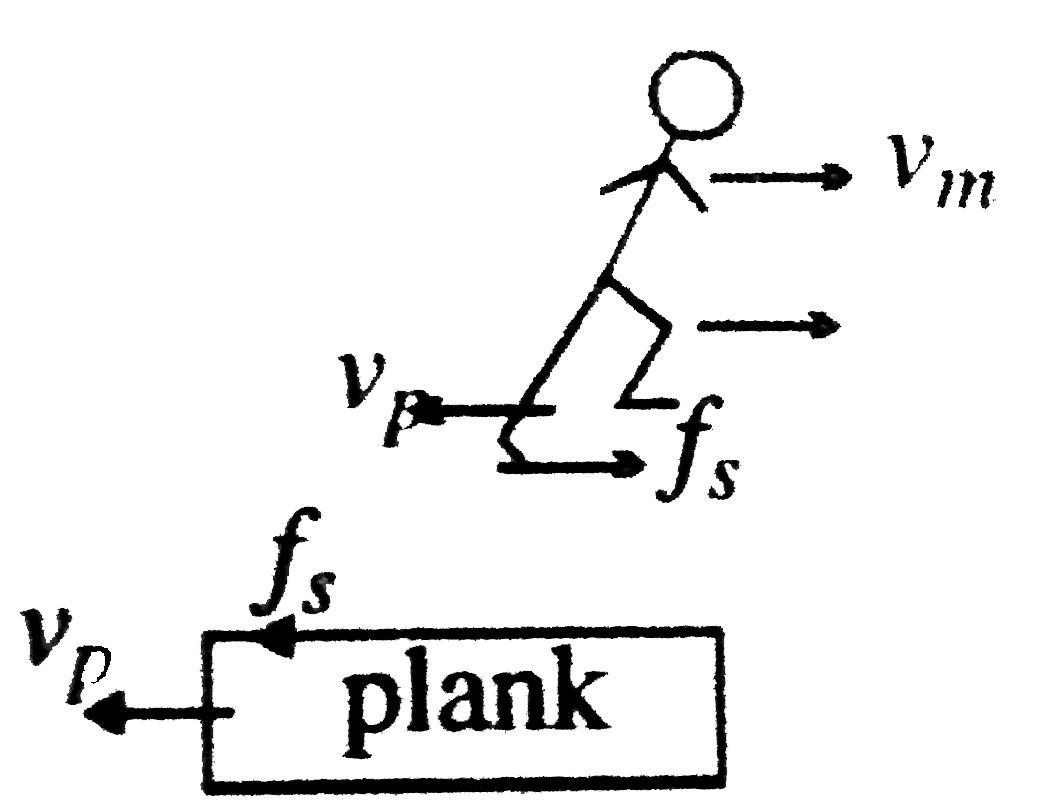
At contact point of man and plank, the relative motion is zero. As plank moves backward, man's foot also moves backwards, but friction on man acts forward. Hence workdone by friction on man is negative. But with respect to plank, foot will be at rest, hence no work done by friction on man w.r.t plank.
Promotional Banner

Topper's Solved these Questions

  • CENTRE OF MASS

    CENGAGE PHYSICS ENGLISH|Exercise Assertion - Reasoning|2 Videos
  • CENTRE OF MASS

    CENGAGE PHYSICS ENGLISH|Exercise Linked Comprehension|105 Videos
  • CENTRE OF MASS

    CENGAGE PHYSICS ENGLISH|Exercise Single Correct|141 Videos
  • CALORIMETRY

    CENGAGE PHYSICS ENGLISH|Exercise Solved Example|13 Videos
  • DIMENSIONS & MEASUREMENT

    CENGAGE PHYSICS ENGLISH|Exercise Integer|2 Videos

Similar Questions

Explore conceptually related problems

A block of mass m=2kg of shown dimensions is placed on a plank of mass M = 6Kg which is placed on smooth horizontal plane. The coefficient of friction between the block and the plank is mu=1/3 . If a horizontal froce F is applied on the plank, then find the maximum value of F (in N) for which the block and the plank move together

A man is running with a constant acceleration on a plank which is placed on a horizontal smooth surface. Then choose the correct option(s):

A block A of mass m is placed over a plank B of mass 2m plank B is placed over a smooth horizontal surface .The coefficient of friction between A and B is 0.4 Block A is given a velocity v_(0) toward right Find acceleration (in ms^(-2) of B relative to A

A plank having mass M is placed on smooth horizontal surface. Block of mass m is placed on it coefficient of friction between block and plank is mu_(0)+kx , where k is constant and x is relative displacement between block and plank. A force F is applied on block where F=at , where a=10 t is in second. find t_(0) when relative motion will occur between block and plank.

A block A of mass m is placed over a plank B of mass 2m. Plank B is placed over a smooth horizontal surface. The coefficient of friction between A and B is (1)/(2) block A is given a velocity v_(0) towards right. Accelration of B relative to A is

Block A of mass m rests on the plank B of mass 3m which is free to slide on a frictionless horizo-ntal surface. The coefficient of friction between the block and plank is 0.2. If a horizontal force of magnitude 2 mg is applied to the plank B, the acceleration of A relative to the plank and relative to the ground respectively, are:

A bolck of mass m =2 kg is placed on a plank of mass M = 10 kg, which is placed on a smooth horizontal plane as shown in the figure. The coefficient of friction between the block and the plank is mu=(1)/(3) . If a horizontal force F is applied on the plank, then the maximum value of F for which the block and the plank move together is (g=10m//s^(2))

A solid sphere of mass m and radius R is placed over a plank of same mass m . There is sufficient friction between sphere and plank to prevent slipping. Angular acceleration of sphere is

A man of mass m is standing on a plank of equal mass m resting on a smooth horizontal surface. The man starts moving on the plank with speed u relative to the plank. The speed of the man relative to the ground is

A solid sphere of mass m and radius R is placed over a plank of same mass m . There is sufficient friction between sphere and plank to prevent slipping. Force of friction between sphere and plank is

CENGAGE PHYSICS ENGLISH-CENTRE OF MASS-Multiple Correct
  1. A block of mass m moving with a velocity v(o) collides with a stationa...

    Text Solution

    |

  2. Two particles of masses m(1) and m(2) and velocities u(1) and alphau(1...

    Text Solution

    |

  3. A pendulum bob of mass m connected to the end of material string of le...

    Text Solution

    |

  4. A string of length 3l is connected to a fixed cylinder whose top view ...

    Text Solution

    |

  5. In the figure, the block B of mass m starts from rest at the top of a ...

    Text Solution

    |

  6. Two blocks A and B of masses in and 2m respectively placed on a smooth...

    Text Solution

    |

  7. Figure shows two identical blocks each of mass m kept on a smooth floo...

    Text Solution

    |

  8. A ball of mass 1 kg is dropped from a height of 3.2 m on smooth inclin...

    Text Solution

    |

  9. A particle of mass m collides with another stationary particle of mass...

    Text Solution

    |

  10. Consider two skaters A and B initially at rest on ice -(friction is ne...

    Text Solution

    |

  11. A man is standing on a plank which is placed on smooth horizontal surf...

    Text Solution

    |

  12. Two particles of equal mass in are projected from the ground with spee...

    Text Solution

    |

  13. A particle A suffers an oblique elastic collision particle B that is a...

    Text Solution

    |

  14. Suppose two particles 1 and 2 are projected in vertical plane simultan...

    Text Solution

    |

  15. A particle of mass m(1) = 4 kg moving at 6hatims^(-1) collides perfect...

    Text Solution

    |

  16. Consider a block of mass 10 kg. which rests on as smooth surface and ...

    Text Solution

    |

  17. Statement I. A particle strikes head-on with another stationary partic...

    Text Solution

    |

  18. Statement I: No external force acts on a system of two spheres which u...

    Text Solution

    |

  19. Statement I: If a sphere of mass mmoving with speed u undergoes a perf...

    Text Solution

    |

  20. Statement I: If a ball projected up obliquely from the ground breaks u...

    Text Solution

    |

