Home
Class 11
PHYSICS
Collision is a physical process in which...

Collision is a physical process in which two or more objects, either particle masses or rigid bodies, experience very high force of interaction for a very small duration. It is not essential for the objects to physically touch each other for collision to occur. Irrespective of the nature of interactive force and the nature of colliding bodies, Newton's second law holds good on the system. Hence, momentum of the system before and after the collision remains conserved if no appreciable external force acts on the system during collision.
The amount of energy loss during collision, if at all, is indeed dependent on the nature of colliding objects. The energy loss is observed to be maximum when objects stick together after collision. The terminology is to define collision as 'elastic' if no energy loss takes place and to define collision as 'plastic' for maximum energy loss. The behaviour of system after collision depends on the position of colliding objects as well. A unidirectional motion of colliding objects before collision can turn into two dimensional after collision if the line joining the centre of mass of the two colliding objects is not parallel to the direction of velocity of each particle before collision. Such type of collision is referred to as oblique collision which may be either two or three dimensional.
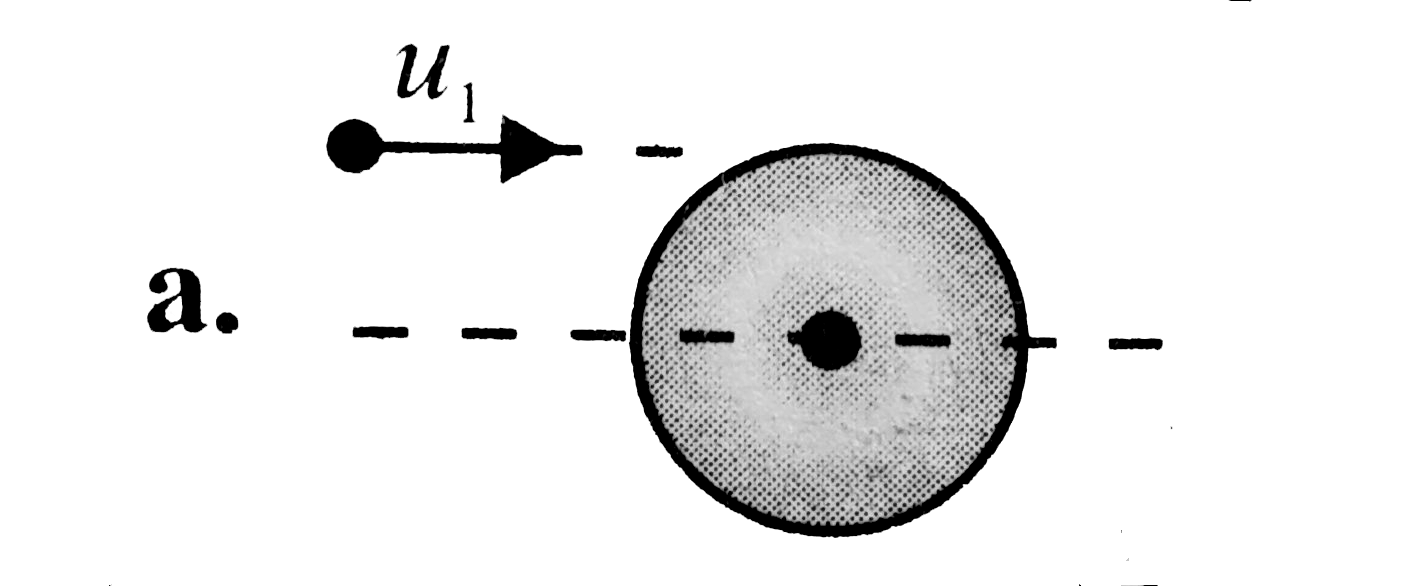
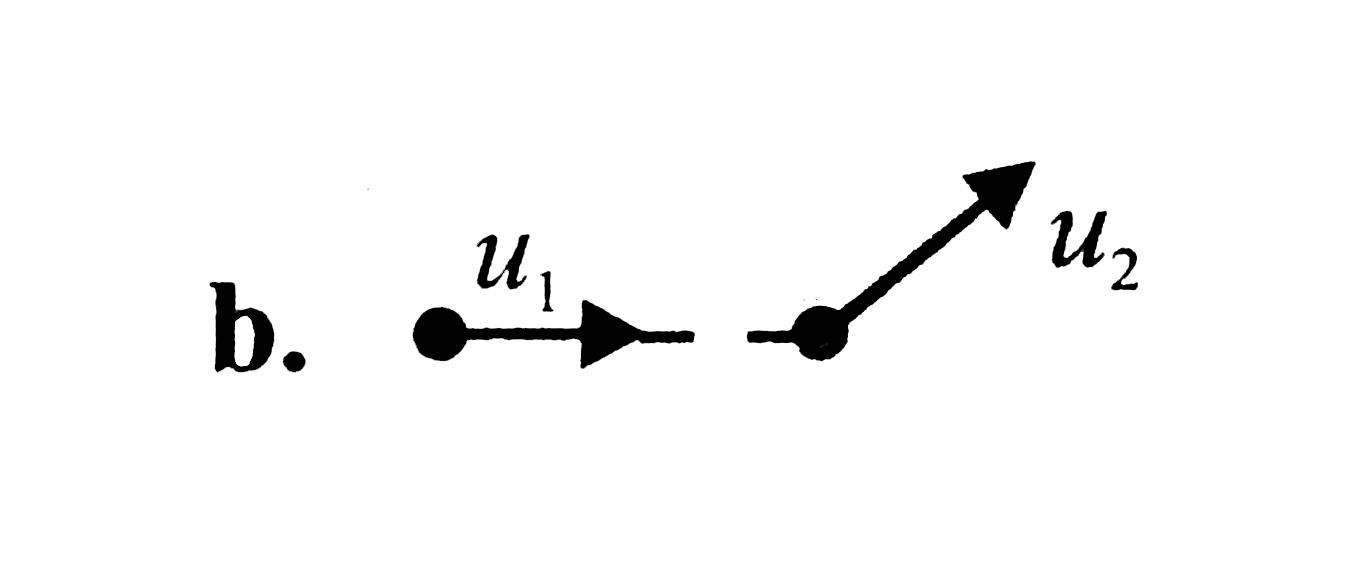
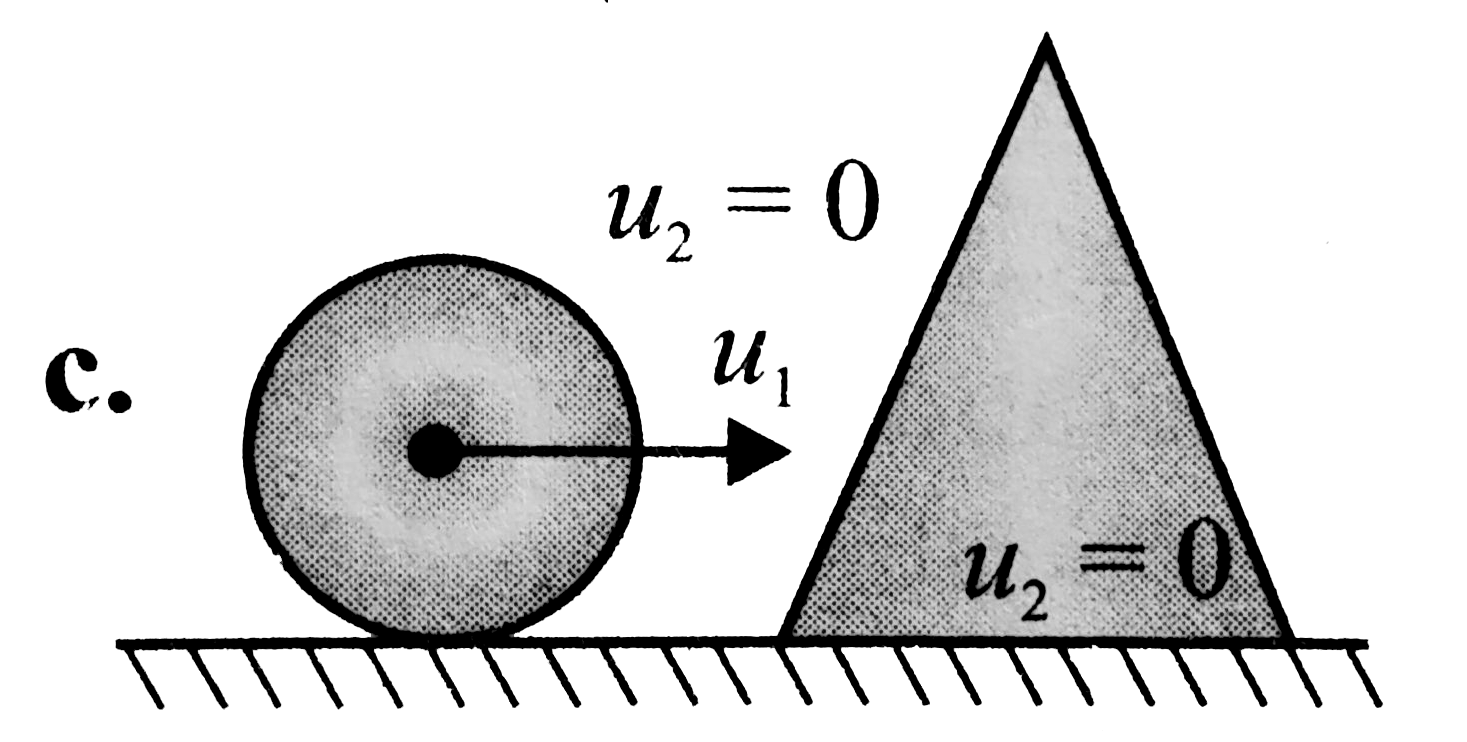
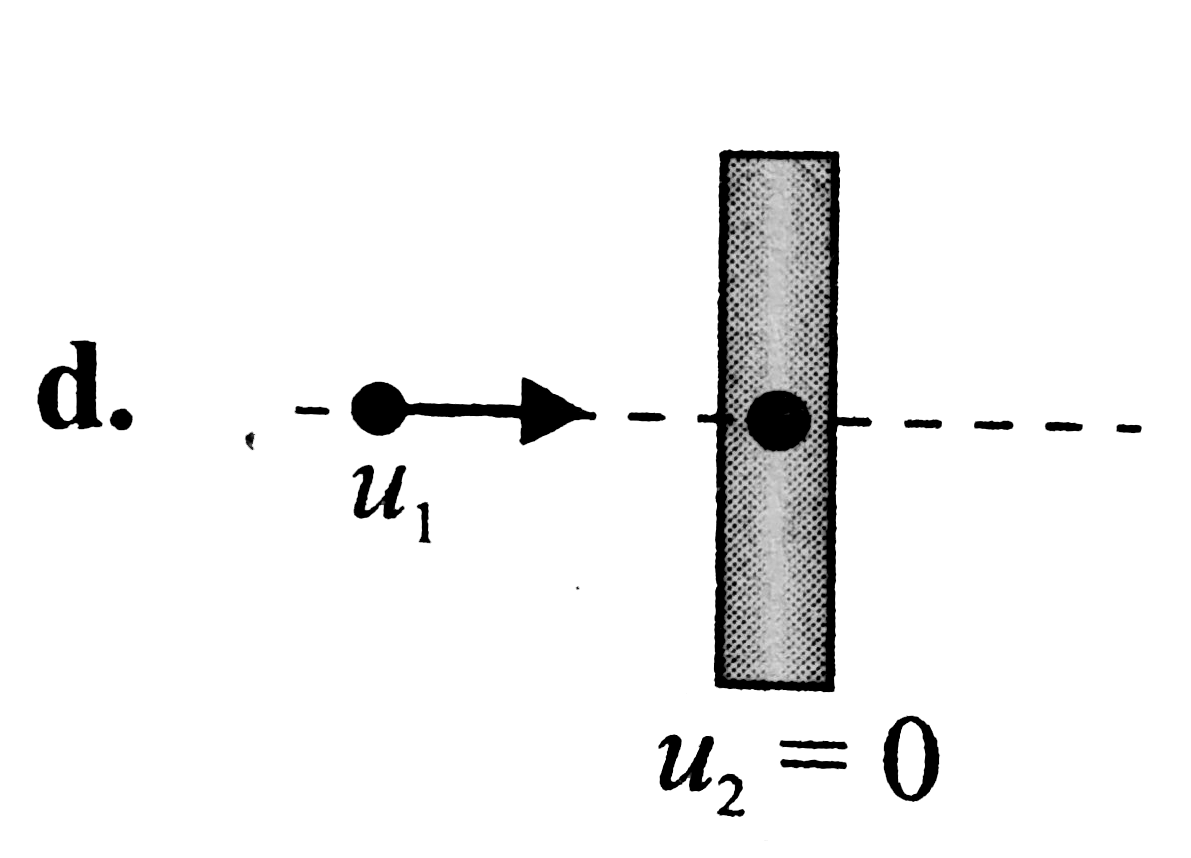
Which of the following collisions is one-dimensional?

A

B

C

D

Text Solution

AI Generated Solution

The correct Answer is:

To determine which of the given collisions is one-dimensional, we need to analyze the options based on the definition of one-dimensional and oblique collisions. Here’s a step-by-step solution: ### Step 1: Understand the Definitions - **One-dimensional collision**: This occurs when the motion of the colliding objects is along a single straight line. The velocities of the objects before and after the collision are parallel to each other. - **Oblique collision**: This occurs when the line joining the centers of mass of the colliding objects is not parallel to the direction of their velocities before the collision, resulting in a change of direction. ### Step 2: Analyze Each Option 1. **Option A**: Check if the velocities of the two particles are parallel to the line joining their centers of mass. - If they are not parallel, this indicates an oblique collision. Therefore, this option is incorrect for one-dimensional collision. 2. **Option B**: Again, check the relationship between the velocities and the line joining the centers of mass. - If the velocities are not parallel, this option is also incorrect for one-dimensional collision. 3. **Option C**: Consider the configuration of the particles and their velocities. - If the line joining the centers of mass is not equal to the direction of the velocities, this indicates an oblique collision. Thus, this option is incorrect for one-dimensional collision. 4. **Option D**: Evaluate the situation where one particle has a velocity and the other has zero velocity. - If the line joining the centers of mass is aligned with the direction of the moving particle's velocity, then this indicates a one-dimensional collision. Therefore, this option is correct. ### Conclusion Based on the analysis, the correct option that represents a one-dimensional collision is **Option D**.

To determine which of the given collisions is one-dimensional, we need to analyze the options based on the definition of one-dimensional and oblique collisions. Here’s a step-by-step solution: ### Step 1: Understand the Definitions - **One-dimensional collision**: This occurs when the motion of the colliding objects is along a single straight line. The velocities of the objects before and after the collision are parallel to each other. - **Oblique collision**: This occurs when the line joining the centers of mass of the colliding objects is not parallel to the direction of their velocities before the collision, resulting in a change of direction. ### Step 2: Analyze Each Option 1. **Option A**: Check if the velocities of the two particles are parallel to the line joining their centers of mass. ...
Promotional Banner

Topper's Solved these Questions

  • CENTRE OF MASS

    CENGAGE PHYSICS ENGLISH|Exercise Integer|16 Videos
  • CENTRE OF MASS

    CENGAGE PHYSICS ENGLISH|Exercise Fill In The Blanks|2 Videos
  • CENTRE OF MASS

    CENGAGE PHYSICS ENGLISH|Exercise Assertion - Reasoning|2 Videos
  • CALORIMETRY

    CENGAGE PHYSICS ENGLISH|Exercise Solved Example|13 Videos
  • DIMENSIONS & MEASUREMENT

    CENGAGE PHYSICS ENGLISH|Exercise Integer|2 Videos
CENGAGE PHYSICS ENGLISH-CENTRE OF MASS-Linked Comprehension
  1. Collision is a physical process in which two or more objects, either p...

    Text Solution

    |

  2. Collision is a physical process in which two or more objects, either p...

    Text Solution

    |

  3. Collision is a physical process in which two or more objects, either p...

    Text Solution

    |

  4. Collision is a physical process in which two or more objects, either p...

    Text Solution

    |

  5. According to the principle of conservation of linear momentum if the e...

    Text Solution

    |

  6. According to the principle of conservation of linear momentum if the e...

    Text Solution

    |

  7. According to the principle of conservation of linear momentum if the e...

    Text Solution

    |

  8. Two identical balls A and B. each of mass 2 kg and radius R, are suspe...

    Text Solution

    |

  9. Two identical balls A and B. each of mass 2 kg and radius R, are suspe...

    Text Solution

    |

  10. Two identical balls A and B. each of mass 2 kg and radius R, are suspe...

    Text Solution

    |

  11. After falling from rest through a height h, a body of mass m begins to...

    Text Solution

    |

  12. After falling from rest through a height h, a body of mass m begins to...

    Text Solution

    |

  13. Three identical balls are connected by light inextensible strings with...

    Text Solution

    |

  14. Three identical balls are connected by light inextensible strings with...

    Text Solution

    |

  15. Three identical balls are connected by light inextensible strings with...

    Text Solution

    |

  16. In Fig. a pulley is shown which is frictionless and a ring of mass m c...

    Text Solution

    |

  17. In Fig. a pulley is shown which is frictionless and a ring of mass m c...

    Text Solution

    |

  18. In Fig. a pulley is shown which is frictionless and a ring of mass m c...

    Text Solution

    |

  19. A system of men and trolley is shown in Fig. To the left, end of the s...

    Text Solution

    |

  20. A system of men and trolley is shown in Fig. To the left, end of the s...

    Text Solution

    |
