Home
Class 11
PHYSICS
Two identical balls, each of mass m, are...

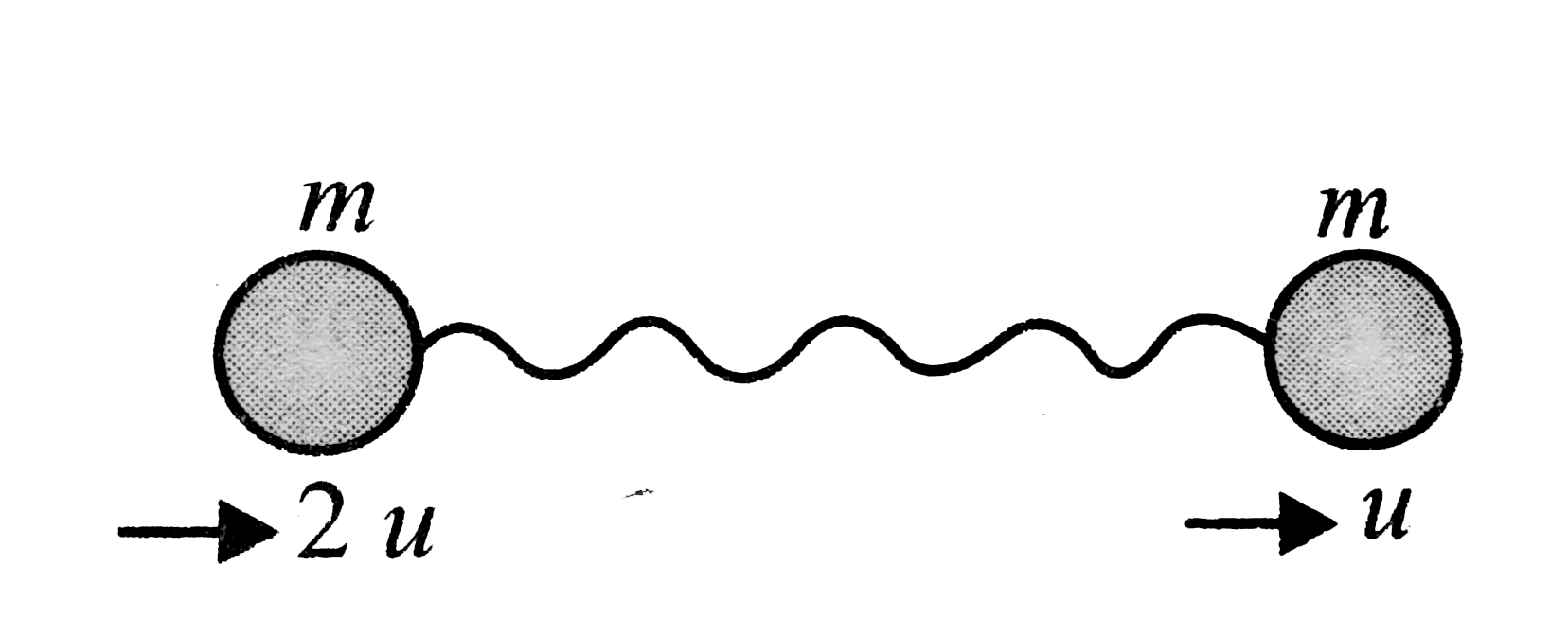
Two identical balls, each of mass `m`, are tied with a string and kept on a frictionless surface. Initially, the string is slack. They are given velocities `2u` and `u`. in the same direction. Collision between the balls is perfectly elastic.

After the first collision, what is the total loss in kinetic energy of the balls?

A

`2"mu"^(2)`

B

`"mu"^(2)`

C

`3"mu"^(2)`

D

zero

Text Solution

Verified by Experts

The correct Answer is:

D

Since the collision is elastic there is no loss in `KE`
Promotional Banner

Topper's Solved these Questions

  • CENTRE OF MASS

    CENGAGE PHYSICS ENGLISH|Exercise Integer|16 Videos
  • CENTRE OF MASS

    CENGAGE PHYSICS ENGLISH|Exercise Fill In The Blanks|2 Videos
  • CENTRE OF MASS

    CENGAGE PHYSICS ENGLISH|Exercise Assertion - Reasoning|2 Videos
  • CALORIMETRY

    CENGAGE PHYSICS ENGLISH|Exercise Solved Example|13 Videos
  • DIMENSIONS & MEASUREMENT

    CENGAGE PHYSICS ENGLISH|Exercise Integer|2 Videos

Similar Questions

Explore conceptually related problems

Two identical balls, each of mass m , are tied with a string and kept on a frictionless surface. Initially, the string is slack. They are given velocities 2u and u . in the same direction. Collision between the balls is perfectly elastic. What is the final loss in kinetic energy of the balls?

Two identical balls, each of mass m , are tied with a string and kept on a frictionless surface. Initially, the string is slack. They are given velocities 2u and u . in the same direction. Collision between the balls is perfectly elastic. What is the impulse generated in the string during the first collision?

Three blocks of masses m , m and M are kept on a frictionless floor as shown in the figure .The leftmost block is given velocity v towards the right . All the collision between the blocks are perfectly inelastic . The loss in kinetic energy after all the collision is 5//6th of initial kinetic energy. The ratio of M//m will be

Two balls of masses m each are moving at right angle to each other with velocities 6 m/s and 8 m/s respectively. If collision between them is perfectly inelastic, the velocity of combined mass is

Two massless string of length 5 m hang from the ceiling very near to each other as shown in the figure. Two balls A and B of masses 0.25kg and 0.5kg are attached to the string. The ball A is released from rest at a height 0.45m as shown in the figure. The collision between two balls is completely elastic. Immediately after the collision, the kinetic energy of ball B is 1 J The velocity of ball A just after the collision is

A metal ball of mass 2 kg moving with a velocity of 36km//h has a head on collision with a stationery ball of mass 3 kg. If after the collision, the two balls move together, the loss in kinetic energy dur to collision is

Two indentical balls A and B moving with velocities u_(A) and u_(B) In the same direction collide. Coefficient of restitution is e. (a) Deduce expression for velocities of the balls after the collision. (b) If collision is perfectly elastic, what do you observe?

Two identical balls each of mass m interconnected by a small light inextensible string are kept on a smooth horizontal surface. One of the balls is pushed towards the other with a speed v_(0) find the loss of K.E. of the ball. What will be the final velocities of the balls ? (e=1).

Two identical ball bearings in contact with each other and resting on a frictionless table are hit head on by another ball bearing of the same mass moving initially with a speed v, figure,. If the collision is elastic, which of the following is a possible result after collisioin?

Two balls having masses m and 2m are fastened to two light strings of same length shown in the figure. The other ends of the strings are fixed at O. The strings are kept in the same horizontal line and the system is released from rest. The collision between the balls is elastic. (a). Find velocities of the balls just after their collision. (b). How high will the balls rise after the collision.

CENGAGE PHYSICS ENGLISH-CENTRE OF MASS-Linked Comprehension
  1. A ballistic pendulum is a device that was used to measure the speeds o...

    Text Solution

    |

  2. A ballistic pendulum is a device that was used to measure the speeds o...

    Text Solution

    |

  3. Two identical balls, each of mass m, are tied with a string and kept o...

    Text Solution

    |

  4. Two identical balls, each of mass m, are tied with a string and kept o...

    Text Solution

    |

  5. Two identical balls, each of mass m, are tied with a string and kept o...

    Text Solution

    |

  6. The following problems illustrate the effect of a time-dependent force...

    Text Solution

    |

  7. The following problems illustrate the effect of a time-dependent force...

    Text Solution

    |

  8. The following problems illustrate the effect of a time-dependent force...

    Text Solution

    |

  9. The following problems illustrate the effect of a time-dependent force...

    Text Solution

    |

  10. Two persons, A of mass 60 kg and B of mass 40 kg, are standing on a ho...

    Text Solution

    |

  11. Two persons, A of mass 60 kg and B of mass 40 kg, are standing on a ho...

    Text Solution

    |

  12. Two persons, A of mass 60 kg and B of mass 40 kg, are standing on a ho...

    Text Solution

    |

  13. A string with one end fixed on a rigid wall, passing over a fixed fric...

    Text Solution

    |

  14. A string with one end fixed on a rigid wall, passing over a fixed fric...

    Text Solution

    |

  15. Two identical shells are fired from a point on the ground with same mu...

    Text Solution

    |

  16. Two identical shells are fired from a point on the ground with same mu...

    Text Solution

    |

  17. Two identical shells are fired from a point on the ground with same mu...

    Text Solution

    |

  18. Two identical shells are fired from a point on the ground with same mu...

    Text Solution

    |

  19. A ball of mass m is thrown at an angle of 45^(@) to the horizontal,, f...

    Text Solution

    |

  20. A ball of mass m is thrown at an angle of 45^(@) to the horizontal,, f...

    Text Solution

    |
