Home
Class 11
PHYSICS
Two identical balls, each of mass m, are...

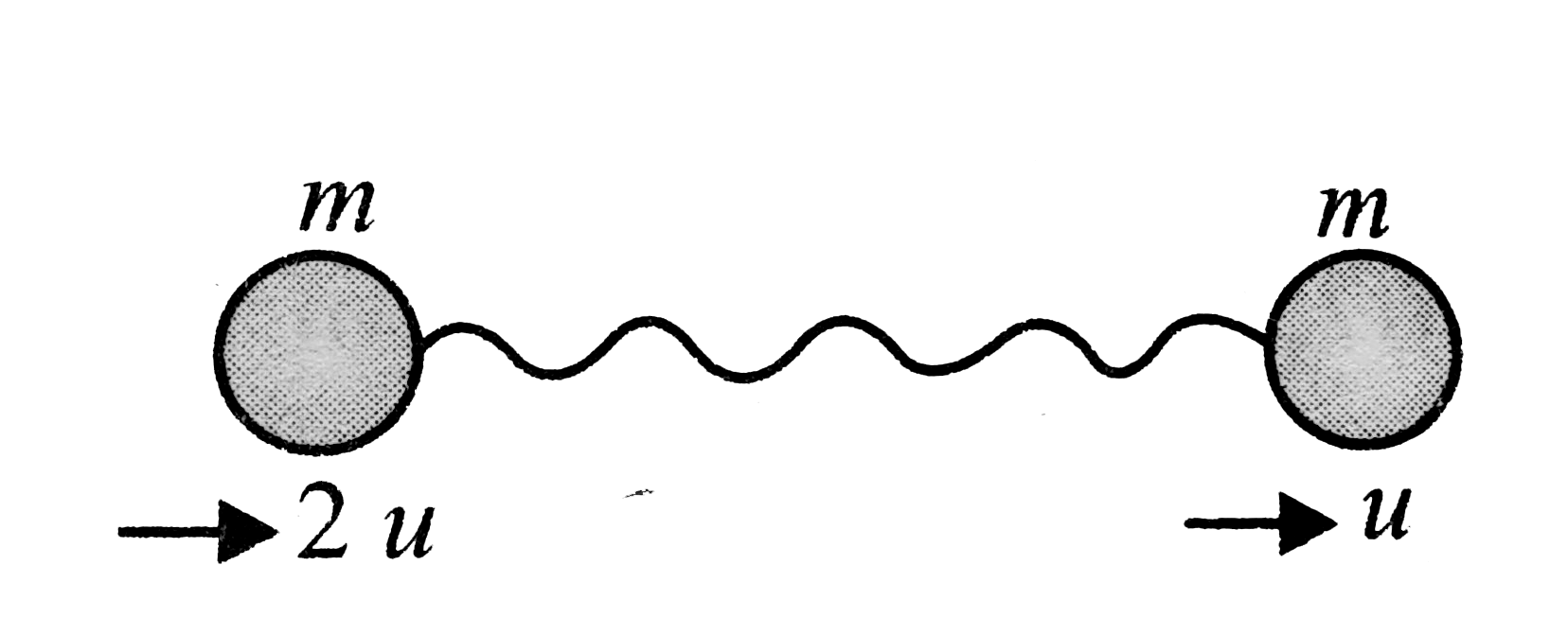
Two identical balls, each of mass `m`, are tied with a string and kept on a frictionless surface. Initially, the string is slack. They are given velocities `2u` and `u`. in the same direction. Collision between the balls is perfectly elastic.

What is the impulse generated in the string during the first collision?

A

`"mu"//2`

B

`"mu"//4`

C

`(2"mu")//3`

D

none of these

Text Solution

Verified by Experts

The correct Answer is:

A

For left ball: `I=mv-"mu"=m(3u)/2-"mu"="mu"//2`
Promotional Banner

Topper's Solved these Questions

  • CENTRE OF MASS

    CENGAGE PHYSICS ENGLISH|Exercise Integer|16 Videos
  • CENTRE OF MASS

    CENGAGE PHYSICS ENGLISH|Exercise Fill In The Blanks|2 Videos
  • CENTRE OF MASS

    CENGAGE PHYSICS ENGLISH|Exercise Assertion - Reasoning|2 Videos
  • CALORIMETRY

    CENGAGE PHYSICS ENGLISH|Exercise Solved Example|13 Videos
  • DIMENSIONS & MEASUREMENT

    CENGAGE PHYSICS ENGLISH|Exercise Integer|2 Videos

Similar Questions

Explore conceptually related problems

Two identical balls, each of mass m , are tied with a string and kept on a frictionless surface. Initially, the string is slack. They are given velocities 2u and u . in the same direction. Collision between the balls is perfectly elastic. What is the final loss in kinetic energy of the balls?

Two identical balls, each of mass m , are tied with a string and kept on a frictionless surface. Initially, the string is slack. They are given velocities 2u and u . in the same direction. Collision between the balls is perfectly elastic. After the first collision, what is the total loss in kinetic energy of the balls?

A sphere of mass m slides with velocity v on as frictionless surface towards a smooth inclined wall as shown in figure. If the collision with the wall is perfectly elastic find a. the impulse imparted by the wall on the sphere b the impulse imparted by the floor on the sphere.

Two balls of masses m each are moving at right angle to each other with velocities 6 m/s and 8 m/s respectively. If collision between them is perfectly inelastic, the velocity of combined mass is

Two balls of equal masses m each undergo oblique collision. If colision is perfectly elastic, then angle between their velocities after collision is

Two indentical balls A and B moving with velocities u_(A) and u_(B) In the same direction collide. Coefficient of restitution is e. (a) Deduce expression for velocities of the balls after the collision. (b) If collision is perfectly elastic, what do you observe?

Two balls having masses m and 2m are fasrtened to two light strings of same length (figure). The other ends of the strings are fixed at O. The strings are kept in the same horizontal line and the system is released from rest. The collision between the balls is elastic. Point A is the lowest point at which either ball can reach The position at which the balls will collide for the first time

Three identical balls, ball I, ball II and ball III are placed on a smooth floor on a straight line at the separation of 10m between balls as shown in figure. Initially balls are stationary. But I is given velocity of 10m//s towards ball II, collision between balls I and II is inelastic with coefficient of restitution 0.5 but collision between balls II and III is perfectly elastic. What is the time interval between two consecutive collisions between ball I and II?

Three identical balls, ball I, ball II and ball III are placed on a smooth floor on a straight line at the separation of 10m between balls as shown in figure. Initially balls are stationary. But I is given velocity of 10m//s towards ball II, collision between balls I and II is inelastic with coefficient of restitution 0.5 but collision between balls II and III is perfectly elastic. What is the time interval between two consecutive collisions between ball I and II?

A hollow circular tube of radius R and negligible internal diameter is fixed on horizontal surface ball A of mas m is given velocity v_(o) in the shown direction. It collides with ball B of mass 2 m . Collision is perfectly elastic. If centre of loop is origin of co-ordinates system, then co-ordinate of next collision is

CENGAGE PHYSICS ENGLISH-CENTRE OF MASS-Linked Comprehension
  1. Two identical balls, each of mass m, are tied with a string and kept o...

    Text Solution

    |

  2. Two identical balls, each of mass m, are tied with a string and kept o...

    Text Solution

    |

  3. Two identical balls, each of mass m, are tied with a string and kept o...

    Text Solution

    |

  4. The following problems illustrate the effect of a time-dependent force...

    Text Solution

    |

  5. The following problems illustrate the effect of a time-dependent force...

    Text Solution

    |

  6. The following problems illustrate the effect of a time-dependent force...

    Text Solution

    |

  7. The following problems illustrate the effect of a time-dependent force...

    Text Solution

    |

  8. Two persons, A of mass 60 kg and B of mass 40 kg, are standing on a ho...

    Text Solution

    |

  9. Two persons, A of mass 60 kg and B of mass 40 kg, are standing on a ho...

    Text Solution

    |

  10. Two persons, A of mass 60 kg and B of mass 40 kg, are standing on a ho...

    Text Solution

    |

  11. A string with one end fixed on a rigid wall, passing over a fixed fric...

    Text Solution

    |

  12. A string with one end fixed on a rigid wall, passing over a fixed fric...

    Text Solution

    |

  13. Two identical shells are fired from a point on the ground with same mu...

    Text Solution

    |

  14. Two identical shells are fired from a point on the ground with same mu...

    Text Solution

    |

  15. Two identical shells are fired from a point on the ground with same mu...

    Text Solution

    |

  16. Two identical shells are fired from a point on the ground with same mu...

    Text Solution

    |

  17. A ball of mass m is thrown at an angle of 45^(@) to the horizontal,, f...

    Text Solution

    |

  18. A ball of mass m is thrown at an angle of 45^(@) to the horizontal,, f...

    Text Solution

    |

  19. A ball of mass m is thrown at an angle of 45^(@) to the horizontal,, f...

    Text Solution

    |

  20. A ball of mass m is thrown at an angle of 45^(@) to the horizontal,, f...

    Text Solution

    |
