Home
Class 11
PHYSICS
A ball of mass in m= 1 kg is hung vertic...

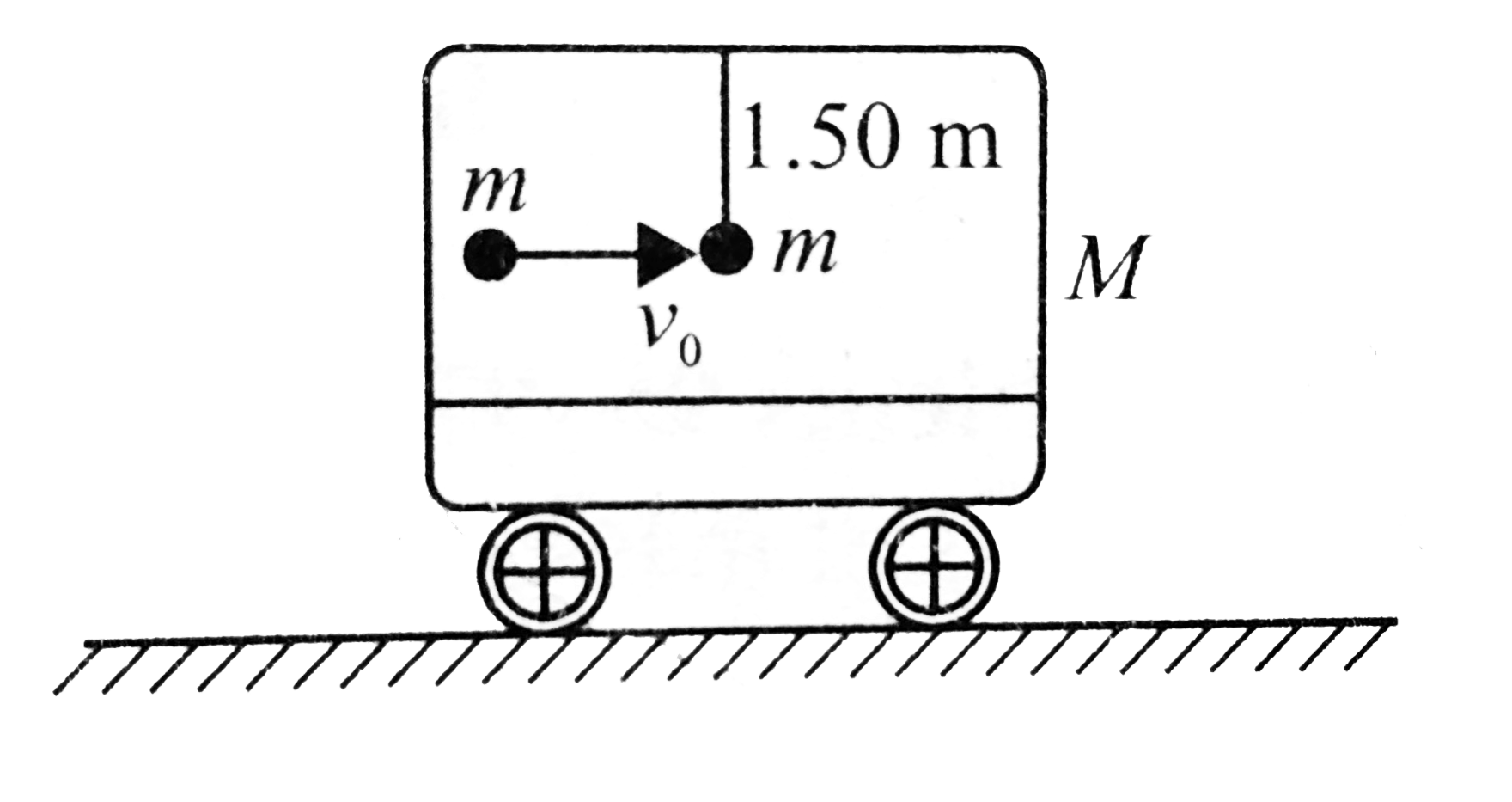
A ball of mass in `m= 1 kg` is hung vertically by a thread of length `l = 1.50 m`. Upper end of the thread is attached to the ceiling of a trolley of mass `M= 4 kg`. Initially, the trolley is stationary and it is free to move along horizontal rails without friction. A shell of mass `m=1` kg, moving horizontally with velocity `v_(0) = 6 m//s` collides with the ball and gets stuck with it. As a result, the thread starts to deflect towards right.

The velocity of the combined body just after collision is

A

`2m//s`

B

`3m//s`

C

`1m//s`

D

`4m//s`

Text Solution

Verified by Experts

The correct Answer is:

B

When shell strikes the ball and gets stuck with it, combined body of mass `2m` starts to move to the right, Let velocity of the combined body (just after collision) be `v_(1)`. According to law of conservation of momentum,
`(m+m) v_(1)=mv_(0)`
`v_(1)=(v_(0))/2=3m//s`
As soon as the combined body starts to move rig wards, thread becomes inclined to the vertical. Horizontal com tension retards the combined body while trolley accelerate rightwards due to the same component of tension.
Inclination of thread with the vertical continues to increase till velocities of both (combined body and trolley) become identical or combined body comes to rest relative to the trolley. Let velocity at that instant of maximum inclination of thread be `v`. according to law of conservation of momentum,
`(2m+M)v=2mv_(1)`
or `v=1m//s`
During collision of ball and shell, a part of energy is lost. But after that there is no loss of energy., Hence, after collision, kinetic energy lost is used up in increasing gravitational potential energy of the combined body.
If maximum inclination of threads with the vertical is `theta`, then according to law of conservation of energy.
`=1/2(2m)v_(1)^(2)-1/2(2m+M)v^(2)=2mg(l-lcostheta)`
`costheta=0.8` or `theta=37^(@)`
Promotional Banner

Topper's Solved these Questions

  • CENTRE OF MASS

    CENGAGE PHYSICS ENGLISH|Exercise Integer|16 Videos
  • CENTRE OF MASS

    CENGAGE PHYSICS ENGLISH|Exercise Fill In The Blanks|2 Videos
  • CENTRE OF MASS

    CENGAGE PHYSICS ENGLISH|Exercise Assertion - Reasoning|2 Videos
  • CALORIMETRY

    CENGAGE PHYSICS ENGLISH|Exercise Solved Example|13 Videos
  • DIMENSIONS & MEASUREMENT

    CENGAGE PHYSICS ENGLISH|Exercise Integer|2 Videos

Similar Questions

Explore conceptually related problems

A ball of mass in m= 1 kg is hung vertically by a thread of length l = 1.50 m . Upper end of the thread is attached to the ceiling of a trolley of mass M= 4 kg . Initially, the trolley is stationary and it is free to move along horizontal rails without friction. A shell of mass m=1 kg , moving horizontally with velocity v_(0 )= 6 m//s collides with the ball and gets stuck with it. As a result, the thread starts to deflect towards right. At the time of maximum deflection of the thread with vertical, the trolley will move with velocity

In the arrangements shown in the figure masses of each ball is 1 kg and mass of trolley is 4 kg . In the figure, shell of mass 1 kg moving horizontally with velocity v = 6 ms^(-1) collides with the ball and get stuck to it then its maximum deflection of the thread (length 1.5 m ) with vertical

A shell of mass 1kg is projected with velocity 20m//s at an angle 60^@ with horizontal. It collides inelastically with a ball of mass 1kg which is suspended through a thread of length 1m . The other end of the thread is attached to the ceiling of a trolley of mass 4/3kg as shown in figure. Initially the trolley is stationary and it is free to move along horizontal rails wihtout any friction. What is the maximum deflection of the thread with vertical? String does not slack. Take g=10m//s^2 .

A mass m moving horizontal (along the x-axis) with velocity v collides and sticks to mass of 3m moving vertically upward (along the y-axis) with velocity 2v . The final velocity of the combination is

A uniform rod of length l and mass 2 m rests on a smooth horizontal table. A point mass m moving horizontally at right angles to the rod with velocity v collides with one end of the rod and sticks it. Then

A uniform rod of length l and mass 2 m rests on a smooth horizontal table. A point mass m moving horizontally at right angles to the rod with velocity v collides with one end of the rod and sticks it. Then

what will be the wavelength of a ball of mass 0.1 kg moving with a velocity of 10 m s^(-1) ?

A ball weighing 4 kg and moving with velocity of 8 m/sec. Collides with a stationary ball of mass 12 kg. After the collision, the two balls move together. The final velocity is

A uniform rod of mass m and length / is hinged at upper end. Rod is free to rotate in vertical plane. A bail of mass m moving horizontally with velocity vo collides at lower end of rod perpendicular to it and sticks to it. The minimum velocity of the ball such that combined system just completes the vertical circle will be

A ball of mass 0.50 kg moving at a speed of 5.0 m/s collides with another ball of mas 1.0 kg. After the collision the balls stick together ane remain motionless. What was the velocity of the 1.0 kg block before the collision?

CENGAGE PHYSICS ENGLISH-CENTRE OF MASS-Linked Comprehension
  1. In the arrangement shown in Fig. the ball and the block have the same ...

    Text Solution

    |

  2. In the arrangement shown in Fig. the ball and the block have the same ...

    Text Solution

    |

  3. A ball of mass in m= 1 kg is hung vertically by a thread of length l =...

    Text Solution

    |

  4. A ball of mass in m= 1 kg is hung vertically by a thread of length l =...

    Text Solution

    |

  5. A ball of mass in m= 1 kg is hung vertically by a thread of length l =...

    Text Solution

    |

  6. Two balls of masses m(1)=100 g and m(2)=300 g are suspended from point...

    Text Solution

    |

  7. Two balls of masses m(1)=100 g and m(2)=300 g are suspended from point...

    Text Solution

    |

  8. Two identical blocks A and B each of mass 2 kg are hanging stationary ...

    Text Solution

    |

  9. Two identical blocks A and B each of mass 2 kg are hanging stationary ...

    Text Solution

    |

  10. Two identical blocks A and B each of mass 2 kg are hanging stationary ...

    Text Solution

    |

  11. A pan of mass m = 1.5 kg and a block of mass M = 3 kg are connected to...

    Text Solution

    |

  12. A pan of mass m = 1.5 kg and a block of mass M = 3 kg are connected to...

    Text Solution

    |

  13. A pan of mass m = 1.5 kg and a block of mass M = 3 kg are connected to...

    Text Solution

    |

  14. A pan of mass m = 1.5 kg and a block of mass M = 3 kg are connected to...

    Text Solution

    |

  15. A horizontal frictionless rod is threaded through a bead of mass m. Th...

    Text Solution

    |

  16. A horizontal frictionless rod is threaded through a bead of mass m. Th...

    Text Solution

    |

  17. A horizontal frictionless rod is threaded through a bead of mass m. Th...

    Text Solution

    |

  18. An initially stationary box on a frictionless floor explodes into two ...

    Text Solution

    |

  19. An initially stationary box on a frictionless floor explodes into two ...

    Text Solution

    |

  20. A circular disc of mass '2m' and radius '3r' is resting on a flat fric...

    Text Solution

    |
