Home
Class 11
PHYSICS
Two balls of masses m(1)=100 g and m(2)=...

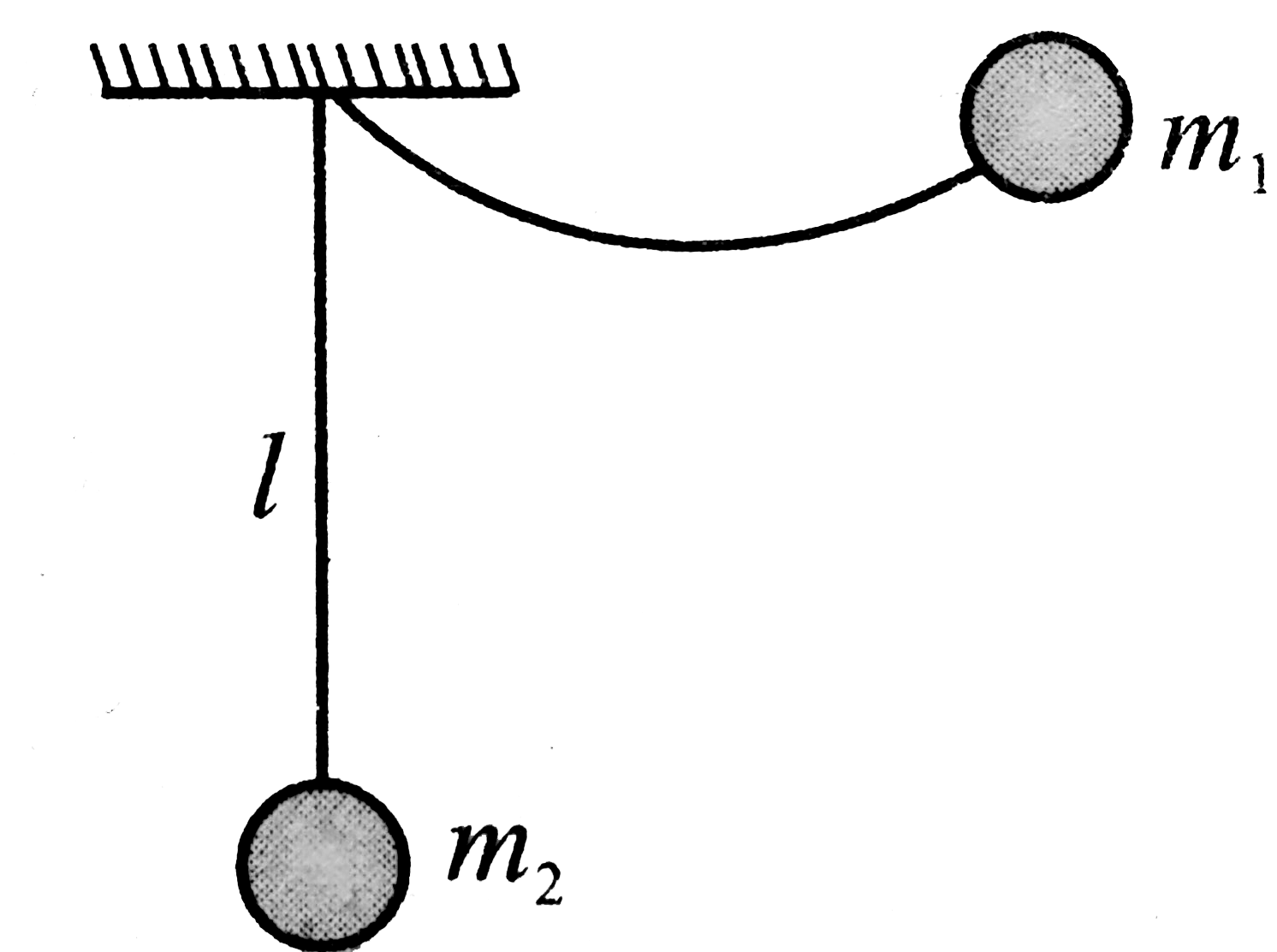
Two balls of masses `m_(1)=100 g` and `m_(2)=300 g` are suspended from point `A` by two equal inextensible threads, each of length `l=32/35m`. Ball of mass `m_(1)` is drawn aside and held at the same level as `A` but at a distance `(sqrt(3)/2)l` from `A`, as shown in Fig. When ball `m_(1)` is released, it collides elastically with the stationary ball of mass `m_(2)`.
The maximum rise of centre of mass of the ball of mass `m_(2)` is

A

a. `0.20m`

B

b. `0.50 m`

C

c. `0.75 m`

D

d. `1m`

Text Solution

Verified by Experts

The correct Answer is:
A

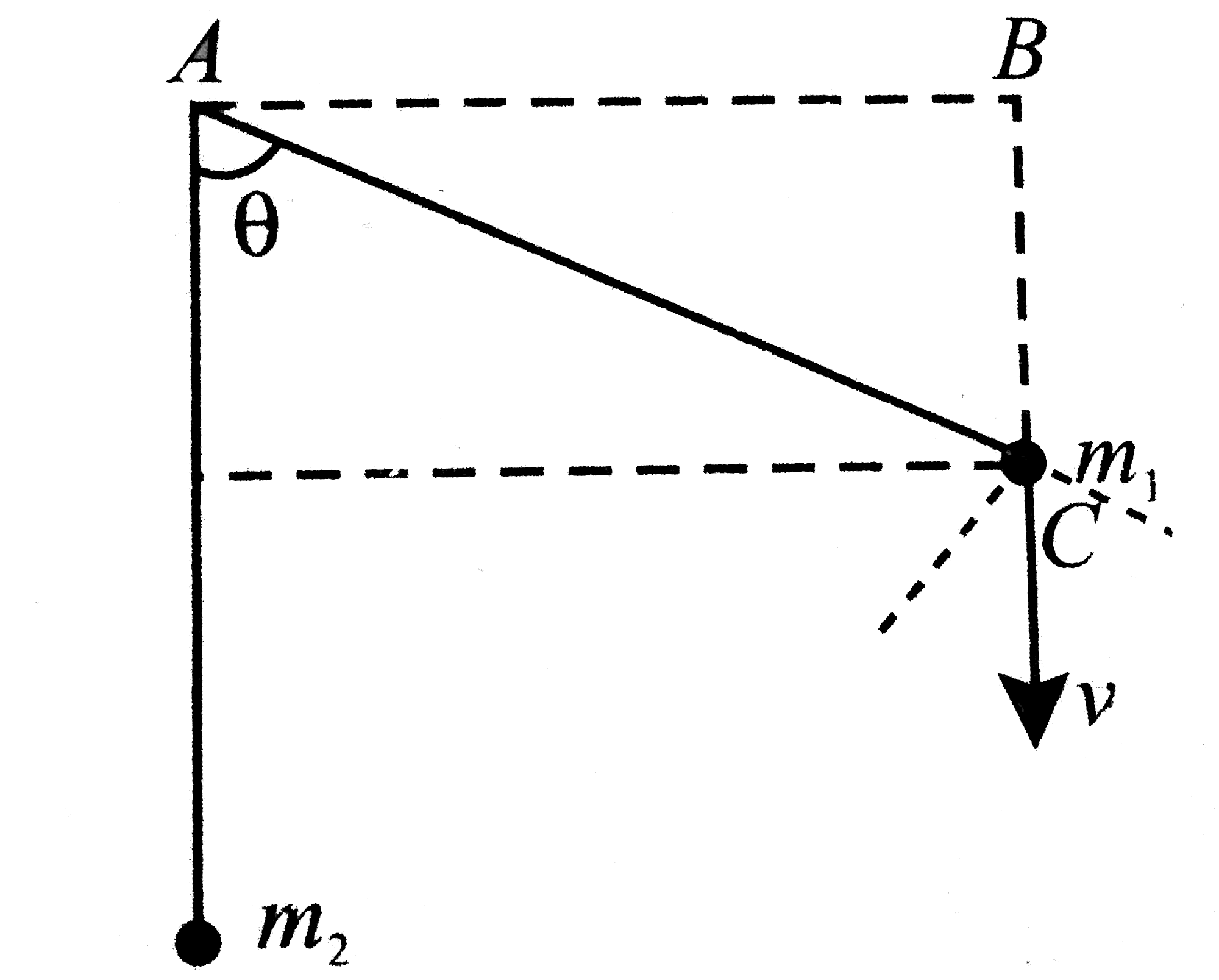
Ball of mass `m_(1)` falls freely till thread becomes taut. At that instant inclination `theta` of the thread with the vertical be given by
`sintheta=(((sqrt(3))/2l))/l=(sqrt(3))/2` or `theta=60^(@)`
Ball of mass `m_(1)` falls freely through height.

Velocity of this ball at this instant is `v=sqrt(2gxxl/2)=sqrt(gl)`
It can be resolved into two components.
i. `v cos theta`, along the thread. But thread is inextensible, hence this component decreases to zero (due to tension developed in the thread).
ii. `v sin theta`, perpendicular to the thread. Due to this component ball starts to move along a circle whose centre is at `A`.
According to law of conservation of energy,
Kinetic energy of ball `m_(1)` just before collision `=` Its kinetic energy at `AC +` Further loss of its potential energy
`1/2m_(1)u_(1)^(2)=1/2m_(1) (sqrt(gl)sintheta)^(2)+m_(1)g(l-lcostheta)`
`u_(1)=4m//s`
According to law of conservation of momentums
`m_(1)v_(1)+m_(2)v_(2)=m_(1)u_(1)+m_(2)u_(2)`
and coefficient of restitution `e=(v_(2)-v_(1))/(u_(2)-u_(1))=1`
substituting `u_(1)=4 m//s, u_(2)=, m_(1)=0.1 kg` and `m_(2)=0.3kg, v_(2)=2m//s,` the height to which it rises is
`h=v_(2)^(2)/(2g)=0.20m`
Promotional Banner

Topper's Solved these Questions

  • CENTRE OF MASS

    CENGAGE PHYSICS ENGLISH|Exercise Integer|16 Videos
  • CENTRE OF MASS

    CENGAGE PHYSICS ENGLISH|Exercise Fill In The Blanks|2 Videos
  • CENTRE OF MASS

    CENGAGE PHYSICS ENGLISH|Exercise Assertion - Reasoning|2 Videos
  • CALORIMETRY

    CENGAGE PHYSICS ENGLISH|Exercise Solved Example|13 Videos
  • DIMENSIONS & MEASUREMENT

    CENGAGE PHYSICS ENGLISH|Exercise Integer|2 Videos

Similar Questions

Explore conceptually related problems

Two balls of masses m_(1)=100 g and m_(2)=300 g are suspended from point A by two equal inextensible threads, each of length l=32/35m . Ball of mass m_(1) is drawn aside and held at the same level as A but at a distance (sqrt(3)/2)l from A , as shown in Fig. When ball m_(1) is released, it collides elastically with the stationary ball of mass m_(2) . Velocity u_(1) with which the hall of mass m_(1) collides with the other ball is

A ball of mass m=200gm is suspended from a point A by an inextensible string of length L . Ball is drawn to a side and held at same level as A but at a distance (sqrt(3))/(2)L from A as shown. Now the ball is released. Then : ( assume string applies only that much jerk which is required so that velocity along string becomes zero ) .

A body of mass M_(1) collides elastically with another mass M_(2) at rest. There is maximum transfer of energy when :

A ball of mass M moving with speed v collides perfectly inelastically with another ball of mass m at rest. The magnitude of impulse imparted to the first ball is

A ball of mass M moving with speed v collides perfectly inelastically with another ball of mass m at rest. The magnitude of impulse imparted to the first ball is

A ball of mass M moving with speed v collides perfectly inelastically with another ball of mass m at rest. The magnitude of impulse imparted to the first ball is

A body of mass m_(1) collides elastically with a stationary body of mass m_(2) and returns along the same line with one fourth of its initial speed, then m_(1)//m_(2)=

A ball of mass m_(1) is moving with velocity 3v. It collides head on elastically with a stationary ball of mass m_(2) . The velocity of both the balls become v after collision. Then the value of the ratio (m_(2))/( m_(1)) is

A spherical ball of mass m_(1) collides head on with another ball of mass m_(2) at rest . The collision is elastic . The fraction of kinetic energy lost by m_(1) is :

A ball of mass m collides with a stationary identical ball a speed v_(0) . Find the impulse of the colliding balls (e=1//2) .

CENGAGE PHYSICS ENGLISH-CENTRE OF MASS-Linked Comprehension
  1. A ball of mass in m= 1 kg is hung vertically by a thread of length l =...

    Text Solution

    |

  2. Two balls of masses m(1)=100 g and m(2)=300 g are suspended from point...

    Text Solution

    |

  3. Two balls of masses m(1)=100 g and m(2)=300 g are suspended from point...

    Text Solution

    |

  4. Two identical blocks A and B each of mass 2 kg are hanging stationary ...

    Text Solution

    |

  5. Two identical blocks A and B each of mass 2 kg are hanging stationary ...

    Text Solution

    |

  6. Two identical blocks A and B each of mass 2 kg are hanging stationary ...

    Text Solution

    |

  7. A pan of mass m = 1.5 kg and a block of mass M = 3 kg are connected to...

    Text Solution

    |

  8. A pan of mass m = 1.5 kg and a block of mass M = 3 kg are connected to...

    Text Solution

    |

  9. A pan of mass m = 1.5 kg and a block of mass M = 3 kg are connected to...

    Text Solution

    |

  10. A pan of mass m = 1.5 kg and a block of mass M = 3 kg are connected to...

    Text Solution

    |

  11. A horizontal frictionless rod is threaded through a bead of mass m. Th...

    Text Solution

    |

  12. A horizontal frictionless rod is threaded through a bead of mass m. Th...

    Text Solution

    |

  13. A horizontal frictionless rod is threaded through a bead of mass m. Th...

    Text Solution

    |

  14. An initially stationary box on a frictionless floor explodes into two ...

    Text Solution

    |

  15. An initially stationary box on a frictionless floor explodes into two ...

    Text Solution

    |

  16. A circular disc of mass '2m' and radius '3r' is resting on a flat fric...

    Text Solution

    |

  17. A circular disc of mass '2m' and radius '3r' is resting on a flat fric...

    Text Solution

    |

  18. A circular disc of mass '2m' and radius '3r' is resting on a flat fric...

    Text Solution

    |

  19. Two blocks of masses m(1) and m(2) are connected by an ideal sprit, of...

    Text Solution

    |

  20. Two blocks of masses m(1) and m(2) are connected by an ideal sprit, of...

    Text Solution

    |

