Home
Class 11
PHYSICS
A block of mass m is connected to anothe...

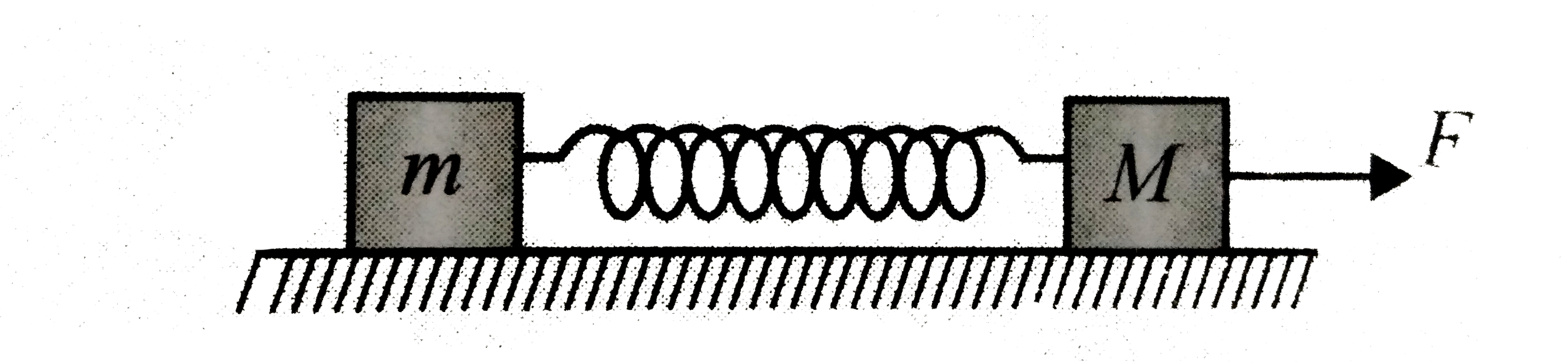
A block of mass `m` is connected to another block of mass `M` by a massless spring of spring constant `k`. the blocks are kept of a smooth horizontal plane and are at rest. The spring is unstretched when a constant force `F` starts acting on the block of mass `M` of pull it. Find the maximum extension of the spring

A

`(2m_(1)F)/((m_(1)+m_(2))k)`

B

`(m_(1)^(2)F)/(2(m_(1)+m_(2))k)`

C

`(2m_(2)F)/(k(m_(1)+m_(2)))`

D

`(m_(2)^(2)F)/(2(m_(1)+m_(2))^(2)k`

Text Solution

Verified by Experts

The correct Answer is:
C


`x_(1)+x_(2)=x` ………..i
`(F-m_(1)a_(cm))x_(1)+m_(2)a_(cm).x_(2)-1/2kx^(2)=0`…….ii
where `a_(cm)=F/(m_(1)+m_(2))`………….iii
solve get answer.
Promotional Banner

Topper's Solved these Questions

  • CENTRE OF MASS

    CENGAGE PHYSICS ENGLISH|Exercise Integer|16 Videos
  • CENTRE OF MASS

    CENGAGE PHYSICS ENGLISH|Exercise Fill In The Blanks|2 Videos
  • CENTRE OF MASS

    CENGAGE PHYSICS ENGLISH|Exercise Assertion - Reasoning|2 Videos
  • CALORIMETRY

    CENGAGE PHYSICS ENGLISH|Exercise Solved Example|13 Videos
  • DIMENSIONS & MEASUREMENT

    CENGAGE PHYSICS ENGLISH|Exercise Integer|2 Videos

Similar Questions

Explore conceptually related problems

A block of mass m is connect to another block of mass M by a massless spring of spring constant k. The blocks are kept on a smooth horizontal plane. Initially the blocks are at rest and the spring is upstretched when a constant force F starts acting on the block of mass M to pull it. Find the maximum extension of the spring.

A block of mass m is connect to another block of mass M by a massless spring of spring constant k. The blocks are kept on a smooth horizontal plane. Initially the blocks are at rest and the spring is unsrtretched when a constnt force F starts acting on the block of mass M to pull it. Find the maximum extension of the spring.

A block of mass 'm' is connected to another block of mass 'M' by a spring (massless) of spring constant 'k' The blocks are kept on a smooth horizontal plane. Initially the blocks are at rest and the spring is unstretched Then a constant force 'F' starts acting on the block of mass 'M' to pull it. Find the force on the block of mass 'm' :

A block of mass m is connected to another .block of mass M by a massless spring of spring constant k. A constant force f starts action as shown in figure, then:

A block of mass m is connected to another block of mass M by a massless spring of spring constant K . Blocks are kept on a smooth horizontal plane. Initally both the blocks the at rest and spring is unstressed. Force F is applied on M to right as shownin the figure then which of the following is correct ?

A block of mass m suspended from a spring of spring constant k . Find the amplitude of S.H.M.

A block of mass m is attached to one end of a mass less spring of spring constant k. the other end of spring is fixed to a wall the block can move on a horizontal rough surface. The coefficient of friction between the block and the surface is mu then the compession of the spring for which maximum extension of the spring becomes half of maximum compression is .

Two blocks of masses 3kg and 6kg respectivley are placed on a smooth horizontal surface. They are connected by a light spring of force constant k=200N//m . Initially the spring is unstretched. The indicated velocities are imparted to the blocks. Find the maximum extension of the spring.

Two blocks of masses 3kg and 6kg respectivley are placed on a smooth horizontal surface. They are connected by a light spring of force constant k=200N//m . Initially the spring is unstretched. The indicated velocities are imparted to the blocks. Find the maximum extension of the spring.

A block of mass m having charge q is attached to a spring of spring constant k . This arrangement is placed in uniform electric field E on smooth horizontal surface as shown in the figure. Initially spring in unstretched. Find the extension of spring in equilibrium position and maximum extension of spring.

CENGAGE PHYSICS ENGLISH-CENTRE OF MASS-Linked Comprehension
  1. A horizontal frictionless rod is threaded through a bead of mass m. Th...

    Text Solution

    |

  2. A horizontal frictionless rod is threaded through a bead of mass m. Th...

    Text Solution

    |

  3. An initially stationary box on a frictionless floor explodes into two ...

    Text Solution

    |

  4. An initially stationary box on a frictionless floor explodes into two ...

    Text Solution

    |

  5. A circular disc of mass '2m' and radius '3r' is resting on a flat fric...

    Text Solution

    |

  6. A circular disc of mass '2m' and radius '3r' is resting on a flat fric...

    Text Solution

    |

  7. A circular disc of mass '2m' and radius '3r' is resting on a flat fric...

    Text Solution

    |

  8. Two blocks of masses m(1) and m(2) are connected by an ideal sprit, of...

    Text Solution

    |

  9. Two blocks of masses m(1) and m(2) are connected by an ideal sprit, of...

    Text Solution

    |

  10. A block of mass m is connected to another block of mass M by a massles...

    Text Solution

    |

  11. A small ball B of mass m is suspended with light inelastic string of l...

    Text Solution

    |

  12. A small ball B of mass m is suspended with light inelastic string of l...

    Text Solution

    |

  13. A small ball B of mass m is suspended with light inelastic string of l...

    Text Solution

    |

  14. A small ball B of mass m is suspended with light inelastic string of l...

    Text Solution

    |

  15. A small ball of mass 1 kg is kept in circular path of radius 1 m Insid...

    Text Solution

    |

  16. A small ball of mass 1 kg is kept in circular path of radius 1 m Insid...

    Text Solution

    |

  17. A small ball of mass 1 kg is kept in circular path of radius 1 m Insid...

    Text Solution

    |

  18. Three balls A, B and C(m(A)=m(C)=4m(B)) are placed onn a smooth horizo...

    Text Solution

    |

  19. A man standing on a trolley pushes another identical a trolley (both t...

    Text Solution

    |

  20. A particle with a mass of 1 kg a velocity of is having 10 m//s in +ve...

    Text Solution

    |

