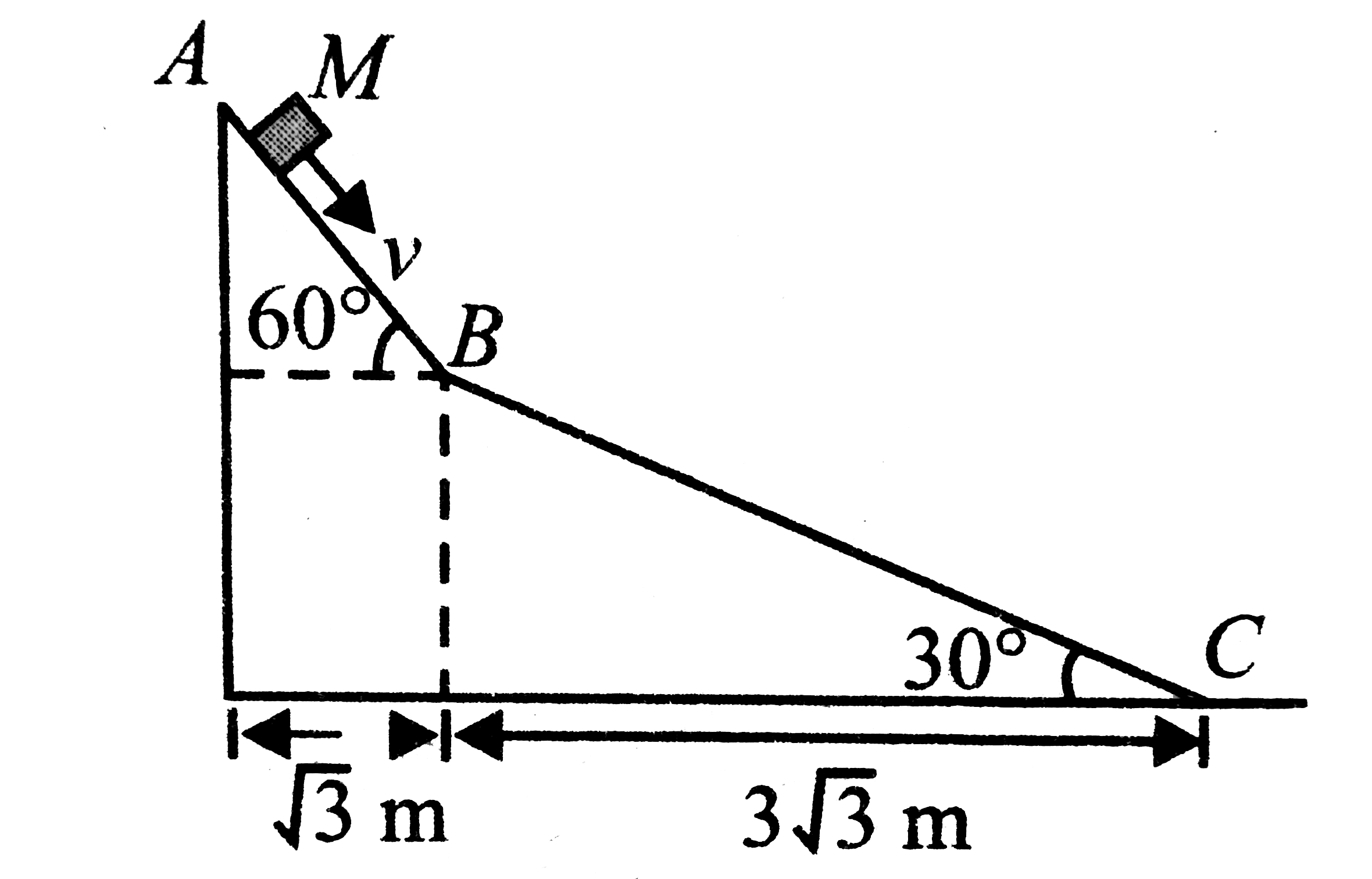
A small block of mass `M` moves on a friction-less surface of an inclined plane, as shown in the figure. The angle of the incline suddenly changes from `60^(@)` to `30^(@)` at point `B`. The block is initially at rest at `A`. If collision between the block and the incline is completely elastic, then the vertical (upward) component of the velocity of the blocks at point `B`, immediately after it strikes the second incline is
A
`sqrt(30) m//s`
B
`sqrt(15) m//s`
C
0
D
`-sqrt(15) m//s`
Text Solution
Verified by Experts
The correct Answer is:
C
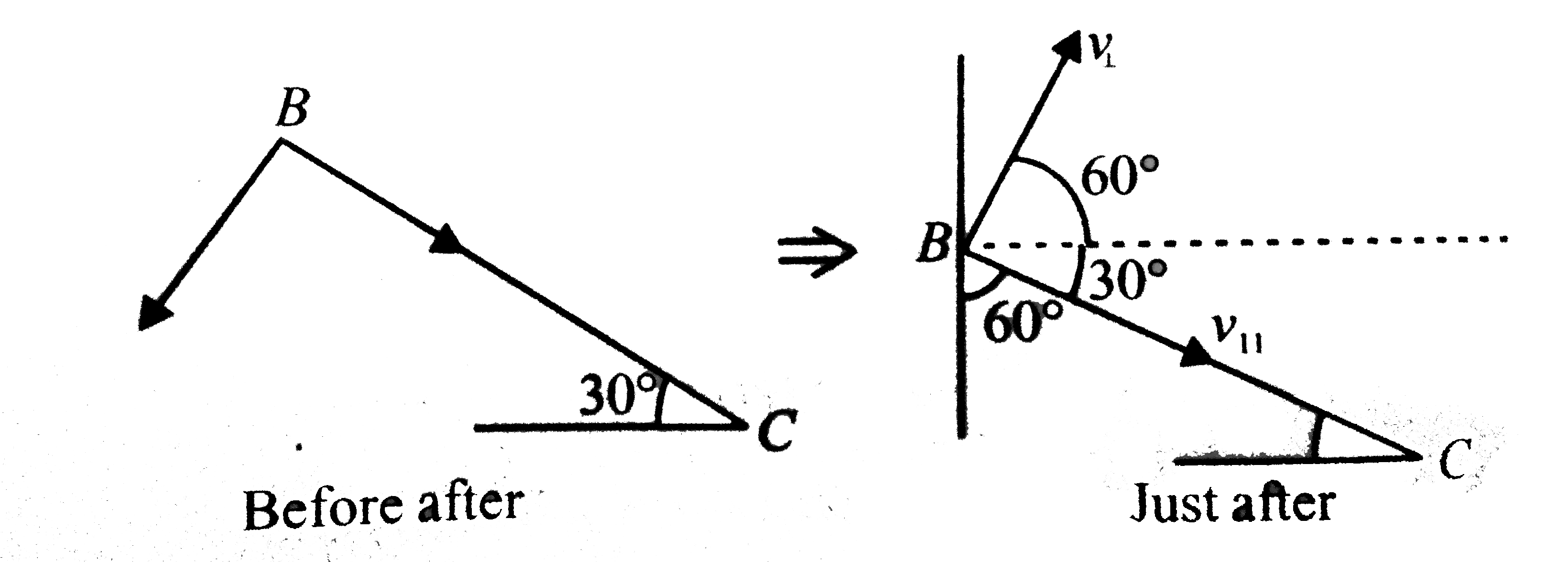
In elastic collision, component of `v_(1)` parallel to `BC` will remailn unchanged, while component perpendicular to `BC` will remain unchanged in magnitude but its direction will be reversed. `v_(||) =v_(1)cos30^(@)=(sqrt60)(1/2)=sqrt(15)m//s` Now the vertical component of velocity of the block `v'=v_(_|_)cos30^(@)-v_(||)cos60^(@)` `=(sqrt(15))((sqrt(3))/2)-(sqrt(45))(1/2)=0`
A small block of mass M moves on a frictionless surface of an inclined plane, as shown in the figure. The angle of the incline suddenly changes from 60^(@) to 30^(@) at point B . The block is many at rest at A . Assume that collisions between the block id the incline are totally inelastic. The speed of the block at point B immediately after it strikes the second incline is
A small block of mass M moves on a frictionless surface of an inclined plane, as shown in the figure. The angle of the incline suddenly changes from 60^(@) to 30^(@) at point B . The block is many at rest at A . Assume that collisions between the block id the incline are totally inelastic. The speed of the block at point C , immediately before it leaves the second incline
A small block of mass M move on a frictionless surface of an inclimed from as down is figure . The engle of the inclime suddenly change from 60^(@) to 30^(@) at point B . The block is initally at rest at A Assume the collsion between the block and the incline are totally inclassic (g = 10m//s^(2) ) If collision between the block and the incline is completely elestic , then the vartical (apward) component of the of the block at point B immediatly after it stricess the scond indine is -
A block of mass 3kg is at rest on a rough inclined plan as shown in the Figure. The magnitude of net force exerted by the surface on the block will be
A block of mass m is kept on an inclined plane is angle inclination theta ( lt phi), where phi= angle of friction. Then :
A block of mass 5 kg is at rest on a rough inclined surface. If angle of inclination of plane is 60^(@) , then force applied by it on block is
A block of mass m moves with constant speed down the inclined plane of inclination theta . Find the coefficient of kinetic friction.
In fig Block m_(2) is loaded on block m_(1) . If there is no relative sliding between the block and the inclined plane is smooth , find the friction force between the block
A block of mass m is at rest on an inclined plane. The coefficient of static friction is mu . The maximum angle of incline before the block begins to slide down is :
A block rests on a rough inclined plane making an angle of 30^(@) with horizontal. The coefficient of static friction between the block and inclined plane is 0.8 . If the frictional force on the block is 10 N , the mass of the block in kg is (g = 10 m//s^(2))