Home
Class 11
PHYSICS
A hoop of mass m is projected on a floor...

A hoop of mass `m` is projected on a floor with linear velocity `v_(0)` and reverse spin `omega_(0)`. The coefficient of friction between the hoop and the ground is `mu`.
a. Under what condition will the hoop return back?
b. How far will it go?
c. How long will it continue to slip when its centre of mass becomes stationary?
d. What is the velocity of return?

Text Solution

Verified by Experts
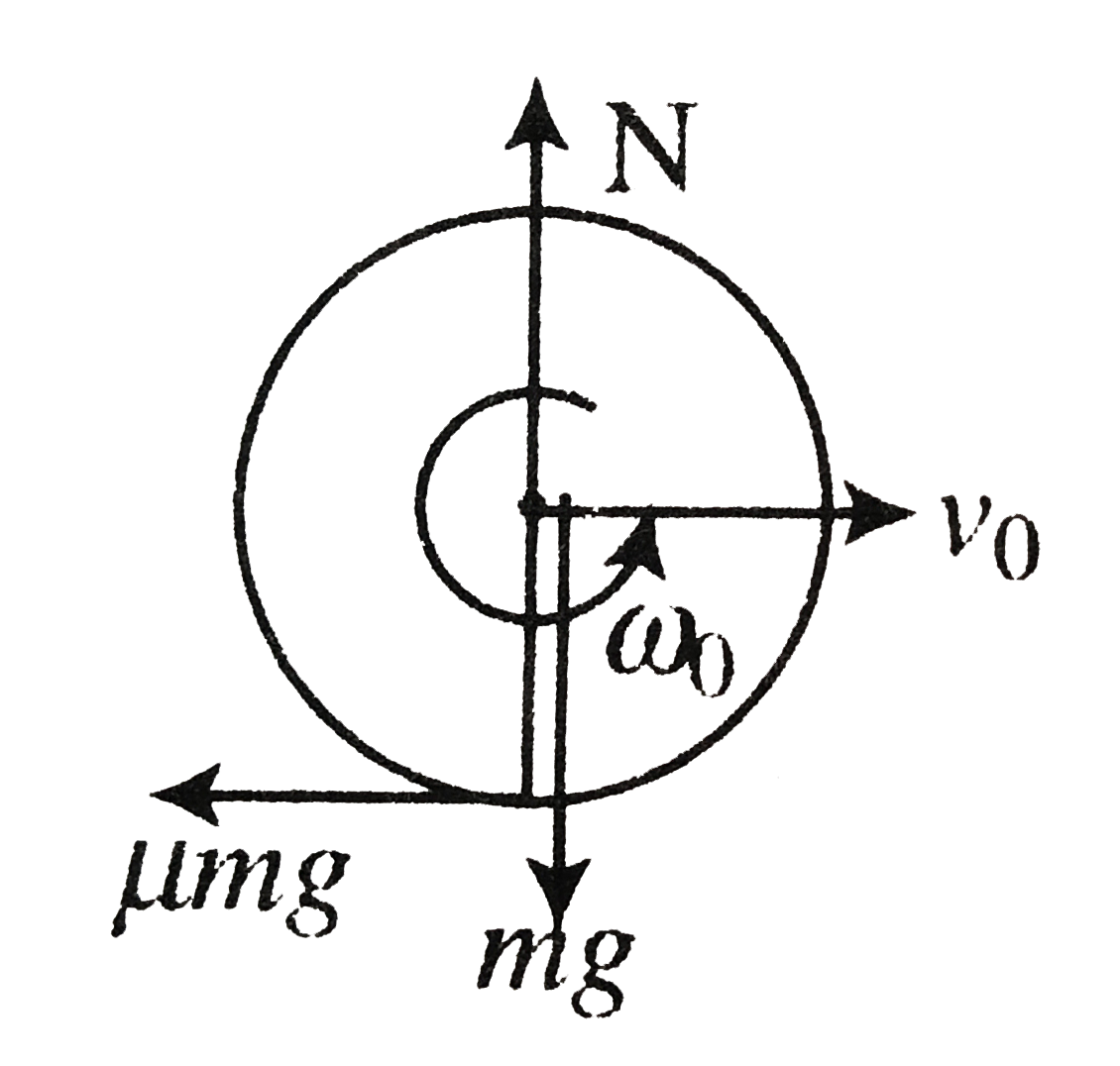
a. The acceleration of hoop, `a=-mug`
Angular acceleration of wheel `=(mg)/R`
Linear velocity at time `t, v=v_(0)-mu"gt"`……….i
Angular velocity at time `omega=omega_(0)-(mg)/Rt`…….ii
Let linear velocity be zero at `t`
So, `0=v_(0)-mu"gt"` or `t_(1)=(v_(0))/(mg)`

Angular velocity of the ring at `t` is
`omega=omega_(0)-((mug)/R)((v_(0))/(mug))=omega_(0)-(v_(0))/R`.......iii
The hoop will return if it has reverse spin at the instant its linear velocity is zero. So the condition for hop to return is
`omega_(0)-(v_(0))/Rgt0` or `omega_(0)gt(v_(0))/R`
b. Let `t_(2)` be the time up to which the hoop slips on the floor and `v` be the return velocity.
Then `v=mu"gt"_(2)` and `omega' =omega-(mug)/Rt_(2)`
For no slip condition is achieved when
`(mug)/Rt_(2)=omega-(mug)/Rt_(2)implies(2mug)/Rt_(2)=omega`......iv
From eqn iii and iv `(2mug)/Rt_(2)=omega=omega_(0)-(v_(0))/R`
or `t_(2)=R/(2mug)(omega_(0)-(v_(0))/R)`
c. `V=mug t_(2)=(omega_(0)R)/2-(v_(0))/2`
Promotional Banner

Topper's Solved these Questions

  • RIGID BODY DYNAMICS 2

    CENGAGE PHYSICS ENGLISH|Exercise Exercise 3.1|11 Videos
  • RIGID BODY DYNAMICS 2

    CENGAGE PHYSICS ENGLISH|Exercise Exercise 3.2|13 Videos
  • RIGID BODY DYNAMICS 2

    CENGAGE PHYSICS ENGLISH|Exercise Interger|2 Videos
  • RIGID BODY DYNAMICS 1

    CENGAGE PHYSICS ENGLISH|Exercise Integer|11 Videos
  • SOUND WAVES AND DOPPLER EFFECT

    CENGAGE PHYSICS ENGLISH|Exercise Integer|16 Videos

Similar Questions

Explore conceptually related problems

A body of mass m is pushed with the initial velocity v_(0) up an inclined plane of angle of inclination theta . The co-efficient or friction between the body and the plane is mu . What is the net work done by fnction during the ascent of the body before it comes to stop ?

The block of mass m is kept on plank of mass M. The block is given velocity V_(0) as shown. The coefficient of friction between the block of mass m and plank of mass M is mu and its value is such that block becomes stationary with respect to plank before it reaches the other end. Then:

A block of mass m is projected up with a velocity v_0 along an inclined plane of angle of inclination theta=37^@ . The coefficient of friction between the inclined plane AB and blocks is mu(=tan theta) . Find the values of v_0 so that the block moves in a circular path from B to C.

A plank of mass M and length L is placed at rest on a smooth horizontal surface. A small block of mass m is projected with a velocity v_0 from the left end of it as shown in figure. The coefficient of friction between the block and the plank is m, and its value is such that the block becomes stationary with respect to the plank before it reaches the other end. a. Find the time and common velocity when relative sliding between the block and the plank stops. b. Find the work done by the friction force on the block during the period it slides on the plank. Is the work positive or negative? c. Calculate the work done on the plank during the same period. Is the work positive or negative? d. Also, determine the net work done by friction, Is it positive or negative?

A small block of mass m is projected on a larger block of mass 10 m and length l with a velocity v as shown in the figure. The coefficient of friction between the two block is mu_(2) while that between the lower block and the ground is mu_(1) . Given that mu_(2) gt 11 mu_(1) . (a) Find the minimum value of v , such that the mass m falls off the block of mass 10 m . (b) If v has minimum value, find the time taken by block m to do so.

The mass of a hoop of radius 0.30 m is 2kg. It rolls along a horizontal floor so that its centre of mass has a speed of 2 m/s. What is the work done to stop it ?

A block mass m = 2 kg is moving with velocity v_(0) towards a mass less unstretched spring of the force constant k = 10 N//m . Coefficient of friction between the block and the ground is mu = 0.2 . Find the maximum value of v_(0) so that after pressing the spring the block does not return back but stops there permanently.

A block of mass m is pushed with a velocity v_(0) along the surface of a trolley car of mass M . If the horizontal ground is smooth and the coefficient of kinetic friction between the block of plank is mu . Find the minimum distance of relative sliding between the block and plank.

On a stationary block of mass 2kg a horizontal forces F starts acting at t = 0 whose veriation with time is shown in figure .The coefficient of friction between the block and ground is 0.5 New answer the following question Find the velocity of the block when for the firsst time its acceleration become zero

A bullet of mass 50g moving with velocity 600m//s hits block of mass 1.0kg placed on a rough horizontal ground and comes out of the block with a velocity of 400m//s . The coefficient of friction between the block and the ground is 0.25 . Neglect loss of mass of the block as the bullet pierces through it. (a) In spite of the fact that friction acts a an external force, can you apply principle of conservation of momentum during interaction of the ullet with the block? (b) Find velocity of the block immediately after the bullet pierces through it. (c)FInd the distance the block will travel before it stops.

