Home
Class 11
PHYSICS
A smooth uniform rod of length L and mas...

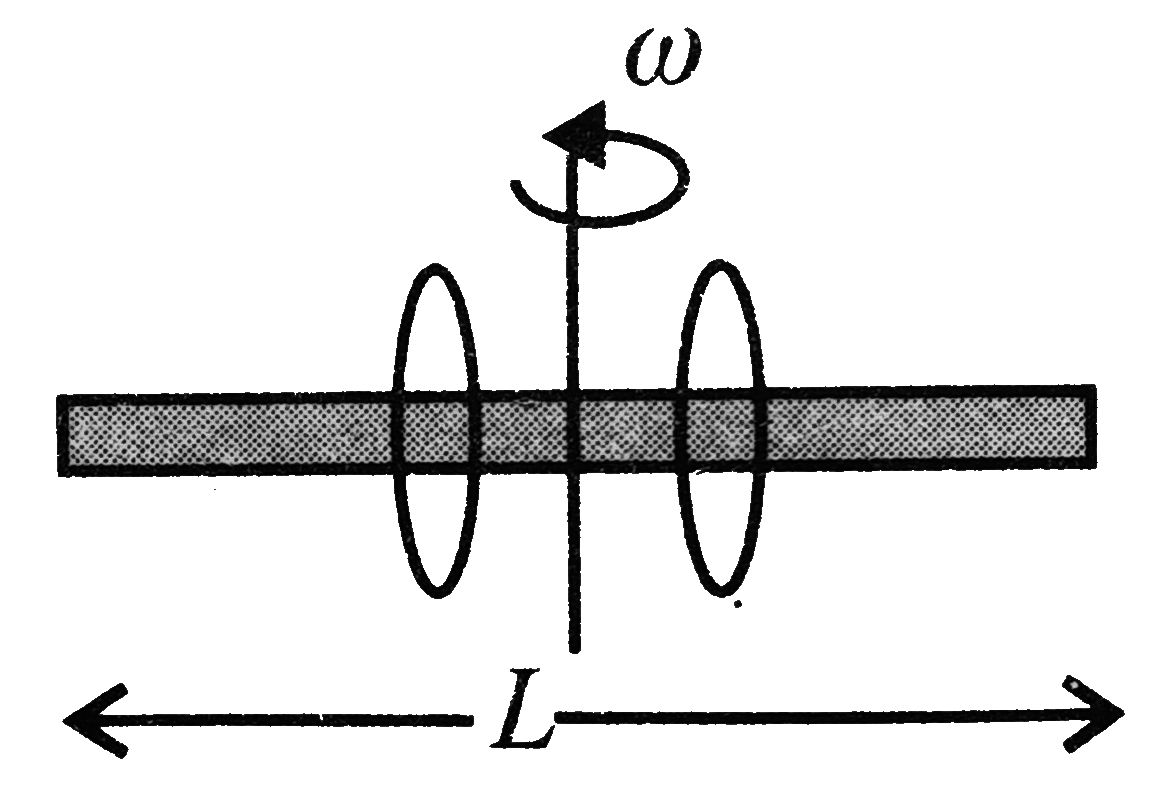
A smooth uniform rod of length `L` and mass `M` has two identical beads (`1` and `2`) of negligible size, each of mass `m`, which can slide freely along the rod. Initially the two beads are at the centre of the rod and the system is rotating with angular velocity `omega_(0)` about an axis perpendicular to the rod and is passing through its midpoint. There are no external forces when the beads reach the ends of the rod, the angular velocity of the system is

Text Solution

Verified by Experts

Since no force and hence no torque is applied,the angular momentum remains constant.
`:. I_(1)omega_(1)=I_(2)omega_(2)`
`:. omega_(2)=(I_(1)omega_(1))/I_(2)`
`=((ML^(2))/12xxomega_(0))/((ML^(2))/12+2mxx(L/2)^(2))=(Momega_(0))/(M+6m)`
Promotional Banner

Topper's Solved these Questions

  • RIGID BODY DYNAMICS 2

    CENGAGE PHYSICS ENGLISH|Exercise True/False|4 Videos
  • RIGID BODY DYNAMICS 2

    CENGAGE PHYSICS ENGLISH|Exercise SCQ_TYPE|29 Videos
  • RIGID BODY DYNAMICS 2

    CENGAGE PHYSICS ENGLISH|Exercise Integer|7 Videos
  • RIGID BODY DYNAMICS 1

    CENGAGE PHYSICS ENGLISH|Exercise Integer|11 Videos
  • SOUND WAVES AND DOPPLER EFFECT

    CENGAGE PHYSICS ENGLISH|Exercise Integer|16 Videos

Similar Questions

Explore conceptually related problems

A smooth uniform rod of length L and mass M has two identical beads of negligible size each of mass m which can slide freely along the rod. Initially the two beads are at the centre of the rod and the system is rotating with an angular velocity omega_0 about an axis perpendicular to the rod and passing through the midpoint of the rod. There are no external forces. When the beads reach the ends of the rod, the angular velocity of the system is ......

In the figure, a ball of mass m is tied with two strings of equal as shown. If the rod is rotated with angular velocity omega_(1) when

A light rod of length l has two masses m_1 and m_2 attached to its two ends. The moment of inertia of the system about an axis perpendicular to the rod and passing through the centre of mass is.

A rod of length l rotates with a small but uniform angular velocity omega about its perpendicular bisector. A uniform magnetic field B exists parallel to the axis of rotation. The potential difference between the centre of the rod and an end is

Calculate the moment of inertia of a rod of mass M, and length l about an axis perpendicular to it passing through one of its ends.

A thin smooth rod of length L and mass M is rotating freely with angular speed omega_(0) about an axis perpendicular ot the rod and passing through its centre. Two beads of mass m and negligible sizer are at the center of the rod intially. The beads are free to slide along the rod. the angular speed of the system, when the beads reach the oppsite ends of rod, will be :

Two particles , each of mass m and charge q , are attached to the two ends of a light rigid rod of length 2 R . The rod is rotated at constant angular speed about a perpendicular axis passing through its centre. The ratio of the magnitudes of the magnetic moment of the system and its angular momentum about the centre of the rod is

Two particles , each of mass m and charge q , are attached to the two ends of a light rigid rod of length 2 R . The rod is rotated at constant angular speed about a perpendicular axis passing through its centre. The ratio of the magnitudes of the magnetic moment of the system and its angular momentum about the centre of the rod is

A uniform rod of mass m and length l rotates in a horizontal plane with an angular velocity omega about a vertical axis passing through one end. The tension in the rod at a distance x from the axis is

Moment of inertia of a thin rod of mass m and length l about an axis passing through a point l/4 from one end and perpendicular to the rod is
