Home
Class 11
PHYSICS
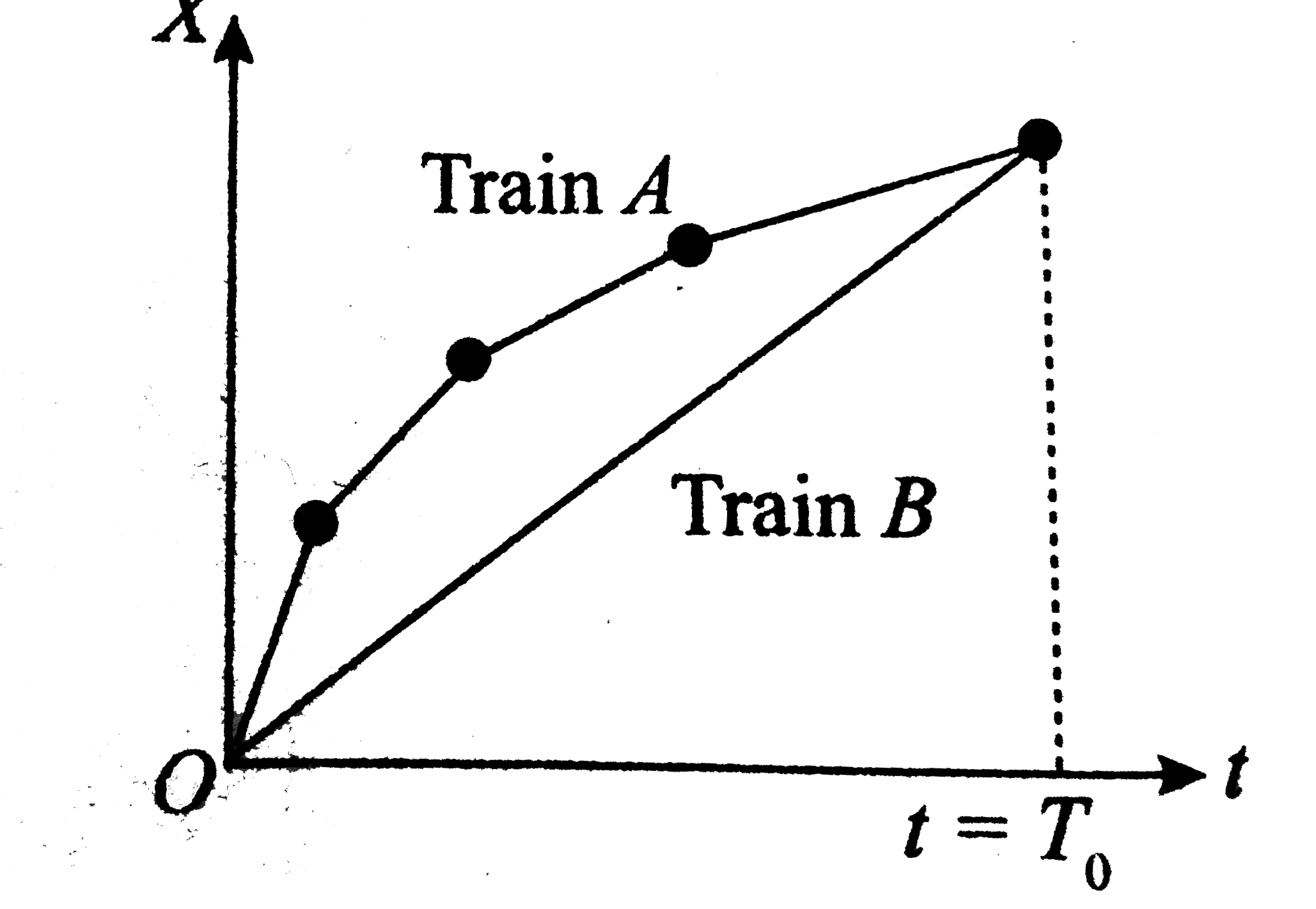
The plot shows the position (x) as a fun...

The plot shows the position (`x`) as a function of time (`t`) for two trains that run on a parallel track. Train `A` is next to train `B` at `t=0` and at `t=T_(0)`.

A

At `T_(0)` both the trains have the same velocity.

B

Both the trains speed up all the times.

C

Both trains have the same velocity at some time before `T_(0)`.

D

At `T_(0)` the trains have covered different distances

Text Solution

Verified by Experts

The correct Answer is:

C

Initially slope of `A` is more than `B` and initially finally slope of `A` is less. So speed of `A` is initially more than finally less than `B`. So somewhere in between their speeds become the same.
Promotional Banner

Topper's Solved these Questions

  • MISCELLANEOUS VOLUME 2

    CENGAGE PHYSICS ENGLISH|Exercise MCQ_TYPE|20 Videos
  • MISCELLANEOUS VOLUME 2

    CENGAGE PHYSICS ENGLISH|Exercise LC_TYPE|34 Videos
  • MISCELLANEOUS KINEMATICS

    CENGAGE PHYSICS ENGLISH|Exercise Interger type|3 Videos
  • NEWTON'S LAWS OF MOTION 1

    CENGAGE PHYSICS ENGLISH|Exercise Integer|5 Videos

Similar Questions

Explore conceptually related problems

The graph given show the position of two cars A and B as a function of time. The cars move along the x axis on parallel but separate tracks, so that they can pass each other's position without colliding. At time t_(3) which car is moving faster?

The figure shows the velocity (v) of a particle plotted against time (t).

The figure shows the velocity (v) of a particle plotted against time (t).

The displacement s of an object is given as a function of time t s=5t^(2)+9t Calculate the instantaneous velocity of object at t = 0.

An object is moving in the x-y plane with the position as a function of time given by vecr = x(t)hati + y(t)hatj . Point O is at x = 0 , y = 0 . The object is definitely moving towards O when

The instantaneous velocity of a particle moving in a straight line is given as a function of time by: v=v_0 (1-((t)/(t_0))^(n)) where t_0 is a constant and n is a positive integer . The average velocity of the particle between t=0 and t=t_0 is (3v_0)/(4 ) .Then , the value of n is

A train A crosses a station with a speed of 40 m/s and whitles a short pulse of natural frequency n_0=596Hz another train B is approaching towards the same station with the same speed along a parallel track, Two track are d=99m apart. When train A whistles. train B is 152 m away from the station as shown in Fig. If velocity of sound in air is v=300(m)/(s) . calculate frequency of the pulse heard by driver of train B.

A train A crosses a station with a speed of 40 m/s and whitles a short pulse of natural frequency n_0=596Hz another train B is approaching towards the same station with the same speed along a parallel track, Two track are d=99m apart. When train A whistles. train B is 152 m away from the station as shown in Fig. If velocity of sound in air is v=300(m)/(s) . calculate frequency of the pulse heard by driver of train B.

A train A crosses a station with a speed of 40 m/s and whitles a short pulse of natural frequency n_0=596Hz another train B is approaching towards the same station with the same speed along a parallel track, Two track are d=99m apart. When train A whistles. train B is 152 m away from the station as shown in Fig. If velocity of sound in air is v=300(m)/(s) . calculate frequency of the pulse heard by driver of train B.

A train A crosses a station with a speed of 40 m/s and whitles a short pulse of natural frequency n_0=596Hz another train B is approaching towards the same station with the same speed along a parallel track, Two track are d=99m apart. When train A whistles. train B is 152 m away from the station as shown in Fig. If velocity of sound in air is v=300(m)/(s) . calculate frequency of the pulse heard by driver of train B.
