Home
Class 11
PHYSICS
A particle is projected with velocity 30...

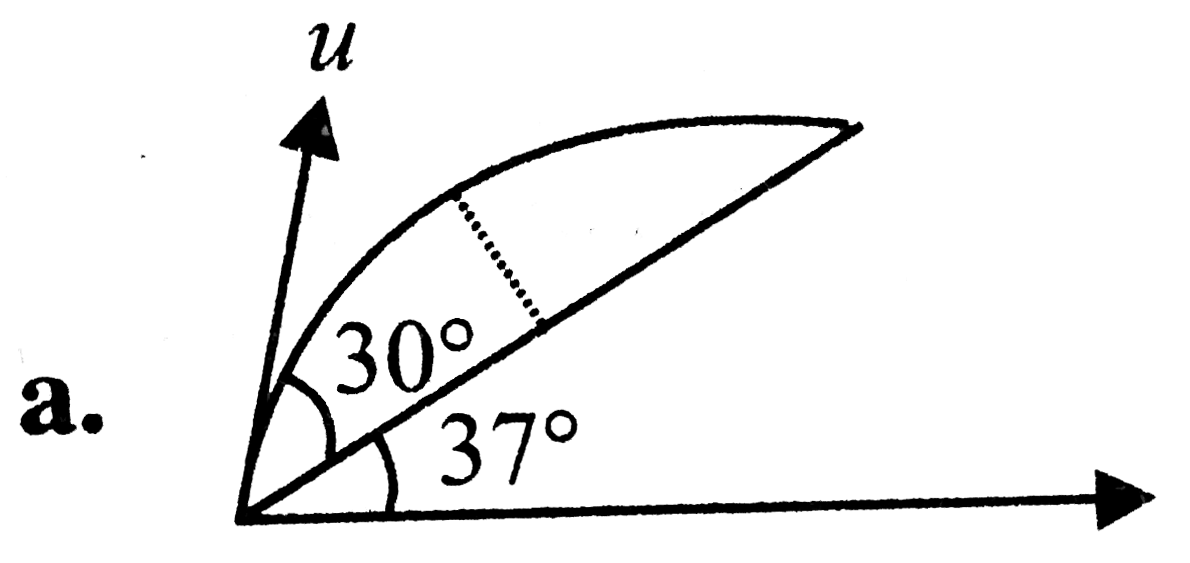
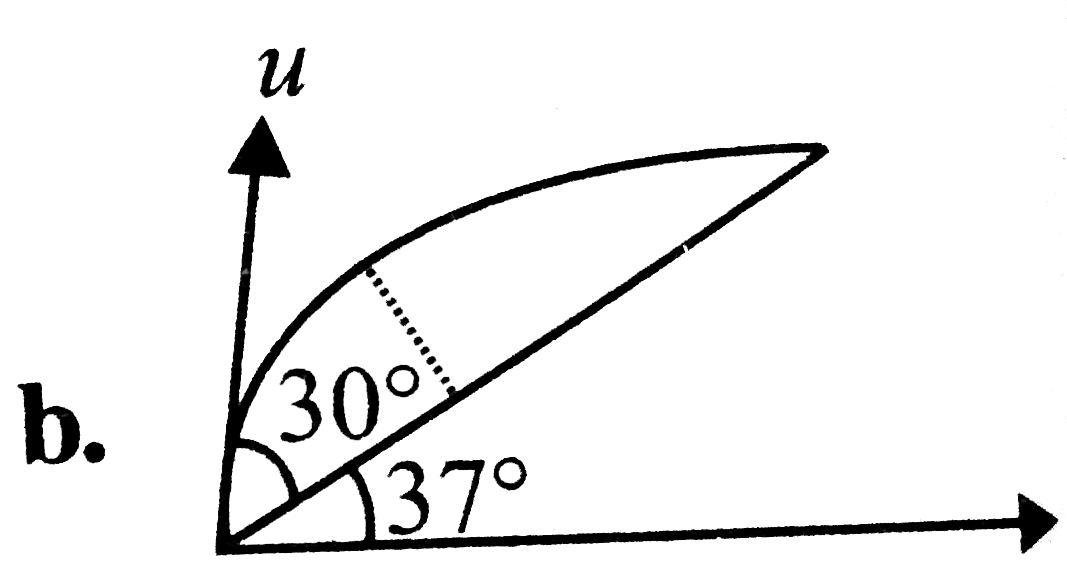
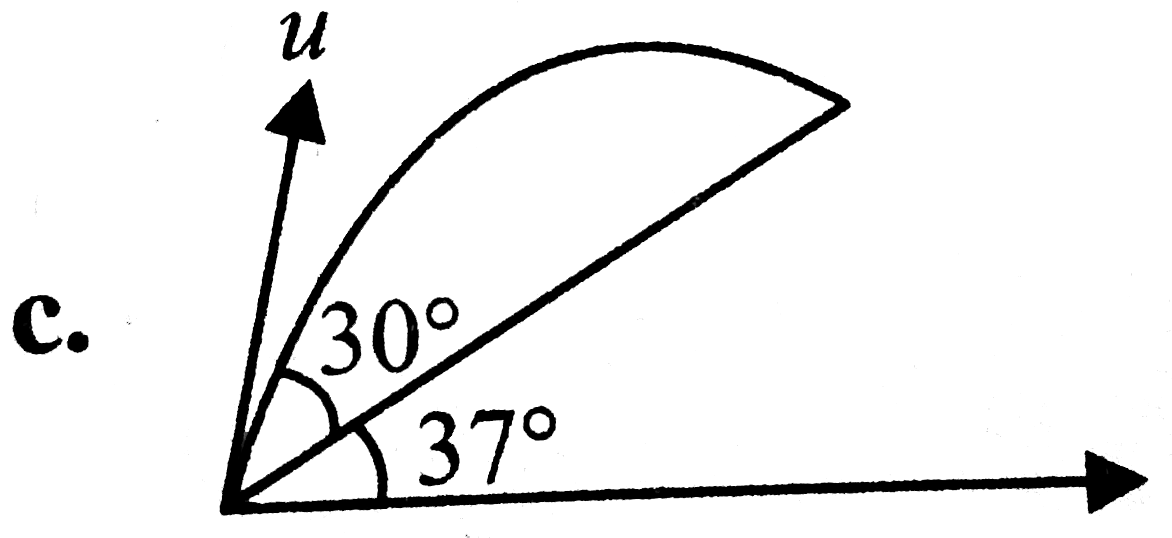
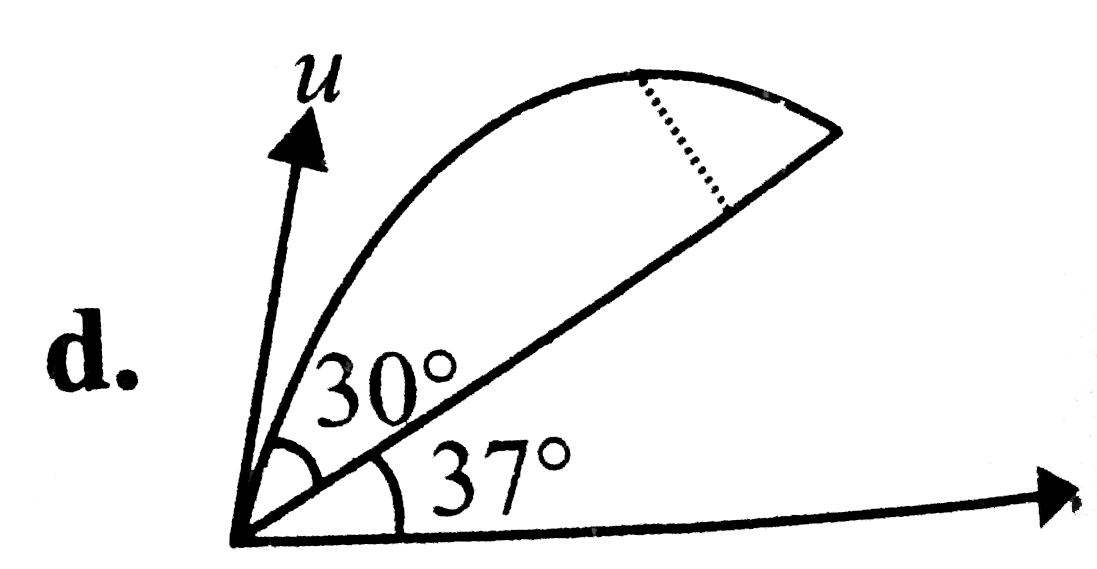
A particle is projected with velocity `30^(@)` above on an inclined plane, inclination of which from horizontal is `37^(@)`. Choose the appropriate path (air resistance is negligible)

A

B

C

D

Text Solution

AI Generated Solution

The correct Answer is:

To solve the problem, we need to analyze the motion of a particle projected at an angle of \(30^\circ\) above an inclined plane that is itself inclined at \(37^\circ\) to the horizontal. We will break down the steps to determine the appropriate path of the particle. ### Step-by-Step Solution: 1. **Identify the Components of Motion**: - The particle is projected with an initial velocity at an angle of \(30^\circ\) above the inclined plane. - The inclined plane is at an angle of \(37^\circ\) to the horizontal. - We need to resolve the gravitational force into two components: one parallel to the incline and one perpendicular to the incline. 2. **Resolve the Gravitational Force**: - The gravitational force \(g\) can be resolved into two components: - Along the incline: \(g \sin(37^\circ)\) - Perpendicular to the incline: \(g \cos(37^\circ)\) 3. **Initial Velocity Components**: - The initial velocity \(u\) of the particle can also be resolved into components relative to the inclined plane: - The component of the initial velocity along the incline (x-direction): \(u_x = u \cos(30^\circ)\) - The component of the initial velocity perpendicular to the incline (y-direction): \(u_y = u \sin(30^\circ)\) 4. **Analyze the Motion**: - As the particle moves, the vertical component of its velocity \(v_y\) will decrease due to the gravitational pull acting down the incline. - At the point of striking the inclined plane, the vertical displacement \(S_y\) will be zero, meaning that the final vertical velocity \(v_y\) will equal the initial vertical velocity \(u_y\). 5. **Use the Equations of Motion**: - We can apply the second equation of motion to analyze the vertical motion: \[ S_y = u_y t + \frac{1}{2}(-g \cos(37^\circ)) t^2 \] - Setting \(S_y = 0\) gives us an equation to solve for time \(t\). 6. **Final Velocity Components**: - The horizontal component of velocity \(v_x\) will decrease due to the acceleration along the incline, which is negative. Thus: \[ v_x = u_x - g \sin(37^\circ) t \] - Since \(v_x\) decreases, the angle of the velocity vector at the time of striking the inclined plane will be steeper than the angle of projection. 7. **Determine the Path**: - The path of the particle will be parabolic, and due to the decrease in the horizontal component of velocity, the angle at which the particle strikes the inclined plane (let's call it \(\beta\)) will be greater than the angle of projection (\(\alpha = 30^\circ\)). - Therefore, the path will appear steeper as it approaches the inclined plane. ### Conclusion: The appropriate path of the particle, when projected at \(30^\circ\) above the inclined plane inclined at \(37^\circ\), will be steeper than the angle of projection. Thus, the answer is that the angle \(\beta\) at which it strikes the incline is greater than \(30^\circ\).

To solve the problem, we need to analyze the motion of a particle projected at an angle of \(30^\circ\) above an inclined plane that is itself inclined at \(37^\circ\) to the horizontal. We will break down the steps to determine the appropriate path of the particle. ### Step-by-Step Solution: 1. **Identify the Components of Motion**: - The particle is projected with an initial velocity at an angle of \(30^\circ\) above the inclined plane. - The inclined plane is at an angle of \(37^\circ\) to the horizontal. - We need to resolve the gravitational force into two components: one parallel to the incline and one perpendicular to the incline. ...
Promotional Banner

Topper's Solved these Questions

  • MISCELLANEOUS VOLUME 2

    CENGAGE PHYSICS ENGLISH|Exercise MCQ_TYPE|20 Videos
  • MISCELLANEOUS VOLUME 2

    CENGAGE PHYSICS ENGLISH|Exercise LC_TYPE|34 Videos
  • MISCELLANEOUS KINEMATICS

    CENGAGE PHYSICS ENGLISH|Exercise Interger type|3 Videos
  • NEWTON'S LAWS OF MOTION 1

    CENGAGE PHYSICS ENGLISH|Exercise Integer|5 Videos

Similar Questions

Explore conceptually related problems

A particle is projected from the bottom of an inclined plane of inclination 30^@ . At what angle alpha (from the horizontal) should the particle be projected to get the maximum range on the inclined plane.

A particle is fired horizontally form an inclined plane of inclination 30^@ with horizontal with speed 50 ms^-1 . If g=10 ms^-2 , the range measured along the incline is

A particle is projected with a certain velocity at an angle prop above the horizontal from the foot of an inclined plane of inclination 30^@ . If the particle strikes the plane normally, then prop is equal to.

A particle is projected with a certain velocity at an angle alpha above the horizontal from the foot of an inclined plane of inclination 30^(@) . If the particle strikes the plane normally then alpha is equal to

A particle is projected from the bottom of an inclined plane of inclination 30^@ with velocity of 40 m//s at an angle of 60^@ with horizontal. Find the speed of the particle when its velocity vector is parallel to the plane. Take g = 10 m//s^2 .

A particle is fired horizontally form an inclined plane of inclination 30 ∘ with horizontal with speed 50 m s − 1 . If g = 10 m s − 2 , the range measured along the incline is

The velocity of a sphere rolling down an inclined plane of height h at an inclination theta with the horizontal, will be :

A particles is projected from the foot of an inclined plane having inclination 45^(@) , with the velocity u at angle theta( gt 45^(@)) with the horizontal in a vertical plane containing the line of greatest slope through the point of projection. Find the value of tantheta if the particle stikes the plane. (i) Horizontally (ii) Normally

A particle is projected up an inclined plane of inclination beta at an elevation prop to the horizontal. Find the ratio between tan prop and tan beta , if the particle strikes the plane horizontally.

A particle is projected with a velocity 10 m//s at an angle 37^(@) to the horizontal. Find the location at which the particle is at a height 1 m from point of projection.
