Home
Class 11
PHYSICS
The ratio of tensions in the string conn...

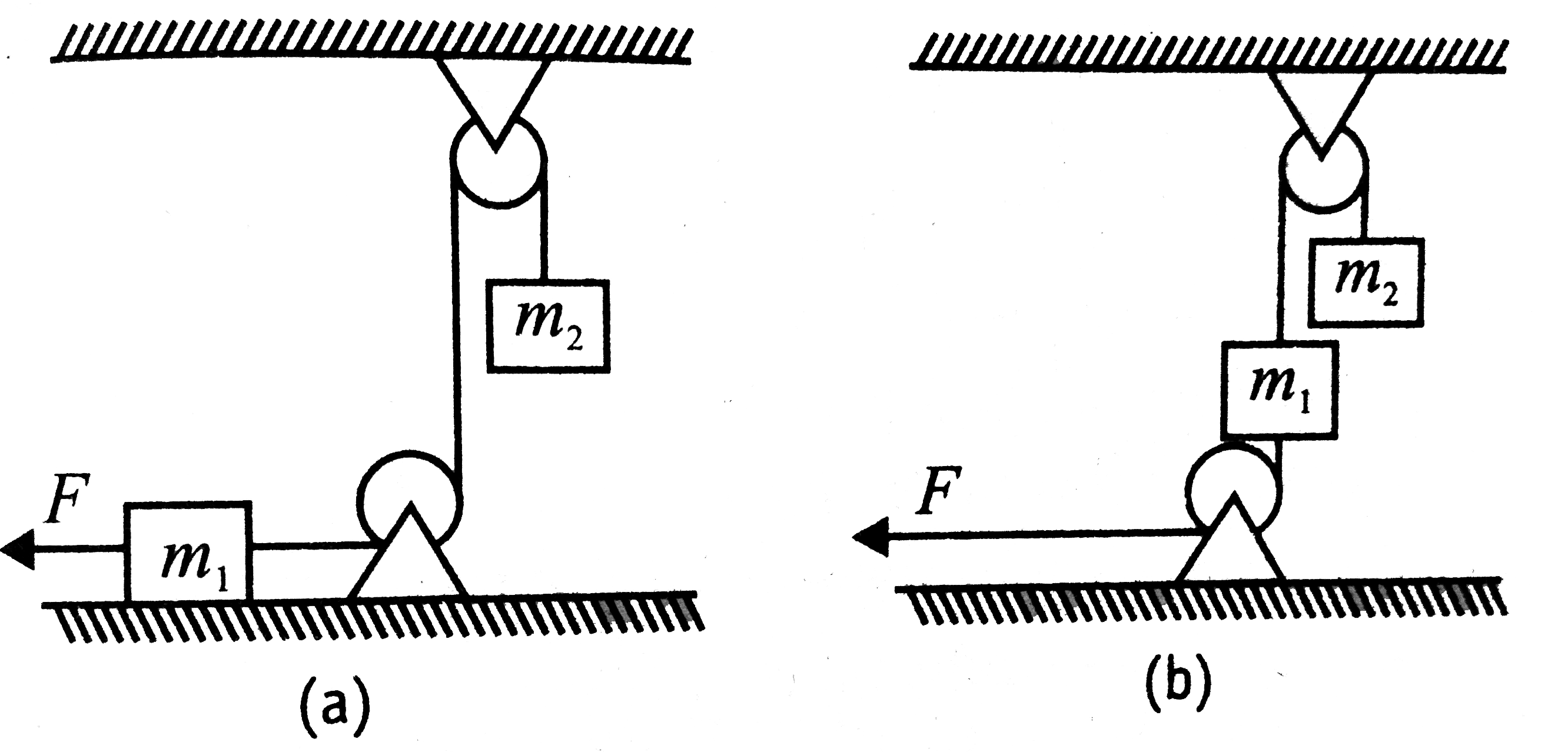
The ratio of tensions in the string connected to the block of mass `m_(2)` in figure, respectively, is (friction is absent everywhere):`[m_(1)=50 kg, m_(2)=80kg` and `F=1000N]`

A

`7:2`

B

`2:7`

C

`3:4`

D

`4:3`

Text Solution

Verified by Experts

The correct Answer is:

C

In fig a in the question let tension in the string be `T_(1)`.
`F-T_(1)=m_(1)a`
`implies1000-T_(1)=50a`…………i
`T_(1)-m_(2)=m_(2)a`
`implies T_1-80g=80a`………..ii
From eqn i and i `T_1=12000/13N`
In fi b, in the equation, let tension in the string be `T_2`
`F+m_1g-T_2=m_1 a`
`implies1000+50g=T_2=50a`...........iii
`T_2=80g=80a`............iv
From eqn iii and iv we get
`T_2=16000/13NimpliesT_1/T_2=12000/16000=3/4`
Promotional Banner

Topper's Solved these Questions

  • MISCELLANEOUS VOLUME 2

    CENGAGE PHYSICS ENGLISH|Exercise MCQ_TYPE|20 Videos
  • MISCELLANEOUS VOLUME 2

    CENGAGE PHYSICS ENGLISH|Exercise LC_TYPE|34 Videos
  • MISCELLANEOUS KINEMATICS

    CENGAGE PHYSICS ENGLISH|Exercise Interger type|3 Videos
  • NEWTON'S LAWS OF MOTION 1

    CENGAGE PHYSICS ENGLISH|Exercise Integer|5 Videos

Similar Questions

Explore conceptually related problems

Find the mass M so that it remains at rest in the abjoining figure. Both the pulley and string are light and friction is absent everywhere. (g = 10 m//s^(2))

The block C shown in the figure is ascending with an acceleration a=3m//s^(2) by means of some motor not shown here. Find the acceleration of the bodies A and B of masses 10 kg and 5kg respectively in m//s^(2) , assuming pulleys are massless and friction is absent everywhere.

A block of mass 'm' is raised by a man of mass m_2 in two different ways as shown ( m_1 = 25kg, m_2 = 50kg)

Two blocks of masses m and M are connected by an inextensible light string as shown in the figure. When a constant horizontal force F acts on the block of the mass M , then tension in the string is : (Assume that constact between the ground and the two blocks are frictionless) and blocks will not topple. (Given: m = 1 kg, M = 4 kg, F = 10 N, theta = 60^(@) )

Three blocks are connected as shown in fig. on a horizontal frictionless table if m_(1)=1 kg, m_(2)=8kg, m_(3)=27kg and T_(3)=36N, T_(2) will be:-

Two blocks are connected by a massless string that passes over a frictionless peg as shown in figure. One end of the string is attached to a mass m_1=3kg , i.e., a distance R=1.20m from the peg. The other end of the string is connected to a block of mass m_2=6kg resting on a table. From what angle theta , measured from the vertical, must the 3-kg block be released in order to just lift the 6kg block off the table?

If the system shown in the figure is rotated in a horizontal circle with angular velocity omega . Find (g=10m//s^(2)) (a) the minimum value of omega to start relative motion between the two blocks. (b) tension in the string connecting m_(1) and m_(2) when slipping just starts between the blocks The coefficient of frition between the two masses is 0.5 and there is no friction between m_(2) and ground. The dimensions of the masses can be neglected. (Take R=0.5m,m_(1)=2Kg,m_(2)=1Kg)

A block of mass m slides down on inclined wedge of same mass m as shown in figure . Friction is absent everywhere . Acceleration of centre of mass of the block and wedge is

A block of mass m slides down on inclined wedge of same mass m as shown in figure . Friction is absent everywhere . Acceleration of centre of mass of the block and wedge is

Three blocks are arranged on a horizontal table ABCD as shown in the figure . The strings and pulleys are massless and both the pulleys stand vertical . The strings connecting blocks m_1 and m_2 are also vertical and are perpendicular to faces AB and BC which are mutually perpendicular to each other . If m_1 and m_2 are 3 kg and 4 kg respectively. Coefficient of friction between the block m_3 = 10 kg and the surface is mu = 0.6 then, frictional force on m_3 is
