Home
Class 11
PHYSICS
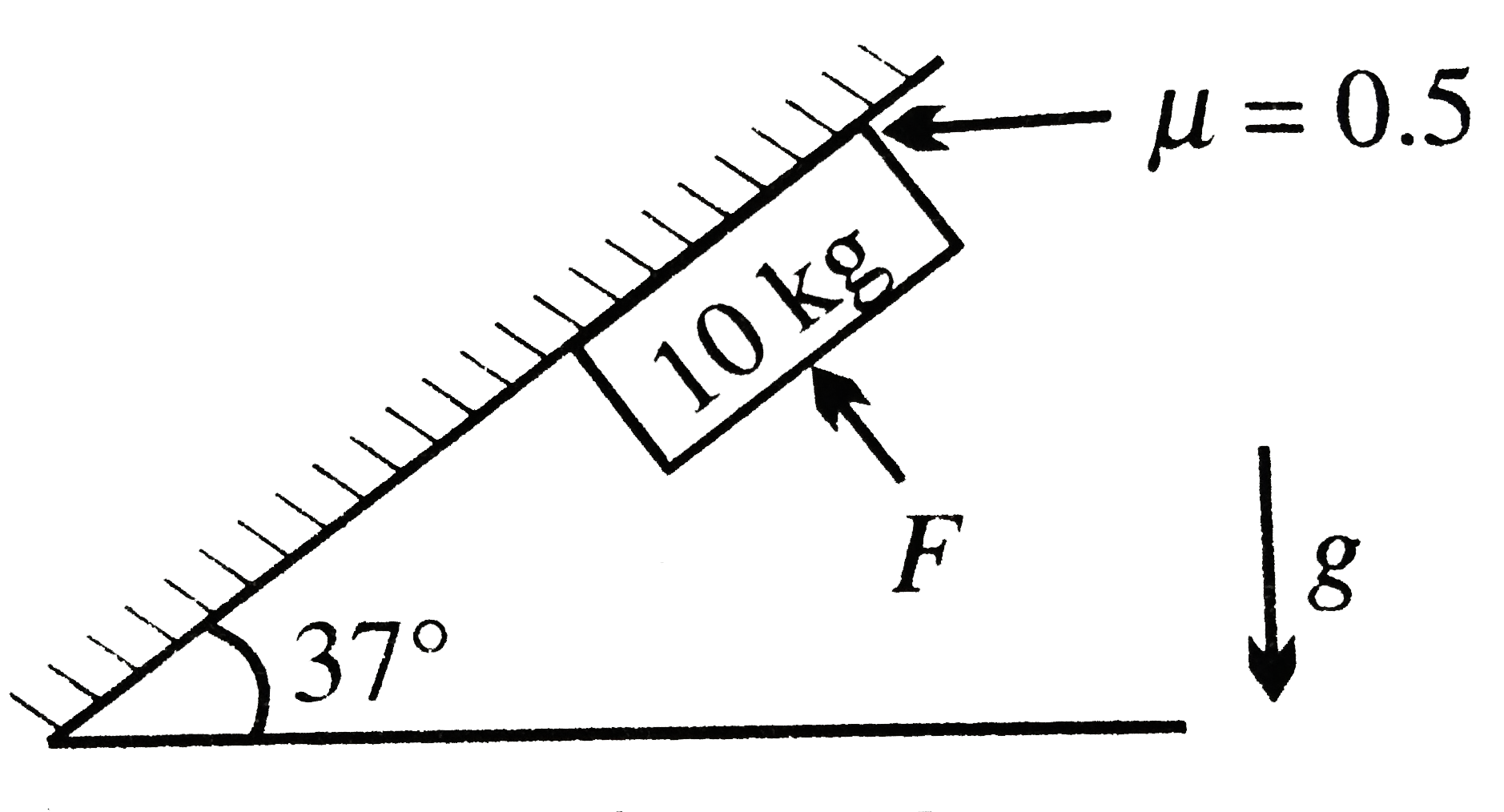
In the figure shown, the minimum force F...

In the figure shown, the minimum force `F` to be applied perpendicular to the incline so that the block does not slide is

A

`200N`

B

`40 N`

C

`120 N`

D

none

Text Solution

Verified by Experts

The correct Answer is:
A


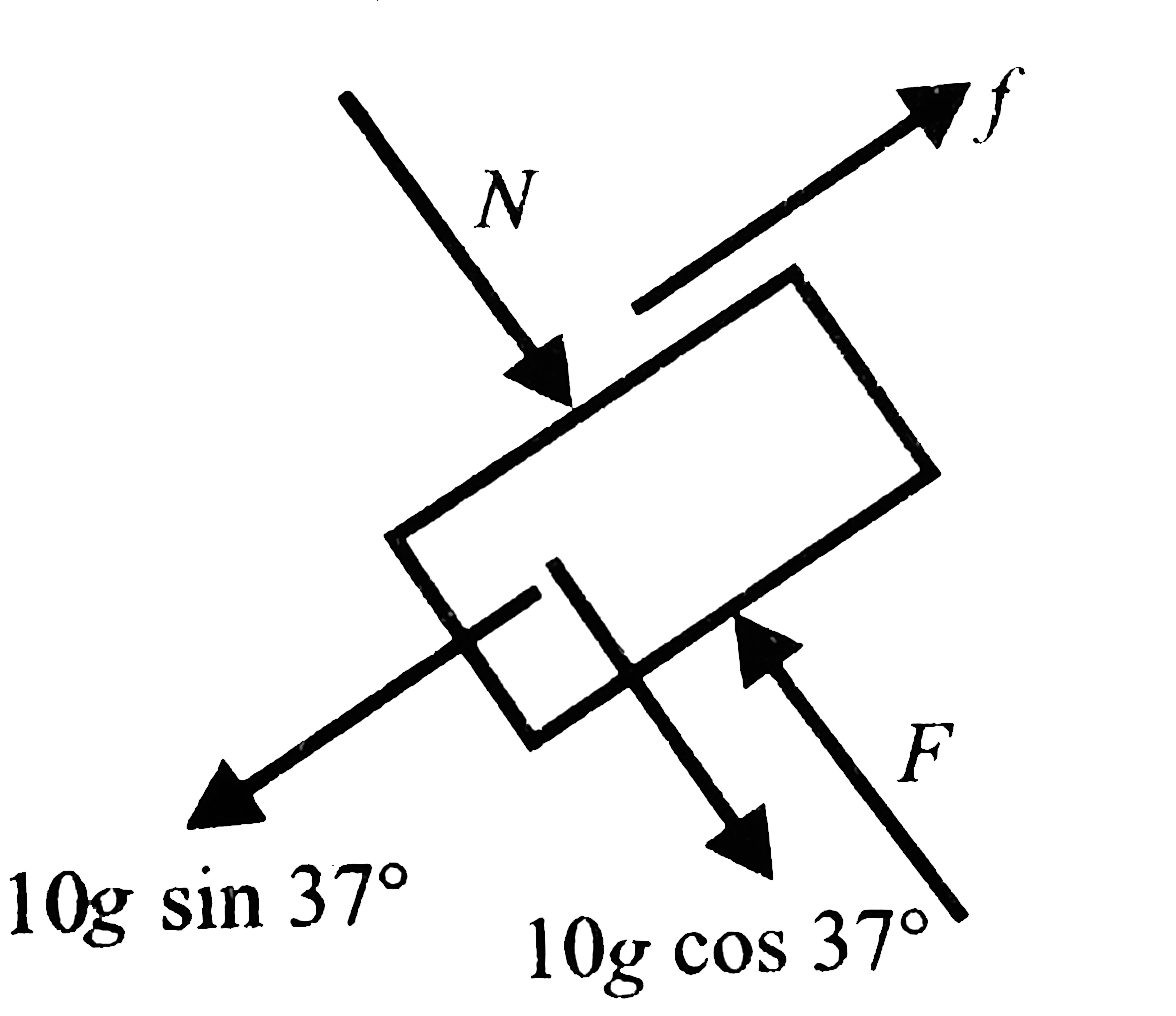
`f_l=muN=0.51[F-10g-cos37^@]`
`f=10gsin37^@`
For the block to not to slide `f_lgtf`.
`L implies0.51[F-10gcos37^@]gt10gsin37^@`
`implies Fgt200N`
Promotional Banner

Topper's Solved these Questions

  • MISCELLANEOUS VOLUME 2

    CENGAGE PHYSICS ENGLISH|Exercise MCQ_TYPE|20 Videos
  • MISCELLANEOUS VOLUME 2

    CENGAGE PHYSICS ENGLISH|Exercise LC_TYPE|34 Videos
  • MISCELLANEOUS KINEMATICS

    CENGAGE PHYSICS ENGLISH|Exercise Interger type|3 Videos
  • NEWTON'S LAWS OF MOTION 1

    CENGAGE PHYSICS ENGLISH|Exercise Integer|5 Videos

Similar Questions

Explore conceptually related problems

A block of mass m=2kg is resting on a rough inclined plane of inclination of 30^(@) as shown in figure. The coefficient of friction between the block and the plane is mu=0.5 . What minimum force F should be applied perpendicular to the plane on the block, so that blocks does not slip on the plane? (g=10m//s^(2))

A block of mass m = 2kg is resting on a inclined plane of inclination 30^(@) as shown in figure The coefficient of friction between the block and the plane is mu = 0.5 what minimum force F (in newton) should be applied perpendicular to the plane on the block so that the does not slip on the plane?

A block of mass m = 2kg is resting on a inclined plane of inclination 30^(@) The coefficient of friction between the block and the plane is mu = 0.5 what minimum force F (in newton) should be applied perpendicular to the plane on the block so that the does not slip on the plane?

In the figure shown, horizontal force F_(1) is applied on a block but the block does not slide. Then as the magnitude of vertical force F_(2) is increased from zero the block begins to slide, the correct statement is

As shown in figure, if we apply a horizontal force F on the block, find the maximum force F (in N ) that can be applied so that block does not slide up. ( "Given" theta=45^(@),g=10m//sec^(2), m=1/5kg,mu=1/2)

A cubical block of edge length 1 m and density 800 kg m^-3 rests on a rough horizontal surface with coefficient of friction mu . A horizontal force F is applied on the block as shown in figure. If the coefficient of friction is sufficiently large so that the block does not slide bofore toppling, then the minimum value of F to topple the block is [Take g = 10 ms^-2 ]

Consider the situation shown in figure. The horizontal surface below the bigger block is smooth. The coefficient of friction between the blocks is mu . Find the minimum and the maximum force F that can be applied in order to keep the smaller block at rest with respect to the bigger block.

A bar of mass m is placed on a triangular block of mass M as shown in figure The friction coefficient between the two surface is mu and ground is smooth find the minimum and maximum horizontal force F required to be applied on block so that the bar will not slip on the inclined surface of block

An equilateral prism of mass m rests on a rough horizontal surface with cofficent of friction mu . A horizontal force F is applied on the prism as shown in the figure. If the cofficent of the friction is sufficently high so that the prism does not slide before toppling, then the minimum force required to topple the prism is

A block of mass M = 10 kg is placed inclined plane , inclined at angle theta = 37^(@) with horizontal The coefficient of friction between the block and inclined is mu = 0.5 a. Calculate the acceleration of the block when it is released b. Now a force F = 75 N is appling on block as shown find out the acceleration of the block If the block is initially at rest . c. In case (b), how much force should be added to 75 N force so that block the starts to move up the incline. d. In case (b), what is the minimum force by which 75N force should be replaced with so that the block does not move?

