Home
Class 11
PHYSICS
Consider a cart being pulled by a horse ...


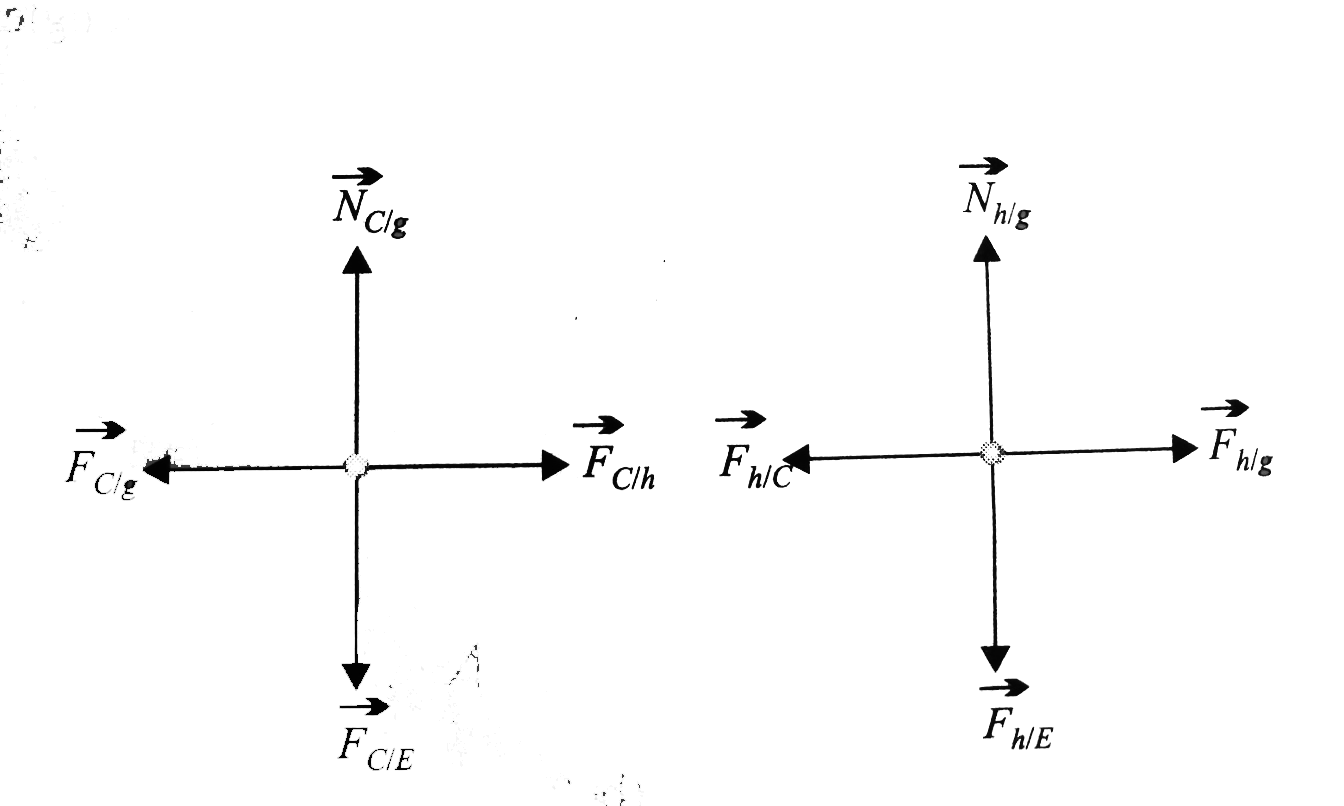
Consider a cart being pulled by a horse with constant velocity. The horse exerts force `vecF_((C )/(h))` on the cart. (The subscript indicate the force on the cart due to horse.). The first subscript denotes the body on which force acts and second due to which it acts.
Choose the statements(s):

A

`vecf_(C//g), vecN_(C//g), vecN_(h//g)` are external force on a system consisting of a horse and a cart.

B

`vecf_(C//g)+vecf_(C//g) = 0

C

`vecN_(C//g)` and `vecF_(C//E)` are action reaction pairs.

D

`vecF_(C//h)vecF_(h//C)` are action reaction pairs

Text Solution

Verified by Experts

The correct Answer is:

A, B, C

a. For the system of `(horse+cart), only vecF_(c//h)` and `vecF_(h//c)` will be internal forces. All other forces will be external.
b. As (horse`+`cart) system is moving with constant velocity, so net horizontal force on it should be zero.
For this `vecF_(h//s)+vecf_(c//s)=0`
`vecN_(C//g) and vecF_(C//E)` cannot be action - reaction pairs, as they act on the same body.
d. `vecF_(C//M) and vecf_(h//C)` are action reaction pairs.
Promotional Banner

Topper's Solved these Questions

  • MISCELLANEOUS VOLUME 2

    CENGAGE PHYSICS ENGLISH|Exercise LC_TYPE|34 Videos
  • MISCELLANEOUS VOLUME 2

    CENGAGE PHYSICS ENGLISH|Exercise INTEGER_TYPE|10 Videos
  • MISCELLANEOUS VOLUME 2

    CENGAGE PHYSICS ENGLISH|Exercise INTEGER_TYPE|10 Videos
  • MISCELLANEOUS KINEMATICS

    CENGAGE PHYSICS ENGLISH|Exercise Interger type|3 Videos
  • NEWTON'S LAWS OF MOTION 1

    CENGAGE PHYSICS ENGLISH|Exercise Integer|5 Videos

Similar Questions

Explore conceptually related problems

Sand is falling on a flat car being pulled with constant speed. The rate of mass falling on the cart is constant. Then the horizontal component of force exerted by the falling sand on the cart (sand particles sticks to the cart)

Gravitational force with which a body attracts the other is always equal to the force with which the other attracts the first. Assuming no other forces acting on the bodies, choose the correct statement.

A 2kg toy car can move along an x axis. Graph shows force F_(x) , acting on the car which being at rest at time t=0 . The velocity of the particle at t=10s is:

A horizontal force F is applied to a homogeneous rectangular block of mass m , width b and height H . The block moves with constant velocity, the coefficient of friction is mu_(k) . a. What is the greater height h at which the force F can be applied so that the block will slide without tipping over ? b. Through which point on the bottom face of the block will the resultant of the friction and normal forces act if h=H//2? c. If the block is at rest and coefficient of static friction is mu_(s) what are the various criteria for which sliding or tipping occurs?

A cart is moving with a velocity 20m/s. Sand is being dropped into the cart at the rate of 50 kg/min. The force required to move the cart with constant velocity will be :-

A current of 10 A flows around a closed path in a circuit which is in the horizontal plane as shown in the figure. The circuit consists oi eight alternating arcs of radii r_1=0.08m and r_2 =0.12m . Each subtends the same angle at the centre. a. Find the magnetic field produced by this circuit at the centre. b. An infinitely long straight wire carrying as current of 10 A is passing through the centre of the above circuit vertically with the direction of the current being into the pane of the circuit. what is the force acting on the wire at the centre due to the current in the circuit? What is the force acting on the arc AC and the straight segment CD due to the current at the centre?

A force of 6 N acts on a body at rest and mass 1 kg. During this time, the body attains a velocity of 30 m/s. The time for which the force acts on the body is

If a body moves through a liquid or a gas then the fluid applies a force on the body which is called drag force. Direction of the drag force is always opposite to the motion of the body relative to the fluid. At low speeds of the body, drag frog ( F _(P)) is directly proportional to the speed. F_(D) = kv What K is a proportionally constant and it depends upon the dimension of the body moving in air at relatively high speeds, the drag force applied by air an the body is proportional to v^(2) Where this proportionally constant K can be given by K_(2) rho CA Where rho is the density of air C is another constant givig the drag property of air A is area of cross-section of the body Consider a case an object of mass m is released from a height h and it falls under gravity. As it's speed increases the drag force starts increasing on the object. Due to this at some instant, the object attains equilibrium. The speed attained by the body at this instant is called "terminal speed" of the body. Assume that the drag force applied by air on the body follows the relation F_(D) = kv ,neglect the force by buoyancy applied by air on the body then answer the following questions. What is the pattern of acceleration change of the body ?

If a body moves through a liquid or a gas then the fluid applies a force on the body which is called drag force. Direction of the drag force is always opposite to the motion of the body relative to the fluid. At low speeds of the body, drag frog ( F _(P)) is directly proportional to the speed. F_(D) = kv What K is a proportionally constant and it depends upon the dimension of the body moving in air at relatively high speeds, the drag force applied by air an the body is proportional to v^(2) Where this proportionally constant K can be given by K_(2) rho CA Where rho is the density of air C is another constant givig the drag property of air A is area of cross-section of the body Consider a case an object of mass m is released from a height h and it falls under gravity. As it's speed increases the drag force starts increasing on the object. Due to this at some instant, the object attains equilibrium. The speed attained by the body at this instant is called "terminal speed" of the body. Assume that the drag force applied by air on the body follows the relation F_(D) = kv ,neglect the force by buoyancy applied by air on the body then answer the following questions. What is the terminal speed of the object ?

Fluids at rest exert a normal force to the walls of the container or to the sruface of the body immersed in the fluid. The pressure exerted by this force at a point inside the liqid is the sum of atmospheric pressure and a factor which depends on the density of the liquid, the acceleration due to gravity and the height of the liquid, above that point. The upthrust acting on a body immersed in a stationary liquid is the net force acting on the body in the upward direction. A number of phenomenon of liquids in motion can be explain by Bernoulli's theorem which relates the pressure, flow speed and height for flow of an ideal incompressible fluid. A container of large uniform corss sectional area. A resting on a horizontal surface holds two immiscible, non viscous and incompressile liquids of densities d and 2d , each of height H//2 as shown in the figure. The lower density liquid is open to the atmosphere having pressure P_(0) . Situation II: A cyliner is removed and the original arrangement is restoreed.A tiny hole of area s(slt ltA) is punched on the veritical side of the containier at a height h(hltH//2) The height h_(m) at which the hole should be punched so that the liquid travels the maximum distance is

CENGAGE PHYSICS ENGLISH-MISCELLANEOUS VOLUME 2-MCQ_TYPE
  1. Figure shows top view of an airplane blown off course by wind in vario...

    Text Solution

    |

  2. Figure shows three blocks on a rough surface under the influene of a f...

    Text Solution

    |

  3. Consider a cart being pulled by a horse with constant velocity. The ho...

    Text Solution

    |

  4. A small spehre of mass m is connected by a stirng to a nail at O and m...

    Text Solution

    |

  5. A man is standing on a plank which is placed on smooth horizontal surf...

    Text Solution

    |

  6. Consider a block of mass 10 kg. which rests on as smooth surface and ...

    Text Solution

    |

  7. A particle of mass m is released from a height H on a smooth curved su...

    Text Solution

    |

  8. A massles spool of inner radius r and other radius R is placed against...

    Text Solution

    |

  9. A rod bent at right angle along its centre line, is placed on a rough ...

    Text Solution

    |

  10. A solid sphere is given an angular velocity omega and kept on a rough ...

    Text Solution

    |

  11. Illustrated below is a uniform cubical block of mass M and side a. Mar...

    Text Solution

    |

  12. A body floats on water and then also on an oil of densily 1.25. Which ...

    Text Solution

    |

  13. A body of density d(2) is dropped from rest at a height x into a beake...

    Text Solution

    |

  14. The limbs of a U-tube are lowerd into beakes A and B. A contains wate...

    Text Solution

    |

  15. The cone of radius R and height H is hanging inside a liquid of densit...

    Text Solution

    |

  16. Two particles move on a circular path (one just inside and the other j...

    Text Solution

    |

  17. A particle starts moving along a straight line path with a velocity 10...

    Text Solution

    |

  18. A boy is sitting on a seat of merry-go-round moving with a constant an...

    Text Solution

    |

  19. Consider three masses A,B and C as shoon in the figure. Friction coeff...

    Text Solution

    |

  20. A man of mass m walks from end A to the other end B of a boat of mass ...

    Text Solution

    |
