Home
Class 11
PHYSICS
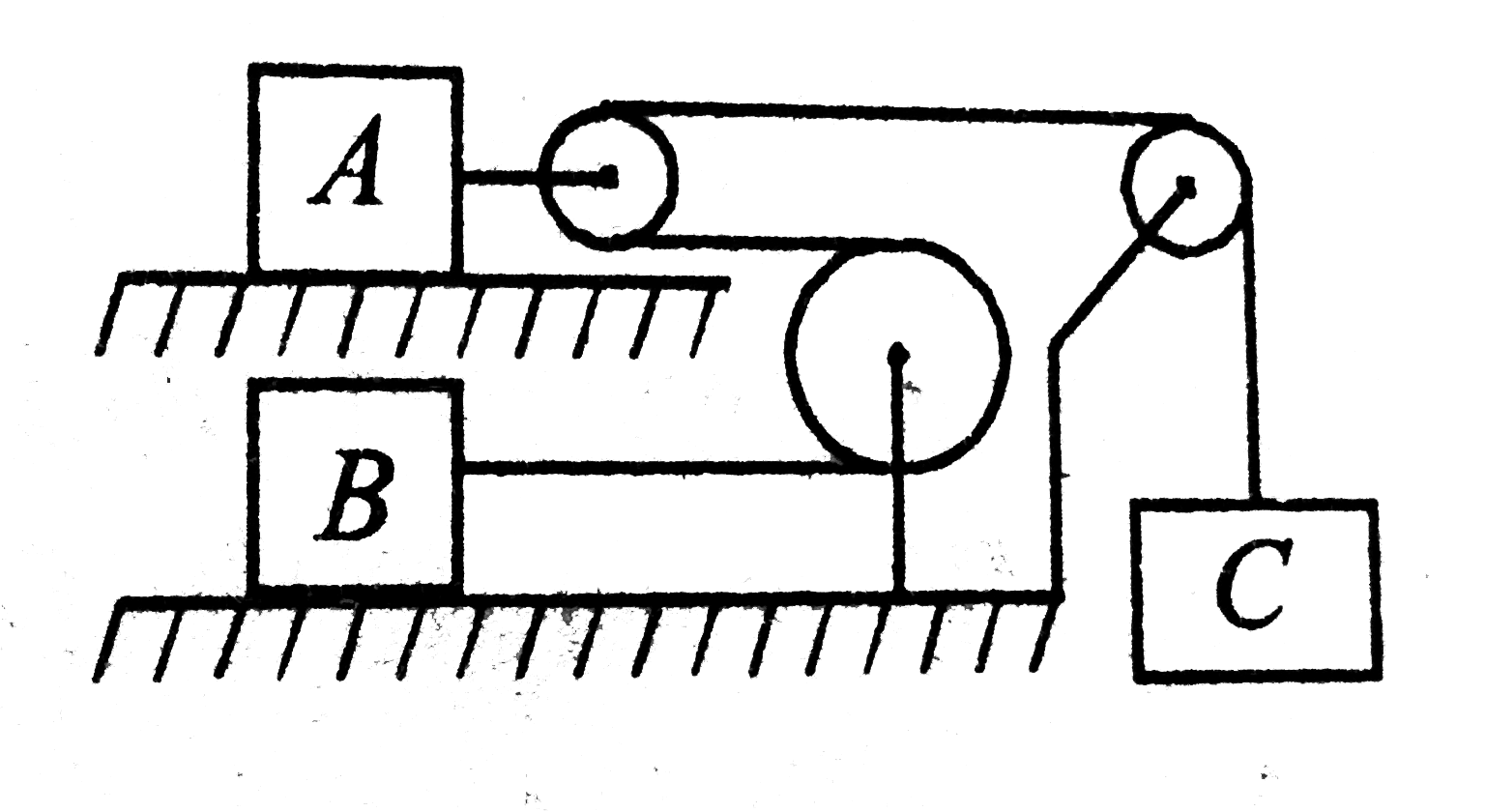
Consider three masses A,B and C as shoon...

Consider three masses `A,B` and `C` as shoon in the figure. Friction coefficient between all surfaces is `0.5`. Pulleys are smooth. (Given `m_(A)=1 kg, m_(B)=1 kg)` Mass of `C` may have any value

A

(a)is possible that both `A` and `B` remain at rest

B

(b) It is possible that both `A` and `B` accelerate.

C

(c) It is possible that both `A` accelerates but `B` does not accelerate

D

(d) If `B` accelearates, then `A` definitely accelarates

Text Solution

Verified by Experts

The correct Answer is:

A, B, C, D

`f_(l_1)=f_(l_2)=0.5xx10xg=5N, T` can have any value depending on mass of C

a. `If 2Tlt5N`, then none of them acclerates.
b. If `Tgt5N,` both accelerate.
c. If `2Tgt5N, but Tlt5N`, then A accelerates B does not accelerate.
d. If B accelerates then `Tgt5N`, so `2Tgt5N`, hence A also accelerates.
Promotional Banner

Topper's Solved these Questions

  • MISCELLANEOUS VOLUME 2

    CENGAGE PHYSICS ENGLISH|Exercise LC_TYPE|34 Videos
  • MISCELLANEOUS VOLUME 2

    CENGAGE PHYSICS ENGLISH|Exercise INTEGER_TYPE|10 Videos
  • MISCELLANEOUS VOLUME 2

    CENGAGE PHYSICS ENGLISH|Exercise INTEGER_TYPE|10 Videos
  • MISCELLANEOUS KINEMATICS

    CENGAGE PHYSICS ENGLISH|Exercise Interger type|3 Videos
  • NEWTON'S LAWS OF MOTION 1

    CENGAGE PHYSICS ENGLISH|Exercise Integer|5 Videos

Similar Questions

Explore conceptually related problems

Two blocks A and B are connected by a string as shown as shown in the figure . Friction coefficient of the inclined plane is 0.5 . The mass of the block A is 5 kg. If minimum and maximum values of mass of the block B for which the block A remains in equilibrium are m_(1) and m_(2) then find the value of (m_(2) - m_(1)) [in kg]

Two block A and B of mass 50 kg and 300 kg respectively are placed as shown in figure. Coefficient of friction between all surface is (1)/(2) Then (take g = 10 m//s )

Two blocks A and B of respective masses 6 kg and 4 kg are connected with a string passing over a light friction less pulley as shown in the figure . The coefficient of friction between the block A and horizontal surface is 0.4 . Then the minimum mass of block C which should be placed over A to prevent it from moving is :

There are two block as shown in the figure of masses 1kg and 4kg . Friction coefficient between any two surfaces are 0.2 then find maximum value of horizontal force F so that both blocks moves together.

An arrangement of the masses and pulleys is shown in the figure. Strings connecting masses A and B with pulley are horizontal and all pulleys and strings are light. Friction coefficient between the surface and the block B is 0.2 and between block A and B is 0.7 . The system is released from rest. (use g=10m//s^(2))

Two masses m_(1)=5kg and m_(2)=10kg, connected by an inextensible string over a frictionless pulley, are moving as shown in the figure. The coefficient of friction of horizontal surface is 0.15. The minimum weitght m that should be put on top of m_(2) to stop the motion is :-

Two masses A and B of 15 kg and 10 kg are connected with a string passing over a frictionless pulley fixed at the corner of a table (as shown in figure). The coefficient of friction between the table and block is 0.4. The minimum mass of C, that may be placed on A to prevent it from moving is:

Two moasses m_(1)=5kg and m_(2)=10kg, connected by an inextensible string over a frictionless pulley, are moving as shown in the figure. The coefficient of friction of horizontal surface is 0.15. The minimum weitght m that should be put on top of m_(2) to stop the motion is :-

Consider the system of masses and pulleys shown in fig. with massless string and fricitionless pulleys. (a) Give the necessary relation between masses m_(1) and m_(2) such that system is in equilibrium and does not move. (b) If m_(1)=6kg and m_(2)=8kg , calculate the magnitude and direction of the acceleration of m_(1) .

In the figure shown A and B are free to move . All the surface are smooth. Mass of A is m . Then

CENGAGE PHYSICS ENGLISH-MISCELLANEOUS VOLUME 2-MCQ_TYPE
  1. Figure shows top view of an airplane blown off course by wind in vario...

    Text Solution

    |

  2. Figure shows three blocks on a rough surface under the influene of a f...

    Text Solution

    |

  3. Consider a cart being pulled by a horse with constant velocity. The ho...

    Text Solution

    |

  4. A small spehre of mass m is connected by a stirng to a nail at O and m...

    Text Solution

    |

  5. A man is standing on a plank which is placed on smooth horizontal surf...

    Text Solution

    |

  6. Consider a block of mass 10 kg. which rests on as smooth surface and ...

    Text Solution

    |

  7. A particle of mass m is released from a height H on a smooth curved su...

    Text Solution

    |

  8. A massles spool of inner radius r and other radius R is placed against...

    Text Solution

    |

  9. A rod bent at right angle along its centre line, is placed on a rough ...

    Text Solution

    |

  10. A solid sphere is given an angular velocity omega and kept on a rough ...

    Text Solution

    |

  11. Illustrated below is a uniform cubical block of mass M and side a. Mar...

    Text Solution

    |

  12. A body floats on water and then also on an oil of densily 1.25. Which ...

    Text Solution

    |

  13. A body of density d(2) is dropped from rest at a height x into a beake...

    Text Solution

    |

  14. The limbs of a U-tube are lowerd into beakes A and B. A contains wate...

    Text Solution

    |

  15. The cone of radius R and height H is hanging inside a liquid of densit...

    Text Solution

    |

  16. Two particles move on a circular path (one just inside and the other j...

    Text Solution

    |

  17. A particle starts moving along a straight line path with a velocity 10...

    Text Solution

    |

  18. A boy is sitting on a seat of merry-go-round moving with a constant an...

    Text Solution

    |

  19. Consider three masses A,B and C as shoon in the figure. Friction coeff...

    Text Solution

    |

  20. A man of mass m walks from end A to the other end B of a boat of mass ...

    Text Solution

    |

