Home
Class 11
PHYSICS
Fluids at rest exert a normal force to ...

Fluids at rest exert a normal force to the walls of the container or to the sruface of the Body immersed in the fluid. The pressure exerted by this force at a point inside the liqid is the sum of atmospheric pressure and a factor which depends on the density of the liquid, the acceleration due to gravity and the height of the liquid, above that point. The upthrust acting on a body immersed in a stationary liquid is the net force acting on the body in the upward direction. A number of phenomenon of liquids in motion can be explain by Bernoulli's theorem which relates the pressure, flow speed and height for flow of an ideal incompressible fluid.
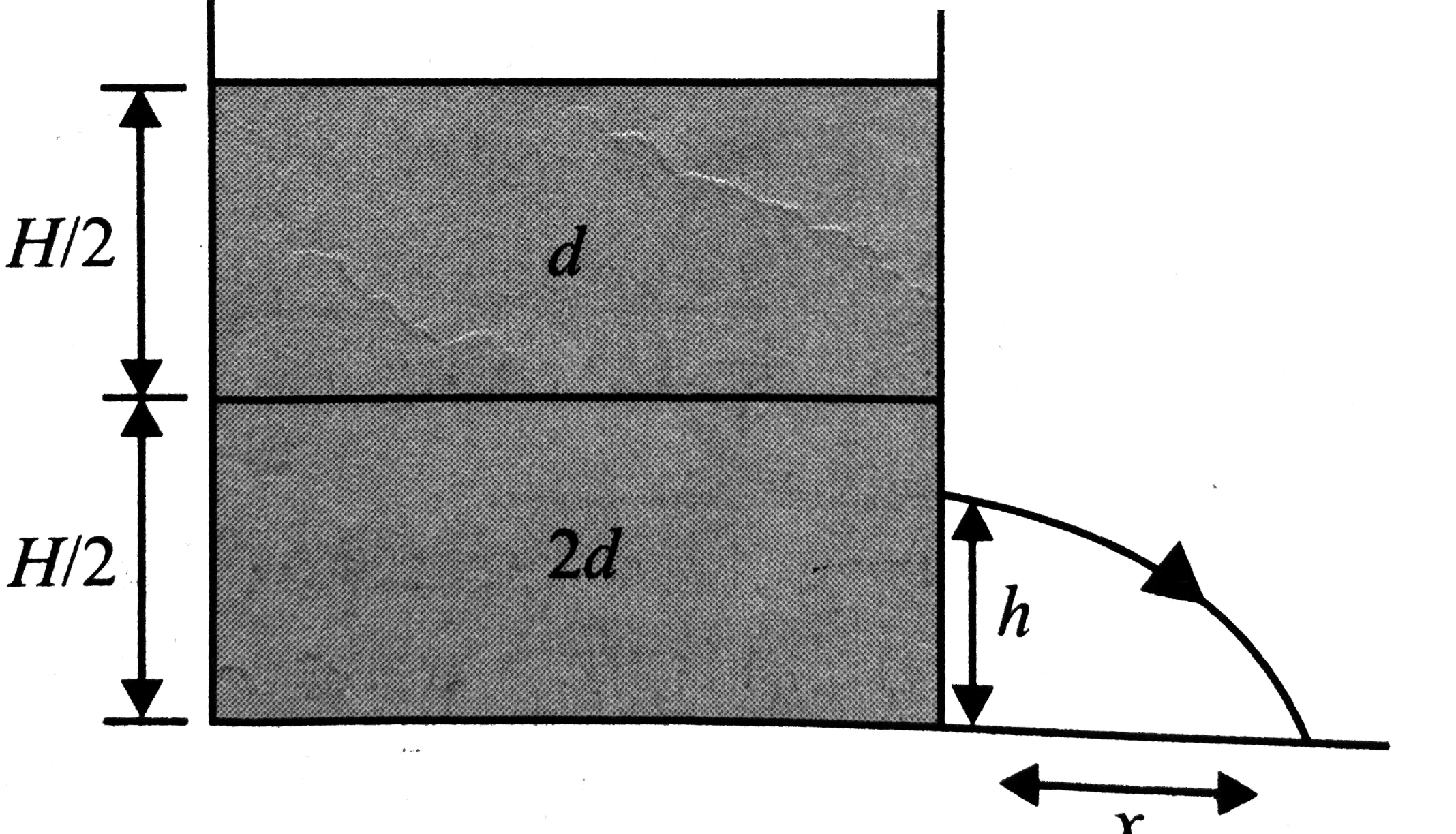
A container of large uniform corss sectional area. A resting on a horizontal surface holds two immiscible, non viscous and incompressile liquids of densities `d` and `2d`, each of height `H//2` as shown in the figure. The lower density liquid is open to the atmosphere having pressure `P_(0)`.
Situation I:
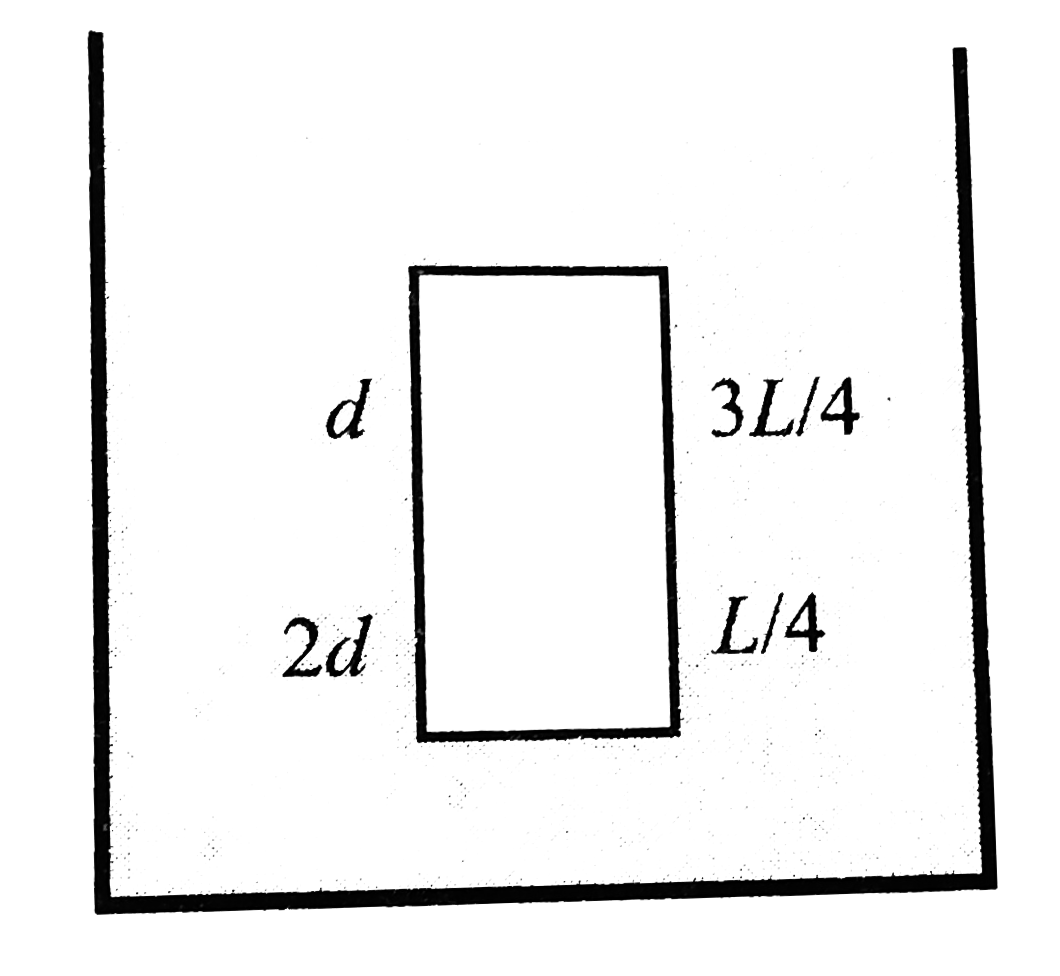
A homogeneous solid cylinder of length `L(LltH//2)`. cross sectional area `A//5` is immersed such that it floats with its axis vertical at liquid -liquid interface with lenght `L//4` in the denser liquid.
The density of the solid is

A

`(5d)/4`

B

`d/4`

C

`(2d)/4`

D

`(3d)/4`

Text Solution

Verified by Experts

The correct Answer is:
A

Since the body is in equlibrium the net fore acting should be zero. i.e., the vector sum of forces should be zero.

The forces on the body are mg downwards, buoyant force due to denser liquid upwards and buoyant force due to lighter liquid in upward direction.
`F_(mg)=("Density" xx"volume")g=Dxx(AL)/5g`............i
`F_("buoyant")=d xx A/5 xx (3L)/4g+2d xx A/5xxL/4g`
`=((5d)/4xxA/5xxL)g=(AdL)/4g`...........ii
From eqn i and ii we have `D xx (AL)/5g=(AdL)/4g`
`impliesD=(5d)/4`
Promotional Banner

Topper's Solved these Questions

  • MISCELLANEOUS VOLUME 2

    CENGAGE PHYSICS ENGLISH|Exercise INTEGER_TYPE|10 Videos
  • MISCELLANEOUS VOLUME 2

    CENGAGE PHYSICS ENGLISH|Exercise MCQ_TYPE|20 Videos
  • MISCELLANEOUS KINEMATICS

    CENGAGE PHYSICS ENGLISH|Exercise Interger type|3 Videos
  • NEWTON'S LAWS OF MOTION 1

    CENGAGE PHYSICS ENGLISH|Exercise Integer|5 Videos

Similar Questions

Explore conceptually related problems

Fluids at rest exert a normal force to the walls of the container or to the sruface of the body immersed in the fluid. The pressure exerted by this force at a point inside the liqid is the sum of atmospheric pressure and a factor which depends on the density of the liquid, the acceleration due to gravity and the height of the liquid, above that point. The upthrust acting on a body immersed in a stationary liquid is the net force acting on the body in the upward direction. A number of phenomenon of liquids in motion can be explain by Bernoulli's theorem which relates the pressure, flow speed and height for flow of an ideal incompressible fluid. A container of large uniform corss sectional area. A resting on a horizontal surface holds two immiscible, non viscous and incompressile liquids of densities d and 2d , each of height H//2 as shown in the figure. The lower density liquid is open to the atmosphere having pressure P_(0) . Situation I: A homogeneous solid cylinder of length L(LltH//2) . cross sectional area A//5 is immersed such that it floats with its axis vertical at liquid -liquid interface with lenght L//4 in the denser liquid. The total pressure at the bottom of the container is

Fluids at rest exert a normal force to the walls of the container or to the sruface of the body immersed in the fluid. The pressure exerted by this force at a point inside the liqid is the sum of atmospheric pressure and a factor which depends on the density of the liquid, the acceleration due to gravity and the height of the liquid, above that point. The upthrust acting on a body immersed in a stationary liquid is the net force acting on the body in the upward direction. A number of phenomenon of liquids in motion can be explain by Bernoulli's theorem which relates the pressure, flow speed and height for flow of an ideal incompressible fluid. A container of large uniform cross sectional area. A resting on a horizontal surface holds two immiscible, non viscous and incompressile liquids of densities d and 2d , each of height H//2 as shown in the figure. The lower density liquid is open to the atmosphere having pressure P_(0) . Situation II: A cyliner is removed and the original arrangement is restored.A tiny hole of area s(slt ltA) is punched on the veritical sideof the containier at a height h(hltH//2) The initial speed of efflux of the liquid at the hole is

Fluids at rest exert a normal force to the walls of the container or to the sruface of the body immersed in the fluid. The pressure exerted by this force at a point inside the liqid is the sum of atmospheric pressure and a factor which depends on the density of the liquid, the acceleration due to gravity and the height of the liquid, above that point. The upthrust acting on a body immersed in a stationary liquid is the net force acting on the body in the upward direction. A number of phenomenon of liquids in motion can be explain by Bernoulli's theorem which relates the pressure, flow speed and height for flow of an ideal incompressible fluid. A container of large uniform corss sectional area. A resting on a horizontal surface holds two immiscible, non viscous and incompressile liquids of densities d and 2d , each of height H//2 as shown in the figure. The lower density liquid is open to the atmosphere having pressure P_(0) . Situation II: A cyliner is removed and the original arrangement is restoreed.A tiny hole of area s(slt ltA) is punched on the veritical sideof the containier at a height h(hltH//2) The horizontal distance x travelled by the liquid is

Fluids at rest exert a normal force to the walls of the container or to the sruface of the ody immersed in the fluid. The pressure exerted by this force at a point inside the liqid is the sum of atmospheric pressure and a factor which depends on the density of the liquid, the acceleration due to gravity and the height of the liquid, above that point. The upthrust acting on a body immersed in a stationary liquid is the net force acting on the body in the upward direction. A number of phenomenon of liquids in motion can be explain by Bernoulli's theorem which relates the pressure, flow speed and height for flow of an ideal incompressible fluid. A container of large uniform corss sectional area. A resting on a horizontal surface holds two immiscible, non viscous and incompressile liquids of densities d and 2d , each of height H//2 as shown in the figure. The lower density liquid is open to the atmosphere having pressure P_(0) . Situation II: A cyliner is removed and the original arrangement is restoreed.A tiny hole of area s(slt ltA) is punched on the veritical side of the container at a height h(hltH//2) The maximum distance travelled x_(m) is

Fluids at rest exert a normal force to the walls of the container or to the sruface of the body immersed in the fluid. The pressure exerted by this force at a point inside the liqid is the sum of atmospheric pressure and a factor which depends on the density of the liquid, the acceleration due to gravity and the height of the liquid, above that point. The upthrust acting on a body immersed in a stationary liquid is the net force acting on the body in the upward direction. A number of phenomenon of liquids in motion can be explain by Bernoulli's theorem which relates the pressure, flow speed and height for flow of an ideal incompressible fluid. A container of large uniform corss sectional area. A resting on a horizontal surface holds two immiscible, non viscous and incompressile liquids of densities d and 2d , each of height H//2 as shown in the figure. The lower density liquid is open to the atmosphere having pressure P_(0) . Situation II: A cyliner is removed and the original arrangement is restoreed.A tiny hole of area s(slt ltA) is punched on the veritical side of the containier at a height h(hltH//2) The height h_(m) at which the hole should be punched so that the liquid travels the maximum distance is

Liquid pressure and atmospheric pressure

Pressure exerted by a liquid at a given point is:

The pressure exerted by the gas on the walls of a container is measured by

Pressure at a point inside a liquid does not depend on

Pressure exerted at any point of an enclosed liquid is transmitted

CENGAGE PHYSICS ENGLISH-MISCELLANEOUS VOLUME 2-LC_TYPE
  1. Two ropes are puling a large ship at rest of mass 1xx106kg into harbou...

    Text Solution

    |

  2. Two ropes are puling a large ship at rest of mass 1xx106kg into harbou...

    Text Solution

    |

  3. Two ropes are puling a large ship at rest of mass 10^6kg into harbour....

    Text Solution

    |

  4. In the given figure F=10N , R=1 m , mass of the body is 2 kg and momen...

    Text Solution

    |

  5. In the given figure F=10N , R=1 m , mass of the body is 2 kg and momen...

    Text Solution

    |

  6. A disc having radius R is rolling without slipping on a horizontal (x-...

    Text Solution

    |

  7. A disc having radius R is rolling without slipping on a horizontal (x-...

    Text Solution

    |

  8. A cylindrical container of length L is full to the brim with a liquid ...

    Text Solution

    |

  9. A cylindrical container of length L is full to the brim with a liquid ...

    Text Solution

    |

  10. A cylindrical container of length L is full to the brim with a liquid ...

    Text Solution

    |

  11. A cylindrical container of length L is full to the brim with a liquid ...

    Text Solution

    |

  12. Fluids at rest exert a normal force to the walls of the container or ...

    Text Solution

    |

  13. Fluids at rest exert a normal force to the walls of the container or ...

    Text Solution

    |

  14. Fluids at rest exert a normal force to the walls of the container or ...

    Text Solution

    |

  15. Fluids at rest exert a normal force to the walls of the container or ...

    Text Solution

    |

  16. Fluids at rest exert a normal force to the walls of the container or ...

    Text Solution

    |

  17. Fluids at rest exert a normal force to the walls of the container or ...

    Text Solution

    |

  18. A hollow sphere is completely filled with a liquid having a density rh...

    Text Solution

    |

  19. A hollow sphere is completely filled with a liquid having a density rh...

    Text Solution

    |

  20. A hollow sphere is completely filled with a liquid having a density rh...

    Text Solution

    |

