Home
Class 11
PHYSICS
The range of water flowing out of a smal...

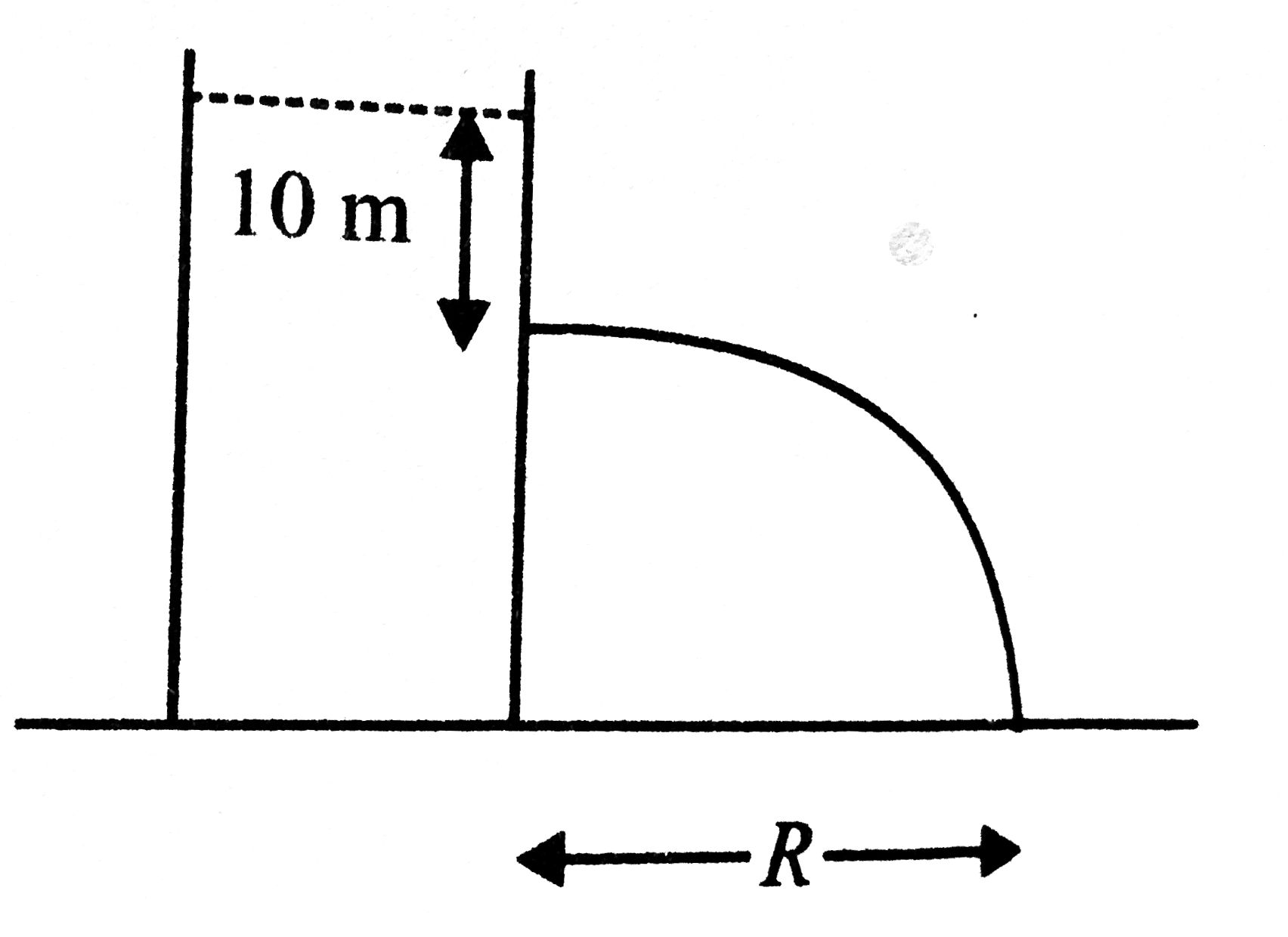
The range of water flowing out of a small hole made at a depth `10 m` below water surface in a large tank is `R`. Find the extra pressure (in atm) applied on the water surface so that range becomes `2R`. Take `1atm=10^(5)Pa`.

Text Solution

Verified by Experts

The correct Answer is:

3

Initial velocity of efflux: `v_1=sqrt(2gh)`
For range to become double, velocity of efflux should be doubled: `v_2=2_(v_1)=2sqrt(2gh)`
Let extra pressur applied be p, then
`(p_0+p_0+pgh)-p_0=1/2pv_2^2`
`implies p+pgh=1/2p8gh`
`impliesp+3rhogh=3xx10^3xx10xx10xx10=3xx10^5Pa=3atm`
Promotional Banner

Topper's Solved these Questions

  • MISCELLANEOUS VOLUME 2

    CENGAGE PHYSICS ENGLISH|Exercise LC_TYPE|34 Videos
  • MISCELLANEOUS KINEMATICS

    CENGAGE PHYSICS ENGLISH|Exercise Interger type|3 Videos
  • NEWTON'S LAWS OF MOTION 1

    CENGAGE PHYSICS ENGLISH|Exercise Integer|5 Videos

Similar Questions

Explore conceptually related problems

A large tank is filled waith water (density = 10^(3) kg//m^(3) ). A small hole is made at a depth 10 m below water surface. The range of water issuing out of the hole is R on ground. Approximately what extra pressure must be applied on the water surface so that the range becomes 2R (take 1 atm = 10^(5) Pa and g = 10 m//s^(2) )

A tank is filled by water ( rho = 10^3 kg//m^3 ). A small hole is made in the side wall of the tank at depth 10 m below water surface. A water jet emerges horizontal from the hole and falls at horizontal distance R from it. The amount of extra pressure (in terms of atmospheric pressure) that must be applied on the water surface, so that range becomes 3R on the on the ground will be (cross section area of hole is negligible and 1 atm = 105 Pa, g = 10 m/ s^2 )

A tank is filled to a height H. The range of water coming out of a hole which is a depth H//4 from the surface of water level is

What is the absolute pressure on a swimmer 10 m below the surface of a lake? Take atmospheric pressure 1xx10^(5)N//m^(2)

An air bubble of radius 1mm is formed inside water at a depth 10m below free surface (where air pressure is 10^5 N/m^2 ). The pressure inside the bubble is – (Surface tension of water = 7 x× 10^(–2) N//m)

A water tank is 20 m deep . If the water barometer reads 10 m at the surface , then what is the pressure at the bottom of the tank in atmosphere ?

An air bubble of radius r in water is at a depth h below the water surface at some instant. If P is atmospheric pressure, d and T are density and surface tension of water respectively . the pressure inside the bubble will be :

An air filled balloon is at a depth of 1 km below the water level in an ocean . The normal stress of the balloon (in Pa) is (Given, rho_("water") = 10^(3) kgm^(-3), g = 9.8 ms^(-2) and P_(atm) = 10^(5) Pa)

What is the pressure on a swimmer 10m below the surface of lake? g=10ms^(-2) , atmospheric pressure = 1.01 xx 10^(5)Pa

Water is flowing condinuously from a tap of area 10^(-4)m^(2) the water velocity as it leaves the top is 1m//s find out area of the water stream at a distance 0.15 m below the top
