Home
Class 12
PHYSICS
Three charges are placed as shown in fig...

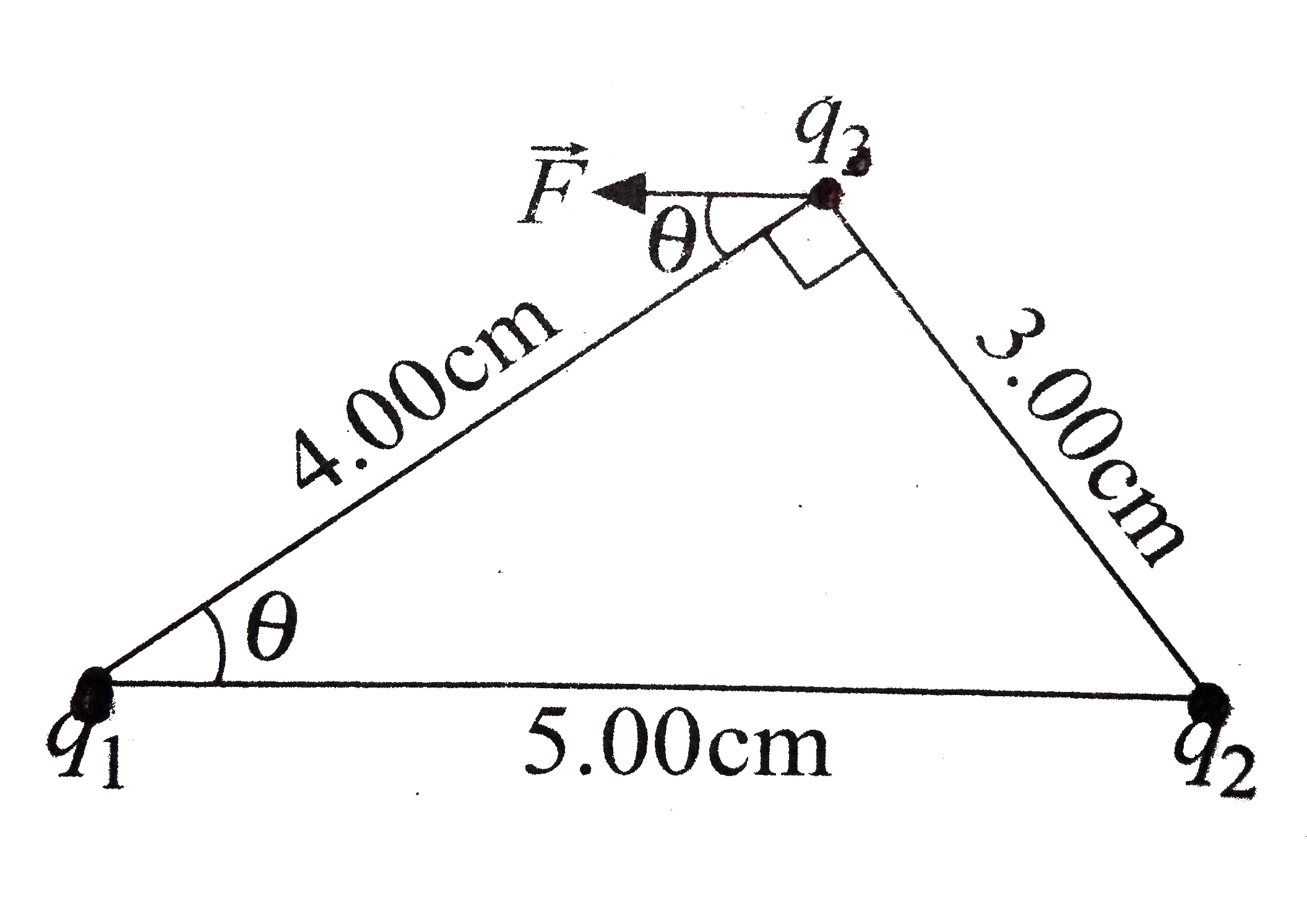
Three charges are placed as shown in fig. the magnitude of `q_(1)` is `2.00mu C`, but its sign is unknown. Value of charge `q_(2)` is unknown and the value of the charge `q_(3)` is `+4.00muC`, and the net force on `q_(3)` is entirely in the negative x-direction

As per the condition given in the problem, the sign of `q_(1)` and `q_(2)` will be

A

`25.25N`

B

`32.5N`

C

`56.25N`

D

`13.5N`

Text Solution

Verified by Experts

The correct Answer is:
C

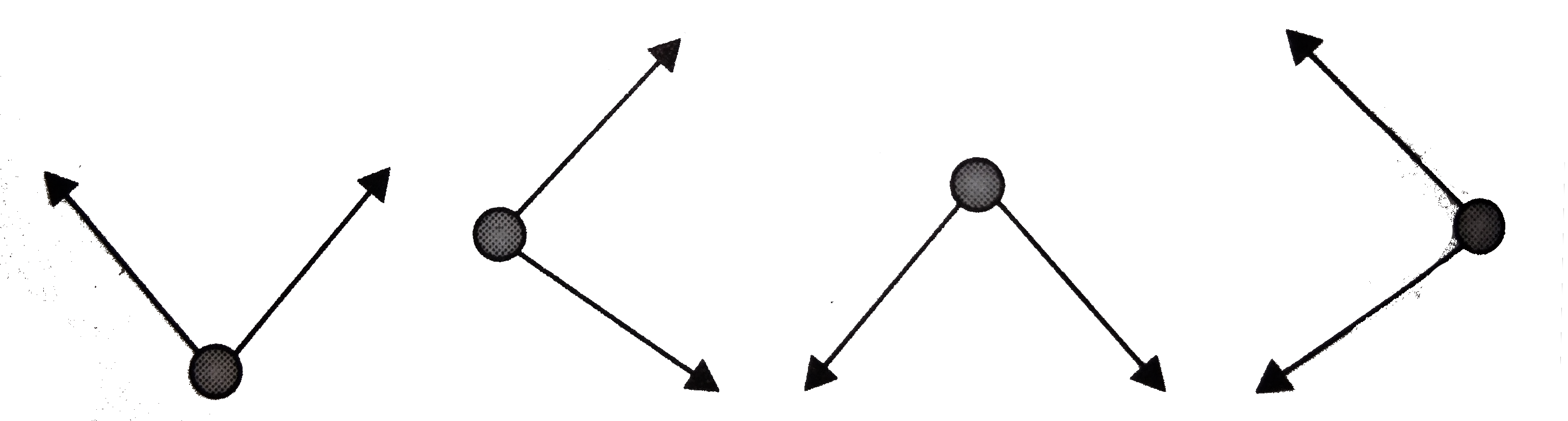
The four possibel force diagrame are shown in fig. Only the last pocture can result in an electric field the negative x-direction
`q_(1)=-2.00(mu)C, q_(2)= +4.00(mu)C, and q_(2)gt0`

`E_(y)=0=(1)/(4 pi epsilon_(0)) (q_1)/((0.0400m)^(2)) sin theta -(1)/(4 pi epsilon_(0))(q_2)/((0.0300m)^(2)) cos theta`
`q_(2)=9/16 (sin theta)/(cos theta)=9/16 q_(1) (3//5)/(4//5)=(27)/(64) q_(1)=0.843mu C`
`F_(3)=q_(3)E_(x)=q_(3)(1)/(4 pi epsilon_(0))((q_(1))/(0.0016)(4)/(5)+(q_(2))/(0.0009)3/5)=56.25N`.
Promotional Banner

Topper's Solved these Questions

  • COULOMB LAW AND ELECTRIC FIELD

    CENGAGE PHYSICS ENGLISH|Exercise Integer|8 Videos
  • COULOMB LAW AND ELECTRIC FIELD

    CENGAGE PHYSICS ENGLISH|Exercise Single Correct Ansewr Type|20 Videos
  • COULOMB LAW AND ELECTRIC FIELD

    CENGAGE PHYSICS ENGLISH|Exercise Multiple Correct|8 Videos
  • CENGAGE PHYSICS DPP

    CENGAGE PHYSICS ENGLISH|Exercise subjective type|51 Videos
  • ELECTRIC CURRENT & CIRCUITS

    CENGAGE PHYSICS ENGLISH|Exercise Kirchhoff s law and simple circuits|15 Videos

Similar Questions

Explore conceptually related problems

Three charges are placed as shown in fig. the magnitude of q_(1) is 2.00mu C , but its sign and the value of the charge q_(3) is +4.00muC , and the net force on q_(3) is entirely in the negative x-direction As per the condition given in the problem, the value of q_(2) will be

A positive point charge q_(1) is placed at (a,0) and another positive point charge q_(2) is placed at (0,a) . Find the force acting on q_(1) .

Three charges -q_(1), +q_(2) and -q_(3) are placed as shown in the figure. The x -component of the force on -q_(1) is proportional to

A charge q_(1) exerts some force on a second charge q_(2) If a third charge q_(3) is brought near q_(2) , then the force exterted by q_(1) on q_(2)

Three charges -q,+2q, and -q are arranged on a line as shown in fig. Calculate the field at a distance rgtgta on the line.

Point charge are placed at the verticas of a squre of side a as shown in fig. What should be the sign of charge q and magnitude of the ratio |q//Q| so that (i) net force on each Q is zero? (ii) net force on each q is zero? Is it possible that the entire system could be in electrostatic equilibrium?

Find the force on a charge q_(1)(=20 mu C) due to the charge of q_(2)(=10 mu C) if the positions of the charges are given as P_(1)(1,-1,2) and Q(-1,1,1)

Three charges q_(1) = 1 mu C, q_(2) = -2 muC and q_(3) = 3mu C are placed on the vertices of an equilateral triangle of side 1.0 m. find the net electric force acting on charge q_(1) . How to proceed Charge q_(2) will attract charge q_(1) (along the line joining them) and charge q_(3) will repel charge q_(1) . Therefore, two forces will act on q_(1) , one due to q_(2) and another due to q_(3) . Since , the force is a vector quantity both of these force (say F_(1) and F_(2) ) will be added by vector method. Following are two methods of their addition

In figure two positive charges q_(2) and q_(3) fixed along the y-axis ,exert a net electric force in the +x direction on a charge q_(1) fixed along the x-axis if a positive charge Q is added at (x,0) the force on q_(1)

In figure two positive charges q_(2) and q_(3) fixed along the y-axis, exert a net electric force in the +x direction on a charge q_(1) fixed along the x-axis if a positive charge Q is added at (x,0) the force on q_(1)

CENGAGE PHYSICS ENGLISH-COULOMB LAW AND ELECTRIC FIELD-Comprehension
  1. Three charges are placed as shown in fig. the magnitude of q(1) is 2.0...

    Text Solution

    |

  2. Three charges are placed as shown in fig. the magnitude of q(1) is 2.0...

    Text Solution

    |

  3. Three charges are placed as shown in fig. the magnitude of q(1) is 2.0...

    Text Solution

    |

  4. Two point charge Q(a) and Q(b) are positional at point A and B. The fi...

    Text Solution

    |

  5. Two point charge Q(a) and Q(b) are positional at point A and B. The fi...

    Text Solution

    |

  6. Two point charge Q(a) and Q(b) are positional at point A and B. The fi...

    Text Solution

    |

  7. Four equal positive charges, each of value Q, are arranged at the four...

    Text Solution

    |

  8. Four equal positive charges, each of value Q, are arranged at the four...

    Text Solution

    |

  9. An electron is projected with an initial speed v(0)=1.60xx10^(6)ms^(-1...

    Text Solution

    |

  10. An electron is projected with an initial speed v(0)=1.60xx10^(6)ms^(-1...

    Text Solution

    |

  11. An electron is projected with an initial speed v(0)=1.60xx10^(6)ms^(-1...

    Text Solution

    |

  12. An electron is projected with an initial speed v(0)=1.60xx10^(6)ms^(-1...

    Text Solution

    |

  13. An electron is projected as shown in fig. with kinetic energy K, at an...

    Text Solution

    |

  14. An electron is projected as shown in fig. with kinetic energy K, at an...

    Text Solution

    |

  15. In 1909, Robert Millikan war the firest to find the charge of an elect...

    Text Solution

    |

  16. In 1909, Robert Millikan was the first to find the charge of an electr...

    Text Solution

    |

  17. A simple pendulum of mass m charged negatively to q coulomb oscillates...

    Text Solution

    |

  18. A simple pendulum of mass m charged negatively to q coulomb oscillates...

    Text Solution

    |

  19. There is an insulator rod of length L and of negligible mass with two ...

    Text Solution

    |

  20. There is an insulator rod of length L and of negligible mass with two ...

    Text Solution

    |

