Home
Class 12
PHYSICS
An electron is projected with an initial...

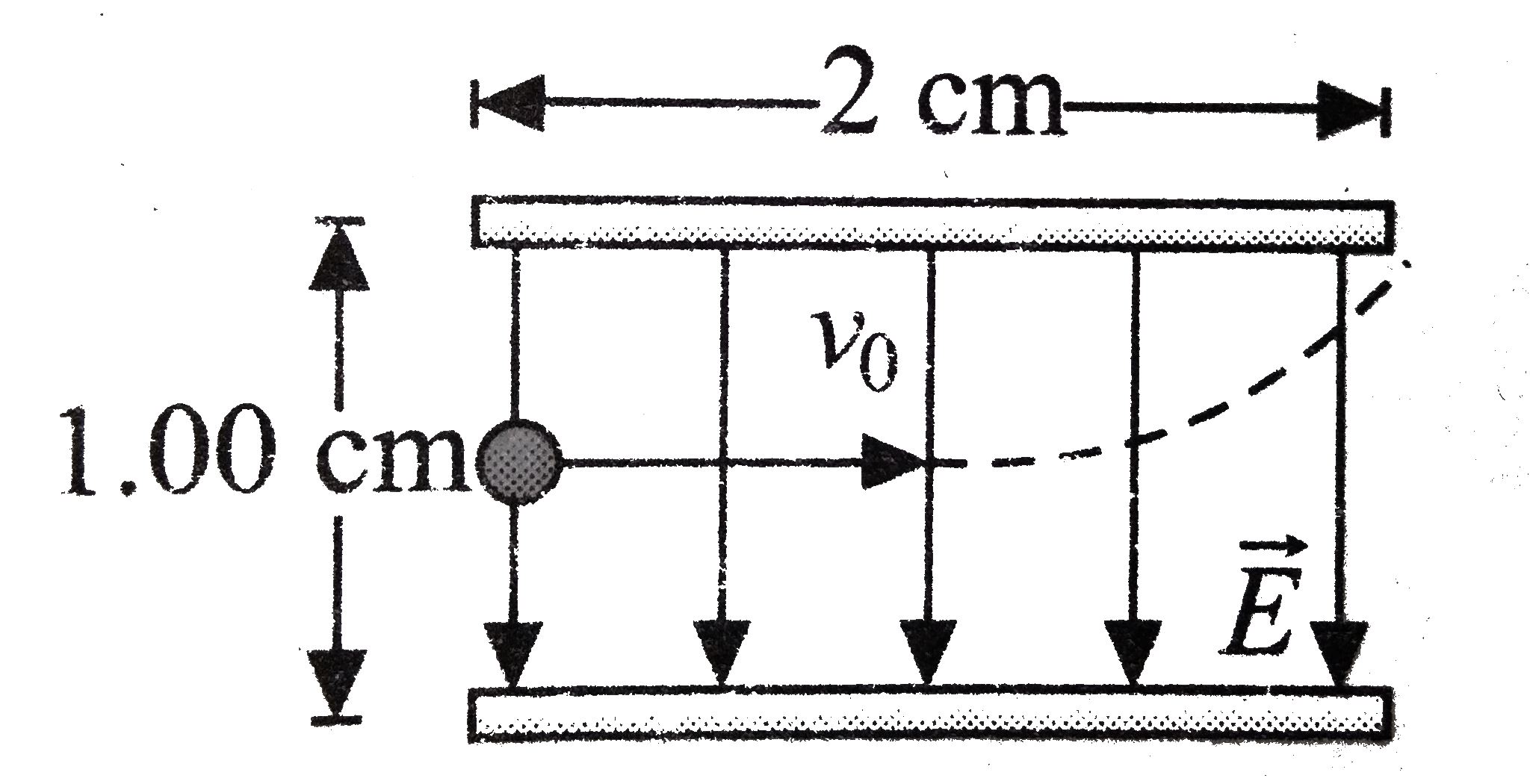
An electron is projected with an initial speed `v_(0)=1.60xx10^(6)ms^(-1)` into the uniform field between the parallel plates as shown in fig. Assume that the field between the plates is uniform and directed vertically downward, and that the field outside the plates is zero. the electrons enters the field at a point midway between the plates. Mass of electron is `9.1xx10^(-31)kg`.

For the condition of hte previous situation, the magnitude of electric field is

A

the proton will hit the upper plate.

B

the proton will hit the lower plate.

C

the proton will not hit either plate.

D

None of these

Text Solution

Verified by Experts

The correct Answer is:

C

Passing between the charged plates, the electron feels a force upward and just misses the top plate. The distance it travels in upward and just misses the to plate. The distance it travels in the y-direction is 0.005m. Time of flight is `t=(0.0200m)/(1.60xx10^(6)ms^(-1))`
`=1.25zz10^(-8)s`
the initial y-velocity is zero.
Now, `y=v_(0y)t+1/2at^(2)`
so, `0.005m=1/2a(1.25xx10^(-8)s)^(2)`
or, `a=6.40xx10^(13)ms^(-2)`
But also `a=(F)/(m)=(eE)/(m_(e))`
`E=((9.1xx10^(-31)kg)(6.40xx10^(13)ms^(-2)))/(1.60xx10^(-19)C)`
`=364NC^(-1)`
Since the proton is more massive, it will acceletate less and not hit the plates. To find the vertical displacement when it exists the plates we use the kinematic equation again.
`y=1/2at^(2)=1/2(eE)/(m_p)(1.25xx10^(-8)s)^(2)`
`=2.73xx10^(-6)m`
As mentioned in (b), the proton will not hit one of the plates because although the electric force felt by the proton is the same as the electrons felt, a smaller accelaration produced by the electric force is much greater than g, it is reasonable to ignore gravity.
Promotional Banner

Topper's Solved these Questions

  • COULOMB LAW AND ELECTRIC FIELD

    CENGAGE PHYSICS ENGLISH|Exercise Integer|8 Videos
  • COULOMB LAW AND ELECTRIC FIELD

    CENGAGE PHYSICS ENGLISH|Exercise Single Correct Ansewr Type|20 Videos
  • COULOMB LAW AND ELECTRIC FIELD

    CENGAGE PHYSICS ENGLISH|Exercise Multiple Correct|8 Videos
  • CENGAGE PHYSICS DPP

    CENGAGE PHYSICS ENGLISH|Exercise subjective type|51 Videos
  • ELECTRIC CURRENT & CIRCUITS

    CENGAGE PHYSICS ENGLISH|Exercise Kirchhoff s law and simple circuits|15 Videos

Similar Questions

Explore conceptually related problems

An electron is projected with an initial speed v_(0)=1.60xx10^(6)ms^(-1) into the uniform field between the parallel plates as shown in fig. Assume that the field between the plates is uniform and directed vertically downward, and that the field outside the plates is zero. the electrons enters the field at a point midway between the plates. Mass of electron is 9.1xx10^(-31)kg . The vertical displacement traveled by the proton as it exits the region between the plated is (mass pf proton is 1.67xx10^(-27)kg ).

An electron is projected with an initial speed v_(0)=1.60xx10^(6)ms^(-1) into the uniform field between the parallel plates as shown in fig. Assume that the field between the plates is uniform and directed vertically downward, and that the field outside the plates is zero. the electrons enters the field at a point midway between the plates. Mass of electron is 9.1xx10^(-31)kg . The vertical displacement traveled by the proton as it exits the region between the plated is (mass pf proton is 1.67xx10^(-27)kg ).

An uncharged parallel plate capacitor is connected to a battery. The electric field between the plates is 10V/m. Now a dielectric of dielectric constant 2 is inserted between the plates filling the entries space. The electric field between the plates now is

The force between two electrons when placed in air is equal to 0.5 times the weight of an electron. Find the distance between two electrons (mass of electron = 9.1 xx 10^(-31)kg )

A uniform electric field E is created between two parallel ., charged plates as shown in figure . An electron . enters the field symmetrically between the plates with a . speed v_(0)'. The length of each plate is l. Find the angle of . deviation of the path of the electron as it comes out . of the field.

A uniform electric field E is created between two parallel ., charged plates as shown in figure . An electron . enters the field symmetrically between the plataes with a . speed v_0. The length of each plate is l. Find the angle of . deviation of the path of the electron as it comes out . of the field.

A parallel plate capacitor has a uniform electric field E in the space between the the plates. If the distance between the plates is d and area of each plate is A, the energy stored in the capacitor is

Two parallel plates carry opposites charges such that the electric field in the space between them is in upward direction. An electron is shot in the space and parallel to the plates . Its deflection from the original direction will be

A uniform electric field and a uniform magneitc field exist in a region in the same direction An electron is projected with velocity pointed in the same direction the electron will

A parallel plate capacitor of plate area A and plates separation distance d is charged by applying a potential V_(0) between the plates. The dielectric constant of the medium between the plates is K. What is the uniform electric field E between the plates of the capacitor ?

CENGAGE PHYSICS ENGLISH-COULOMB LAW AND ELECTRIC FIELD-Comprehension
  1. Three charges are placed as shown in fig. the magnitude of q(1) is 2.0...

    Text Solution

    |

  2. Three charges are placed as shown in fig. the magnitude of q(1) is 2.0...

    Text Solution

    |

  3. Two point charge Q(a) and Q(b) are positional at point A and B. The fi...

    Text Solution

    |

  4. Two point charge Q(a) and Q(b) are positional at point A and B. The fi...

    Text Solution

    |

  5. Two point charge Q(a) and Q(b) are positional at point A and B. The fi...

    Text Solution

    |

  6. Four equal positive charges, each of value Q, are arranged at the four...

    Text Solution

    |

  7. Four equal positive charges, each of value Q, are arranged at the four...

    Text Solution

    |

  8. An electron is projected with an initial speed v(0)=1.60xx10^(6)ms^(-1...

    Text Solution

    |

  9. An electron is projected with an initial speed v(0)=1.60xx10^(6)ms^(-1...

    Text Solution

    |

  10. An electron is projected with an initial speed v(0)=1.60xx10^(6)ms^(-1...

    Text Solution

    |

  11. An electron is projected with an initial speed v(0)=1.60xx10^(6)ms^(-1...

    Text Solution

    |

  12. An electron is projected as shown in fig. with kinetic energy K, at an...

    Text Solution

    |

  13. An electron is projected as shown in fig. with kinetic energy K, at an...

    Text Solution

    |

  14. In 1909, Robert Millikan war the firest to find the charge of an elect...

    Text Solution

    |

  15. In 1909, Robert Millikan was the first to find the charge of an electr...

    Text Solution

    |

  16. A simple pendulum of mass m charged negatively to q coulomb oscillates...

    Text Solution

    |

  17. A simple pendulum of mass m charged negatively to q coulomb oscillates...

    Text Solution

    |

  18. There is an insulator rod of length L and of negligible mass with two ...

    Text Solution

    |

  19. There is an insulator rod of length L and of negligible mass with two ...

    Text Solution

    |

  20. There is an insulator rod of length L and of negligible mass with two ...

    Text Solution

    |
