Home
Class 12
PHYSICS
A simple pendulum of mass m charged nega...

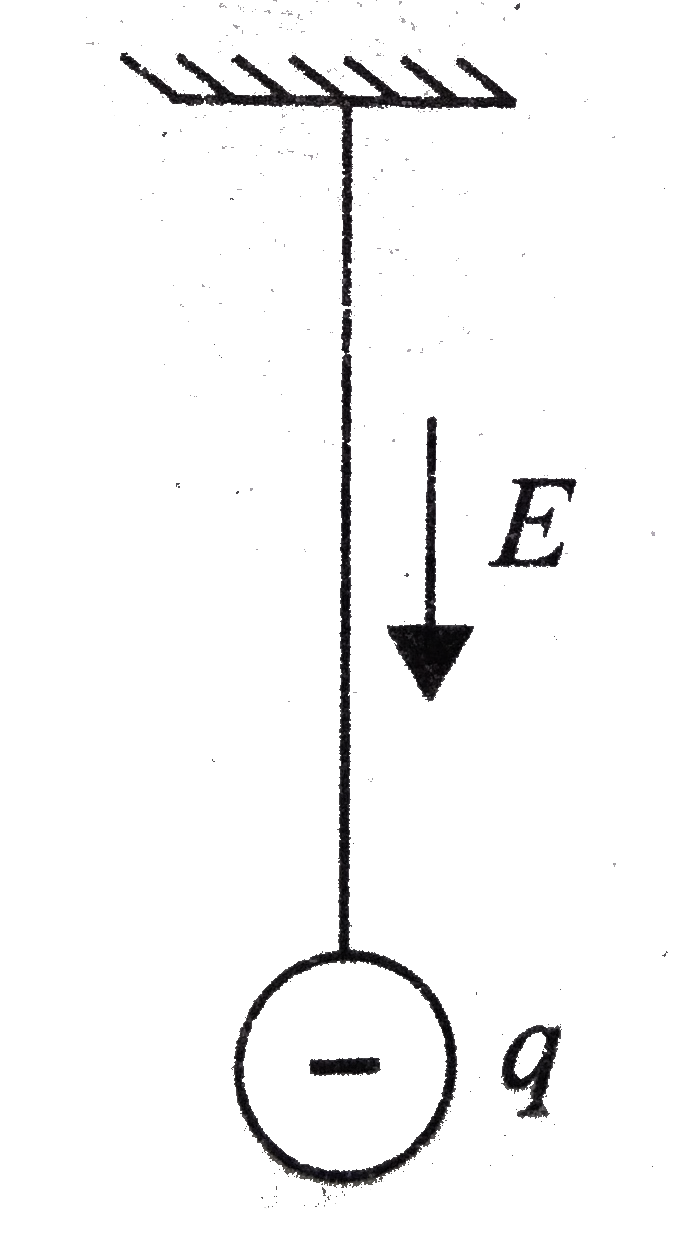
A simple pendulum of mass m charged negatively to q coulomb oscillates with a timeperiod T in a down ward electric field E such that `mggtqE..

If the electric field is withdrawn, at equilibrium of he bob, the change in tension in the string will be (assuming rest condition)

A

mg

B

qE

C

2qE

D

`qE//2`

Text Solution

Verified by Experts

The correct Answer is:

B

`T=2 pi sqrt((l)/((mg-qE)//m))`
`T'=2 pi sqrt((l)/(g))`
or ` T' lt T`
Obviously change in tension is qE. Tension will increase by qE.
Promotional Banner

Topper's Solved these Questions

  • COULOMB LAW AND ELECTRIC FIELD

    CENGAGE PHYSICS ENGLISH|Exercise Integer|8 Videos
  • COULOMB LAW AND ELECTRIC FIELD

    CENGAGE PHYSICS ENGLISH|Exercise Single Correct Ansewr Type|20 Videos
  • COULOMB LAW AND ELECTRIC FIELD

    CENGAGE PHYSICS ENGLISH|Exercise Multiple Correct|8 Videos
  • CENGAGE PHYSICS DPP

    CENGAGE PHYSICS ENGLISH|Exercise subjective type|51 Videos
  • ELECTRIC CURRENT & CIRCUITS

    CENGAGE PHYSICS ENGLISH|Exercise Kirchhoff s law and simple circuits|15 Videos

Similar Questions

Explore conceptually related problems

A simple pendulum of mass m charged negatively to q coulomb oscillates with a timeperiod T in a down ward electric field E such that mggtqE.. If the electric field is withdrawn, the new time period

A simple pendulum of mass m charged negatively to q coulomb oscillates with a time period T in a down ward electric field E such that mg gt qE.. If the electric field is withdrawn, the new time period

A pendulum bob of mass m charge q is at rest with its string making an angle theta with the vertical in a uniform horizontal electric field E. The tension in the string in

A simple pendulum having a bob of mass m under goes small oscillations with amplitude theta_0 Find the tension in the string as a function of the angle made by the string with the vertical. When in this tension maximum, and when is it minimum?

A particle of mass m and charge Q is attached to a string of length l. It is whirled in a vertical circle in the region of an electric field E as shown in the figure-5.105.What is the speed given to the particle at the point B,so that tension in the string when the particle is at A is ten times the weight of the particle?

A charged particle of mass m and charge q is released from rest in an electric field of constant magnitude E . The kinetic energy of the particle after time t is

A simple pendulum with charge bob is oscillating as shown in the figure. Time period of oscillation is T and angular ampliltude is theta . If a uniform magnetic field perpendicular to the plane of oscillation is switched on, then

Statement 1: A pendulum made of an insulated rigid massless rod of length l is attached to a small sphere of mass m and charge q. The pendulum is undergoinng oscillations of small amplitude having time period T. Now a uniform horizontal magnetic field vec B out of plane of page is switched on. As a result of this change, the time period of oscillations does not change. Statement 2: A force acting along the string on the bob of a simple pendulum (such that tension in string is never zero) does not produce any restoring torque on the bob about the hinge.

Two particles, carrying charges -q and +q and having equal masses m each, are fixed at the rod is clamped at an end and is placed in a uniform electric field E with the axis of the dipole along the electric field. The rod is slightly tlted and then released. Neglecting gravity find the time period of small oscillations.

A charge of mass .m. charge .2e. is released from rest in a uniform electric field of strength .E.. The time taken by it to travel a distance .d. in the field is

CENGAGE PHYSICS ENGLISH-COULOMB LAW AND ELECTRIC FIELD-Comprehension
  1. Three charges are placed as shown in fig. the magnitude of q(1) is 2.0...

    Text Solution

    |

  2. Three charges are placed as shown in fig. the magnitude of q(1) is 2.0...

    Text Solution

    |

  3. Two point charge Q(a) and Q(b) are positional at point A and B. The fi...

    Text Solution

    |

  4. Two point charge Q(a) and Q(b) are positional at point A and B. The fi...

    Text Solution

    |

  5. Two point charge Q(a) and Q(b) are positional at point A and B. The fi...

    Text Solution

    |

  6. Four equal positive charges, each of value Q, are arranged at the four...

    Text Solution

    |

  7. Four equal positive charges, each of value Q, are arranged at the four...

    Text Solution

    |

  8. An electron is projected with an initial speed v(0)=1.60xx10^(6)ms^(-1...

    Text Solution

    |

  9. An electron is projected with an initial speed v(0)=1.60xx10^(6)ms^(-1...

    Text Solution

    |

  10. An electron is projected with an initial speed v(0)=1.60xx10^(6)ms^(-1...

    Text Solution

    |

  11. An electron is projected with an initial speed v(0)=1.60xx10^(6)ms^(-1...

    Text Solution

    |

  12. An electron is projected as shown in fig. with kinetic energy K, at an...

    Text Solution

    |

  13. An electron is projected as shown in fig. with kinetic energy K, at an...

    Text Solution

    |

  14. In 1909, Robert Millikan war the firest to find the charge of an elect...

    Text Solution

    |

  15. In 1909, Robert Millikan was the first to find the charge of an electr...

    Text Solution

    |

  16. A simple pendulum of mass m charged negatively to q coulomb oscillates...

    Text Solution

    |

  17. A simple pendulum of mass m charged negatively to q coulomb oscillates...

    Text Solution

    |

  18. There is an insulator rod of length L and of negligible mass with two ...

    Text Solution

    |

  19. There is an insulator rod of length L and of negligible mass with two ...

    Text Solution

    |

  20. There is an insulator rod of length L and of negligible mass with two ...

    Text Solution

    |
