


Home
Class 12
PHYSICS
There is an insulator rod of length L an...

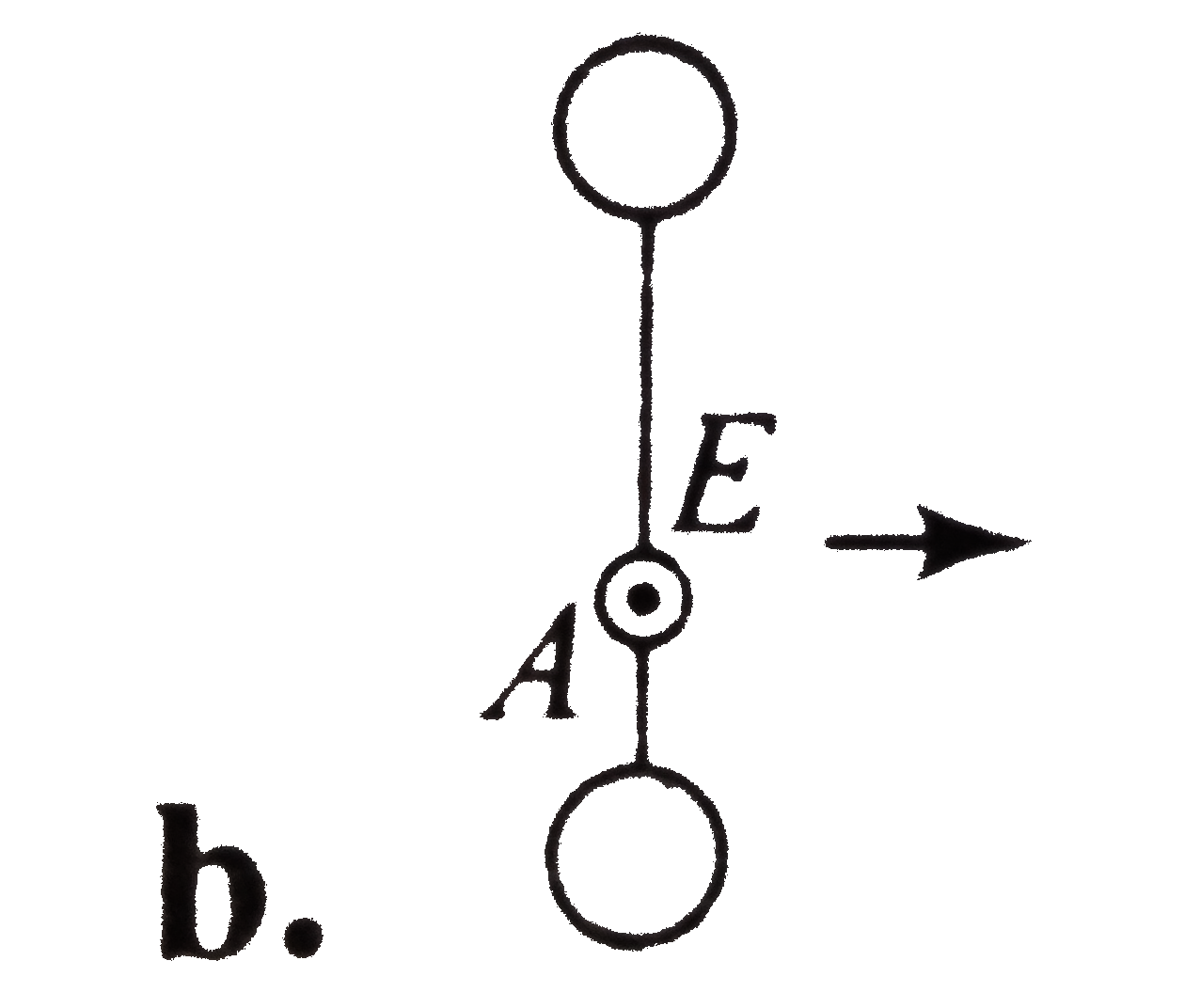
There is an insulator rod of length L and of negligible mass with two small balls of mass m and electric charge Q attached to its ends. The rod can rotate in the horizontal plane around a vertical axis crossing it at a distance `L//4` from one of its ends.
What is the time period of the SHM as mentioned in the above question, if an electric field `E` is applied along horizontal?

A

B

C

D

Text Solution

AI Generated Solution

The correct Answer is:

To solve the problem, we need to determine the time period of the simple harmonic motion (SHM) of the system described. Here’s a step-by-step solution: ### Step 1: Understand the System We have an insulating rod of length \( L \) with two small balls of mass \( m \) and charge \( Q \) attached to its ends. The rod can rotate about a vertical axis at a distance \( \frac{L}{4} \) from one end. An electric field \( E \) is applied horizontally. ### Step 2: Identify the Forces Acting on the System When the rod is displaced from its equilibrium position, the electric force acting on each ball due to the electric field is given by: \[ F = QE \] This force will cause a torque about the pivot point. ### Step 3: Calculate the Torque The torque \( \tau \) due to the electric force on each ball can be calculated. For the ball at a distance \( \frac{3L}{4} \) from the pivot, the torque is: \[ \tau_1 = \left(\frac{3L}{4}\right) \cdot QE \cdot \sin(\theta) \] For the ball at a distance \( \frac{L}{4} \) from the pivot, the torque is: \[ \tau_2 = \left(\frac{L}{4}\right) \cdot QE \cdot \sin(\theta) \] The net torque \( \tau \) acting on the system is: \[ \tau = \tau_1 - \tau_2 = \left(\frac{3L}{4}QE - \frac{L}{4}QE\right) \sin(\theta) = \left(\frac{2L}{4}QE\right) \sin(\theta) = \frac{LQE}{2} \sin(\theta) \] ### Step 4: Relate Torque to Angular Acceleration According to Newton's second law for rotation, the torque is also related to the moment of inertia \( I \) and angular acceleration \( \alpha \): \[ \tau = I \alpha \] For the system, the moment of inertia \( I \) can be calculated as: \[ I = m\left(\frac{L}{4}\right)^2 + m\left(\frac{3L}{4}\right)^2 = m\left(\frac{L^2}{16} + \frac{9L^2}{16}\right) = m\left(\frac{10L^2}{16}\right) = \frac{5mL^2}{8} \] ### Step 5: Set Up the Equation for SHM Substituting the expression for torque into the equation for angular acceleration gives: \[ \frac{LQE}{2} \sin(\theta) = \frac{5mL^2}{8} \alpha \] Since for small angles \( \sin(\theta) \approx \theta \) and \( \alpha = \frac{d^2\theta}{dt^2} \), we can write: \[ \frac{LQE}{2} \theta = \frac{5mL^2}{8} \frac{d^2\theta}{dt^2} \] ### Step 6: Rearranging to Find the Angular Frequency Rearranging gives: \[ \frac{d^2\theta}{dt^2} + \frac{4QE}{5mL} \theta = 0 \] This is the standard form of SHM, where the angular frequency \( \omega^2 \) is: \[ \omega^2 = \frac{4QE}{5mL} \] ### Step 7: Calculate the Time Period The time period \( T \) of SHM is given by: \[ T = \frac{2\pi}{\omega} = 2\pi \sqrt{\frac{5mL}{4QE}} \] ### Final Answer Thus, the time period of the SHM is: \[ T = 2\pi \sqrt{\frac{5mL}{4QE}} \]

To solve the problem, we need to determine the time period of the simple harmonic motion (SHM) of the system described. Here’s a step-by-step solution: ### Step 1: Understand the System We have an insulating rod of length \( L \) with two small balls of mass \( m \) and charge \( Q \) attached to its ends. The rod can rotate about a vertical axis at a distance \( \frac{L}{4} \) from one end. An electric field \( E \) is applied horizontally. ### Step 2: Identify the Forces Acting on the System When the rod is displaced from its equilibrium position, the electric force acting on each ball due to the electric field is given by: \[ ...
Promotional Banner

Topper's Solved these Questions

  • COULOMB LAW AND ELECTRIC FIELD

    CENGAGE PHYSICS ENGLISH|Exercise Integer|8 Videos
  • COULOMB LAW AND ELECTRIC FIELD

    CENGAGE PHYSICS ENGLISH|Exercise Single Correct Ansewr Type|20 Videos
  • COULOMB LAW AND ELECTRIC FIELD

    CENGAGE PHYSICS ENGLISH|Exercise Multiple Correct|8 Videos
  • CENGAGE PHYSICS DPP

    CENGAGE PHYSICS ENGLISH|Exercise subjective type|51 Videos
  • ELECTRIC CURRENT & CIRCUITS

    CENGAGE PHYSICS ENGLISH|Exercise Kirchhoff s law and simple circuits|15 Videos

Similar Questions

Explore conceptually related problems

There is an insulator rod of length L and of negligible mass with two small balls of mass m and electric charge Q attached to its ends. The rod can rotate in the horizontal plane around a vertical axis crossing it ata distance L//4 from one of its ends. At first the rod is in unstabele equillbrium in a Horizontal uniform electric field of field strenght E. Then we gently displace it from this position. Determine the maximim velocity attained by the ball taht is closer to the axis in the subsequent motion

What will be the magnitude and polarity of induced emf across the rod, if it is rotating about an axis at a distance (L)/(4) from one of its ends.

A light rigid rod of mass M, and length L is pivoted at one of its end. The rod can swing freely in the vertical plane through a horizontal axis passing through the pivot. Show that the time period of the rod about the pivot is T = pi sqrt((2L)/(3g))

The moment of inertia of a uniform thin rod of length L and mass M about an axis passing through a point at a distance of L//3 from one of its ends and perpendicular to the rod is

A uniform rod of mass m and length l rotates in a horizontal plane with an angular velocity omega about a vertical axis passing through one end. The tension in the rod at a distance x from the axis is

A uniform rod of mass m and length L is free to rotate in the vertical plane about a horizontal axis passing through its end. The rod initially in horizontal position is released. The initial angular acceleration of the rod is:

A mass m is at a distance a from one end of a uniform rod of length l and mass M. Find the gravitational force on the mass due to tke rod.

A mass m is at a distance a from one end of a uniform rod of length l and mass M. Find the gravitational force on the mass due to the rod.

A uniform rod of length l , mass m , cross-sectional area A and Young's modulus Y is rotated in horizontal plane about a fixed vertical axis passing through one end, with a constant angular velocity omega . Find the total extension in the rod due to the tension produced in the rod.

A uniform rod ofmass M and length L is hanging from its one end free to rotate in a veritcal plane.A small ball of equal mass is attached of the lowe end as shown. Time period of small oscillations of the rod is

CENGAGE PHYSICS ENGLISH-COULOMB LAW AND ELECTRIC FIELD-Comprehension
  1. Three charges are placed as shown in fig. the magnitude of q(1) is 2.0...

    Text Solution

    |

  2. Three charges are placed as shown in fig. the magnitude of q(1) is 2.0...

    Text Solution

    |

  3. Two point charge Q(a) and Q(b) are positional at point A and B. The fi...

    Text Solution

    |

  4. Two point charge Q(a) and Q(b) are positional at point A and B. The fi...

    Text Solution

    |

  5. Two point charge Q(a) and Q(b) are positional at point A and B. The fi...

    Text Solution

    |

  6. Four equal positive charges, each of value Q, are arranged at the four...

    Text Solution

    |

  7. Four equal positive charges, each of value Q, are arranged at the four...

    Text Solution

    |

  8. An electron is projected with an initial speed v(0)=1.60xx10^(6)ms^(-1...

    Text Solution

    |

  9. An electron is projected with an initial speed v(0)=1.60xx10^(6)ms^(-1...

    Text Solution

    |

  10. An electron is projected with an initial speed v(0)=1.60xx10^(6)ms^(-1...

    Text Solution

    |

  11. An electron is projected with an initial speed v(0)=1.60xx10^(6)ms^(-1...

    Text Solution

    |

  12. An electron is projected as shown in fig. with kinetic energy K, at an...

    Text Solution

    |

  13. An electron is projected as shown in fig. with kinetic energy K, at an...

    Text Solution

    |

  14. In 1909, Robert Millikan war the firest to find the charge of an elect...

    Text Solution

    |

  15. In 1909, Robert Millikan was the first to find the charge of an electr...

    Text Solution

    |

  16. A simple pendulum of mass m charged negatively to q coulomb oscillates...

    Text Solution

    |

  17. A simple pendulum of mass m charged negatively to q coulomb oscillates...

    Text Solution

    |

  18. There is an insulator rod of length L and of negligible mass with two ...

    Text Solution

    |

  19. There is an insulator rod of length L and of negligible mass with two ...

    Text Solution

    |

  20. There is an insulator rod of length L and of negligible mass with two ...

    Text Solution

    |
