Home
Class 12
PHYSICS
A simple pendulum of length l and bob ma...

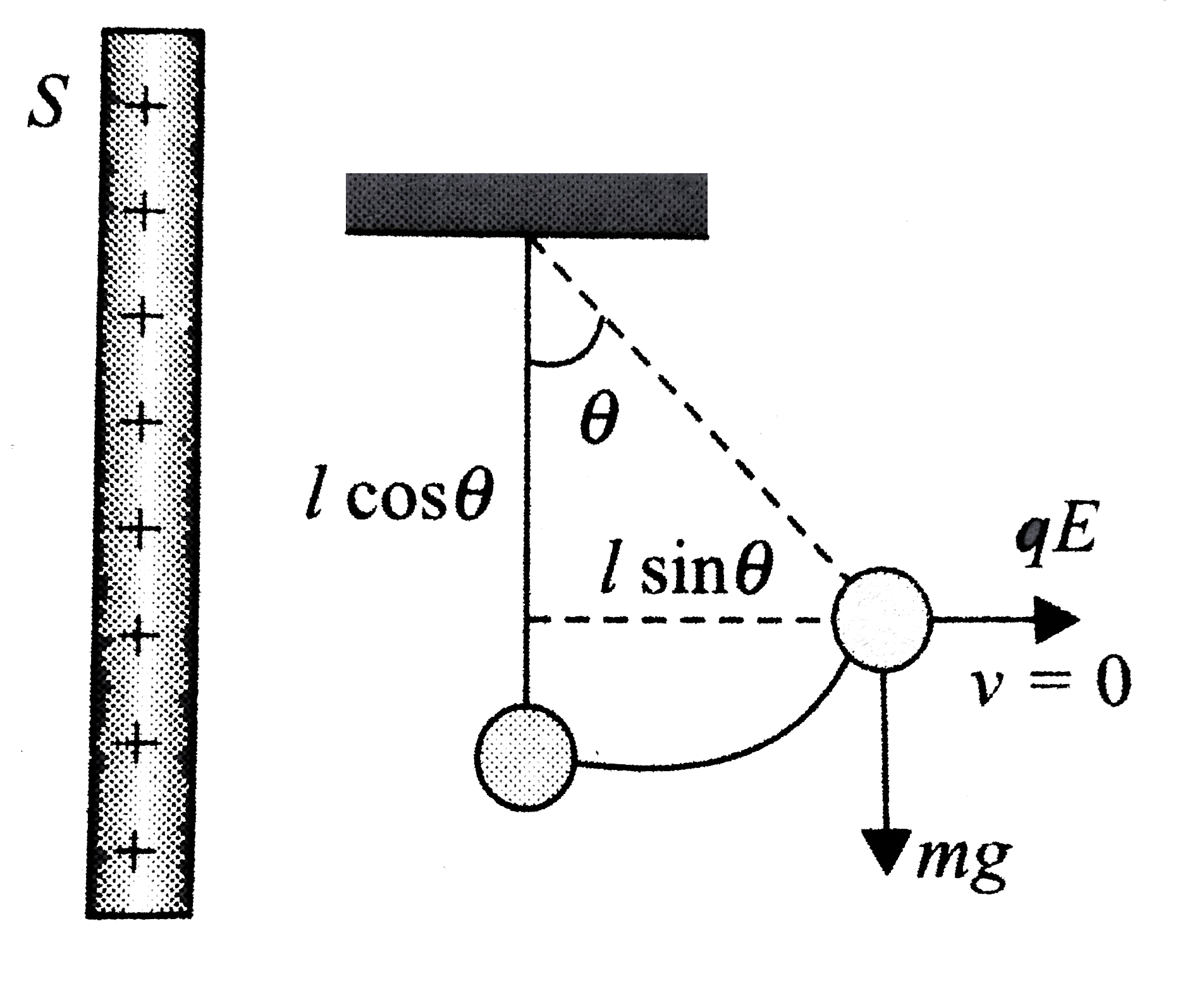
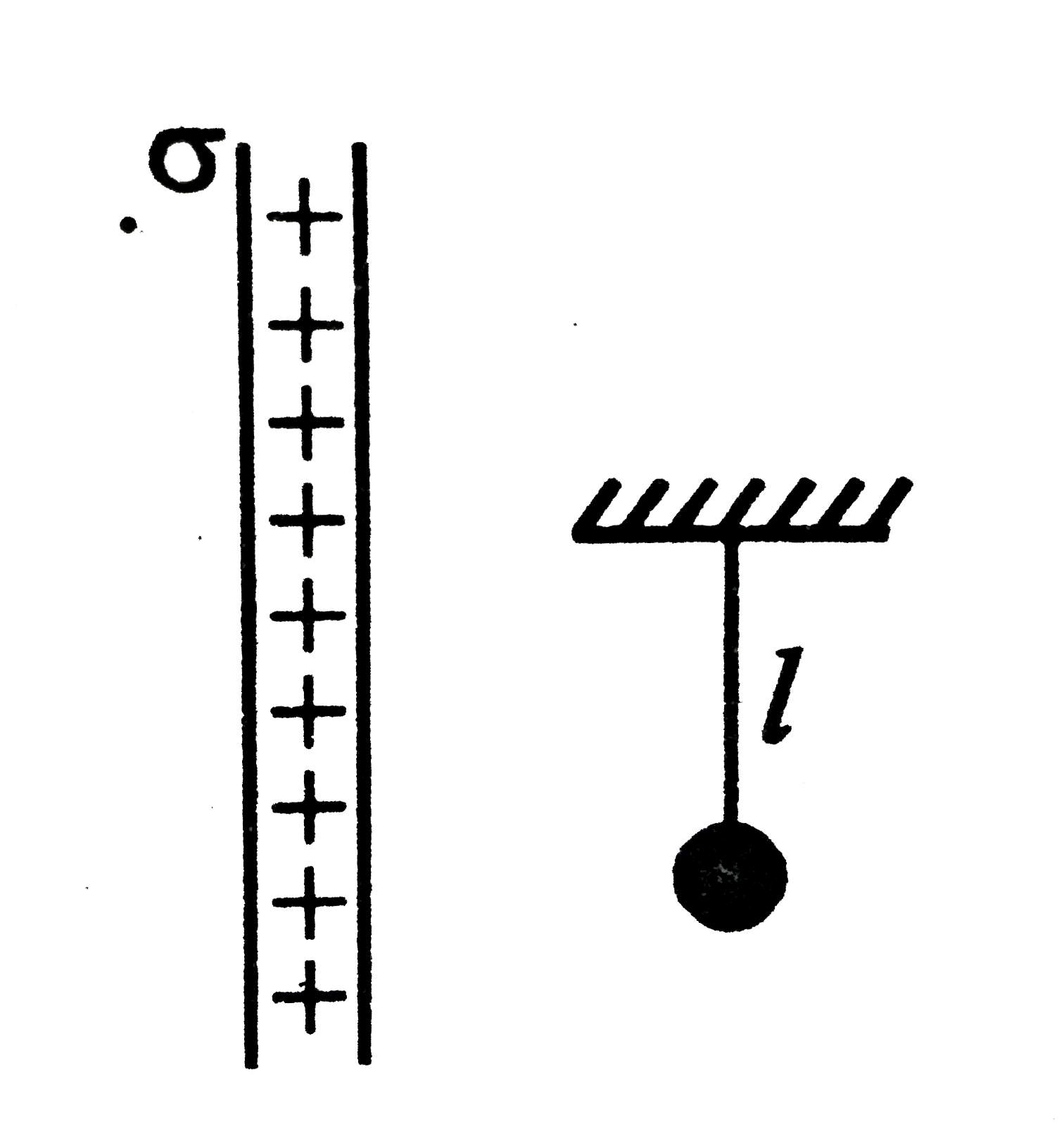
A simple pendulum of length `l` and bob mass `m` is hanging in front of a large nonconducting sheet having surface charge density `sigma`. If suddenly a charge `+q` is given to the bob `&` it is released from the position shown in figure. Find the maximum angle through which the string is deflected from vertical .
.

Text Solution

Verified by Experts

The electric field intensity due to nonconducting sheet is
`E = (sigma)/(2epsilon_0)` … (i)
According to work energy theorem, `W_("net") = Delta k = 0`
Since initial and final velocity of bob is zero,
.
Therefore, `W_E + W_g = 0` (ii)
`W_E = q E l sin theta`
`W_g = -mg (l - l cos theta)`
Putting the values in Eq. (ii)
`q E l sin theta - m g l (1 - cos theta) = 0`
or `q E l sin theta = mg l (1 - cos theta)`
or `(q E l)/(m g l)= (1 - cos theta)/(sin theta)` or `(q E)/(m g) = (2 "sin"^2 theta/2)/(2 "sin" theta/2"cos" theta/2 )`
or `(q E)/(m g) = "tan" theta/2` or `theta/2= "tan" ^-1((q E)/(m g))`
or `theta = 2 tan^-1 ((qE)/(mg))`
Putting the value of E from Eq. (i),
`theta=2 tan^(-1)((q sigma)/(2 epsilon_0 mg))`.
Promotional Banner

Topper's Solved these Questions

  • ELECTRIC POTENTIAL

    CENGAGE PHYSICS ENGLISH|Exercise Exercise 3.3|9 Videos
  • ELECTRIC POTENTIAL

    CENGAGE PHYSICS ENGLISH|Exercise Subjective|28 Videos
  • ELECTRIC POTENTIAL

    CENGAGE PHYSICS ENGLISH|Exercise Exercise 3.1|23 Videos
  • ELECTRIC FLUX AND GAUSS LAW

    CENGAGE PHYSICS ENGLISH|Exercise MCQ s|38 Videos
  • ELECTRICAL MEASURING INSTRUMENTS

    CENGAGE PHYSICS ENGLISH|Exercise M.C.Q|2 Videos

Similar Questions

Explore conceptually related problems

A bob of mass m is hanging from a cart of mass M . System is relased from rest from the position shown. Find the maximum speed of the cart with respect to ground.

A large nonconducting sheet M is given a uniform charge density. Two unchared small metal rods A and B are placed near the sheet as shown in figure

A large nonconducting sheet M is given a uniform charge density. Two unchared small metal rods A and B are placed near the sheet as shown in figure

A simple pendulum consisting of a mass M attached to a string of length L is released from rest at an angle alpha . A pin is located at a distance l below the pivot point. When the pendulum swings down, the string hits the pin as shown in figure. The maximum angle theta which the string makes with the vertical after hitting the pin is

An infinite, uniformly charged sheet with surface charge density sigma cuts through a spherical Gaussian surface of radius R at a distance X from its center, as shown in the figure. The electric flux Phi through the Gaussian surface is .

A simple pendulum of length l and bob of mass m is displaced from its equilibrium position O to a position P so that hight of P above O is h . If is then released. What is the tension in the string when the bob passes through the through the equilibrium position O ? Neglect friction. v is the velocity of the bob at O

Figure shows a large conducting ceiling having uniform charge particle of charge density sigma below which a charge particle of charge q_0 and mass m is hung from point O, through a small string of length l. Calculate the minimum horizontal velocity v required for the string to become horizontal. .

A simple pendulum of length l and mass m free to oscillate in vertical plane. A nail is located at a distance d=l-a vertically below the point of suspension of a simple pendulum. The pendulum bob is released from the position where the string makes an angle of 90^@ from vertical. Discuss the motion of the bob if (a) l=2a and (b) l=2.5a .

In a simple pendulum, the breaking strength of the string is double the weight of the bob. The bob is released from rest when the string is horizontal. The string breaks when it makes an angle theta with the vertical.

A simple pendulum of length 'l' and having bob of mass 'm' is doing angular SHM inside water A constant buoyant force equal to half the weight of he bob is acting on the ball. Find the time period of oscillation?