Home
Class 12
PHYSICS
Three concentric spherical conductors of...

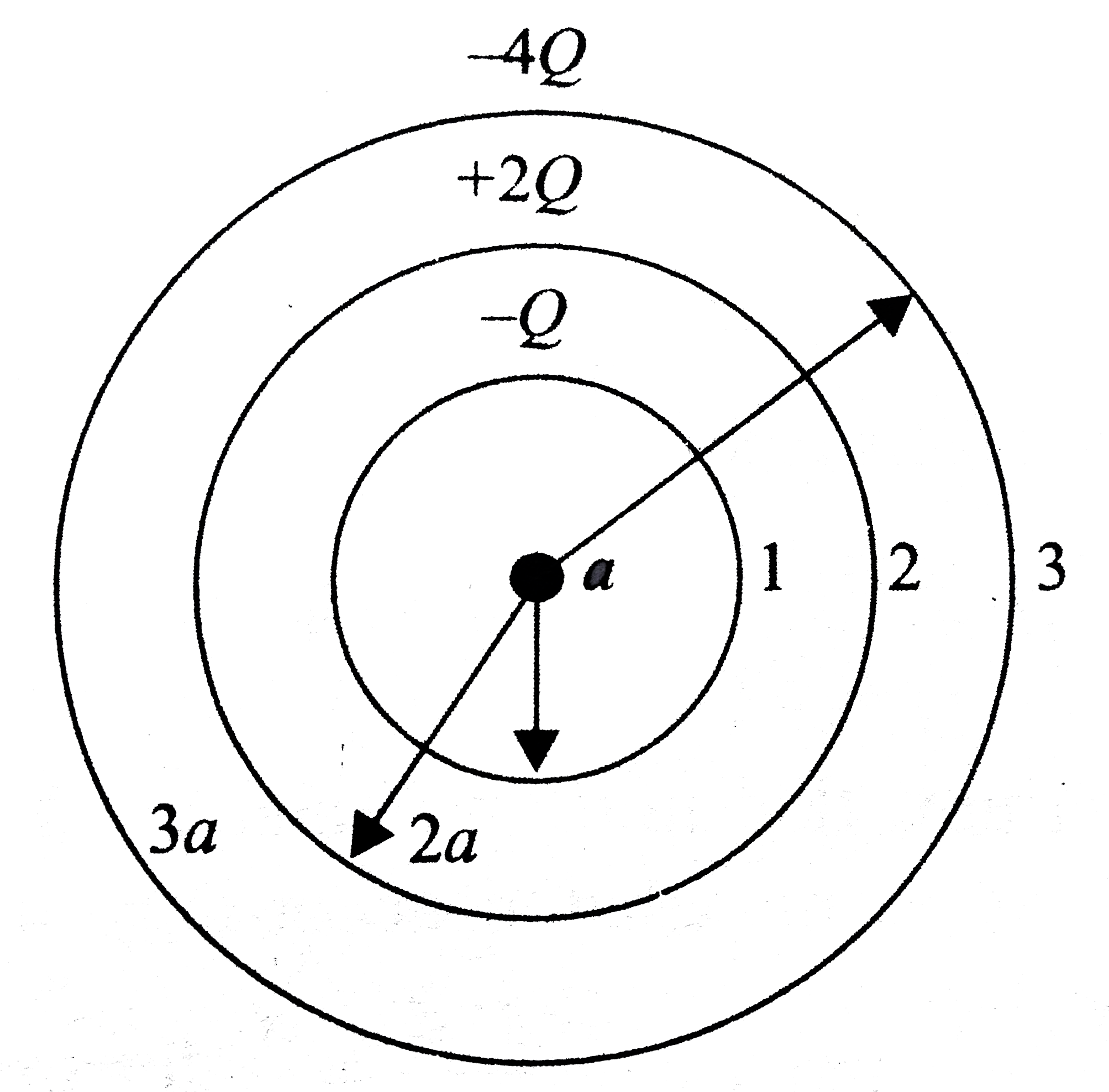
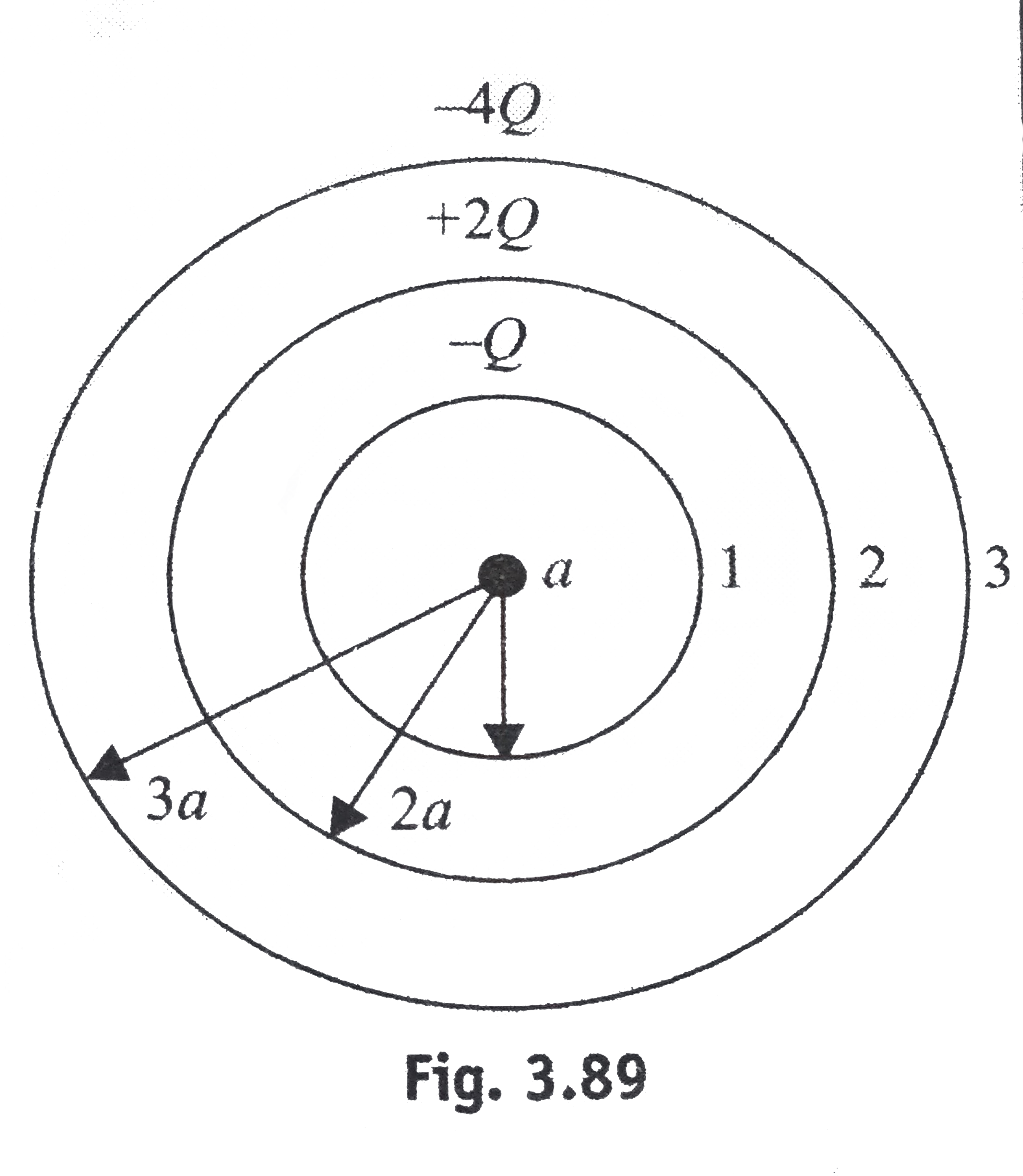
Three concentric spherical conductors of radii a, 2a, and 3a have charges `-Q, +2Q`, and `-4Q`, respectively. If r is the distance of the point under consideration from the center of the spheres, then find the electric field and potential due to the given configuration, for the values
(i) `r lt a`
(ii) `a lt r lt 2a`
(iii) `2 a lt r lt 3 a`
`r gt 3 a`.
.

Text Solution

Verified by Experts

(i) `r lt a`
`V = v_(1, "in") + V_(2,"in") + V_(3,"in")`
=`(1)/(4 pi epsilon_0) ((- Q))/a + (1)/(4 pi epsilon_0) ((2 Q))/(2 a) + (1)/(4 pi epsilon_0) ((-4 Q))/(3 a)`
=`(1)/(4 pi epsilon_0) Q/a[- 1 + 1 -(4)/(3)] = (1)/(4 pi epsilon_0)Q/a[-(4)/(3)] = -Q/(3 pi epsilon_0 a)`
.
(ii) `a,r lt 2 a`
`V = V_(1,out) + V_(2,out) + V_(3,out)`
=`(1)/(4 pi epsilon_0) ((-Q))/(r) + (1)/(4 pi epsilon_0) ((2 Q))/(2 a) + (1)/(4 pi epsilon_0)((-4Q))/(3 a)`
=`(1)/(4 pi epsilon_0) Q [-(1)/(r) + (1)/a -(4)/(3 a)] = (1)/(4 pi epsilon_0) Q [-(1)/(r) - (1)/(3 a)]`
=`- (1)/(4 pi epsilon_0) [(1)/(r) + (1)/(3 a)]`
(iii) `2a lt r, 3a`
`V = V_(1,out) + V_(2, out) + V_(3,"in")`
=`(1)/(4 pi epsilon_0)((- Q))/(r) + (1)/(4 pi epsilon_0)((2 Q))/(r) + (1)/(4 pi epsilon_0) ((-4Q))/(3 a)`
=`Q/(4 pi epsilon_0)[-(1)/(r) + (2)/(r) - (4)/(3 a)] = Q/(4 pi epsilon_0)[(1)/(r) - (4)/(3 a)]`
(iv) `r gt 3a`
`V = V_(1,out) + V_(2, out) + V_(3, out)`
=`(1)/(4 pi epsilon_0)((-Q))/(r) + (1)/(4 pi epsilon_0)((2 Q))/(r) + (1)/(4pi epsilon_0) ((-4 Q))/(r)`
=`(1)/(4 pi epsilon_0) Q/(r) [-1 + 2- 4] = -(3)/(4 pi epsilon_0)Q/(r)`.
Promotional Banner

Topper's Solved these Questions

  • ELECTRIC POTENTIAL

    CENGAGE PHYSICS ENGLISH|Exercise Exercise 3.3|9 Videos
  • ELECTRIC POTENTIAL

    CENGAGE PHYSICS ENGLISH|Exercise Subjective|28 Videos
  • ELECTRIC POTENTIAL

    CENGAGE PHYSICS ENGLISH|Exercise Exercise 3.1|23 Videos
  • ELECTRIC FLUX AND GAUSS LAW

    CENGAGE PHYSICS ENGLISH|Exercise MCQ s|38 Videos
  • ELECTRICAL MEASURING INSTRUMENTS

    CENGAGE PHYSICS ENGLISH|Exercise M.C.Q|2 Videos

Similar Questions

Explore conceptually related problems

Two concentric conducting shells of radii R and 2R are having charges Q and -2Q respectively.In a region r

Three concentric conducting spherical shells of radii R, R2 and 3R carry charges Q,-2Q and 3Q, respectively compute the electric field at r = (5)/(2) R

Three concentric spherical conductors A, B, and C of radii r, 2R, and 4R, respectively. A and C is shorted and B is uniformly charged (charge +Q). Potential at B is

Three concentric spherical conductors A, B, and C of radii r, 2R, and 4R, respectively. A and C is shorted and B is uniformly charged (charge +Q). Potential at A is

Three concentric spherical conductors A, B, and C of radii r, 2R, and 4R, respectively. A and C is shorted and B is uniformly charged (charge +Q). Charge on conductor A is

Two concentric spherical conducting shells of radii r and R (r lt R ) carry charges q and Q respectively . The two shells are now connected by a conducting wire. The final charge on the inner shell is

Three concentric conducting spherical shells of radii R,2R carry charges Q, -2Q and 3Q, respectively. Find the electric potential at r = R and at r = 3 R, where r is the radii distance from the centre.

Two concentric spherical conducting shells of radii R and 2R are carrying charges q and 2q, respectively. Both are now connected by a conducting wire. Find the change in electric potential (inV) on the outer shell.

Two concentric spherical shells of radii R and 2R have charges Q and 2Q as shown in figure If we draw a graph between potential V and distance r from the centre, the graph will be like

Three concentric conducting spherical shells have radii r, 2r, and 3r and charges q_1,q_2 and q_3 , respectively. Innermost and outermost shells are earthed as shown in figure. The charges shown are after earthing. Select the correct alternative.