Home
Class 12
PHYSICS
Electrically charged drops of mercury fa...

Electrically charged drops of mercury fall from an altitude h into a spherical metal vessel of radius R. There is a small opening in the upper part of the vessel. The mass of each drop is m, and the charge on the drop is Q. What will be the number n of the last drop that can still enter the sphere?

Text Solution

Verified by Experts
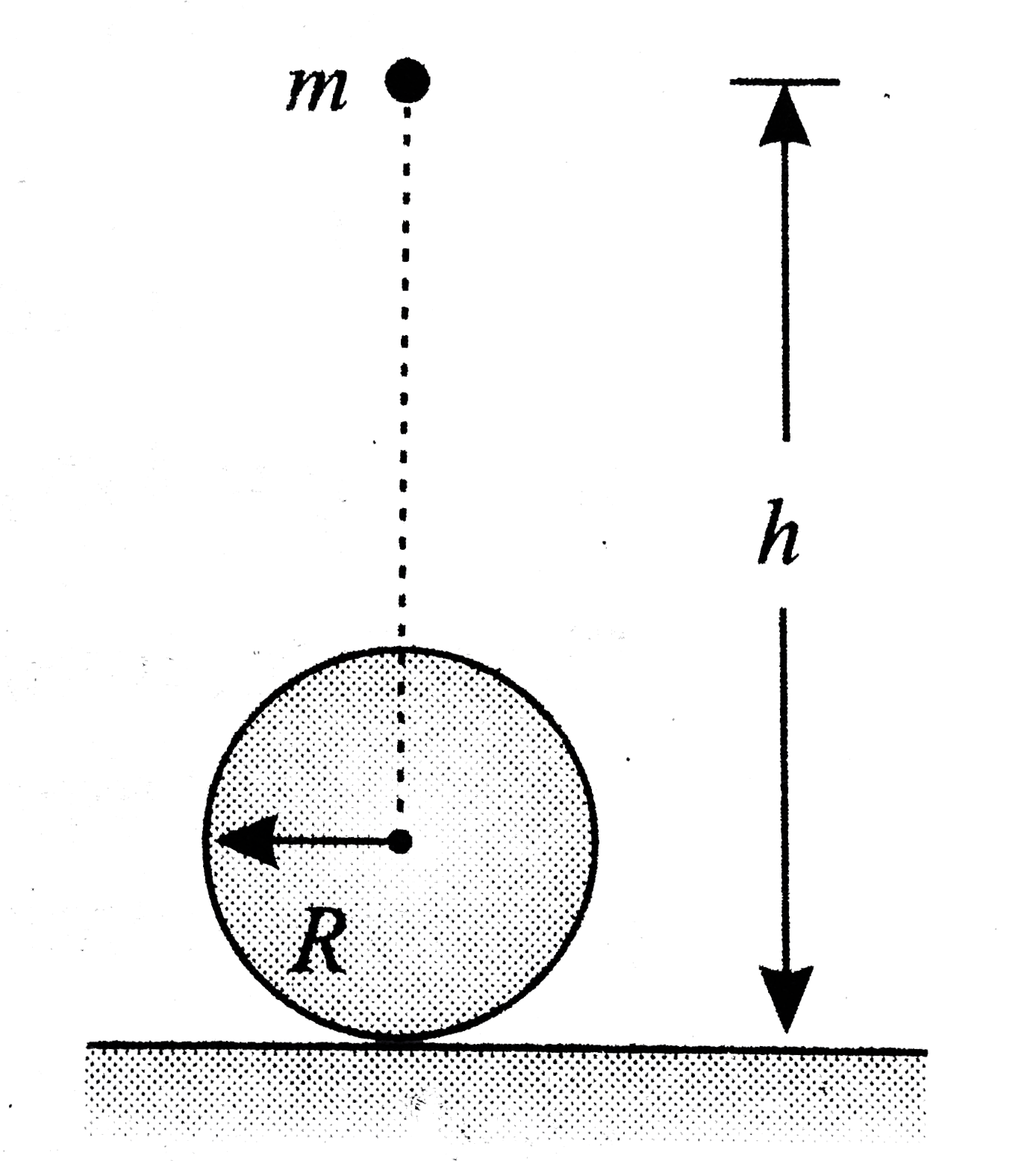
Each charged drop that falls into the conducting vessel increases the charge of the vessel by Q. The accumulated charge on the conducting vessel is uniformly distributed on the surface of the vessel. The charged spherical vessel crates its own electric field that can be calculated by assuming the electric charge of the sphere to be concentrated at its center. Let n drops have accumulated in the vessel and (n + 1) th be in the state of equilibrium at a height h. The equilibrium exists under the influence of repulsive coulomb force (directed upward) and force of gravity (downward). Thus, we have
`((n Q)Q)/(4 pi epsilon_0(h - R)^2 ) = m g`
Hence
`n = (4 pi epsilon_0 m g(h - R)^2)/(Q^2)`.
.
Promotional Banner

Topper's Solved these Questions

  • ELECTRIC POTENTIAL

    CENGAGE PHYSICS ENGLISH|Exercise Exercise 3.3|9 Videos
  • ELECTRIC POTENTIAL

    CENGAGE PHYSICS ENGLISH|Exercise Subjective|28 Videos
  • ELECTRIC POTENTIAL

    CENGAGE PHYSICS ENGLISH|Exercise Exercise 3.1|23 Videos
  • ELECTRIC FLUX AND GAUSS LAW

    CENGAGE PHYSICS ENGLISH|Exercise MCQ s|38 Videos
  • ELECTRICAL MEASURING INSTRUMENTS

    CENGAGE PHYSICS ENGLISH|Exercise M.C.Q|2 Videos

Similar Questions

Explore conceptually related problems

Electrically charged drops of nercury fall from an altitude h into a sperical metal vessel of radius R. There is a small opening in the upperapart of the vessel. The mass of eanc drop is m, and the charge on the drop is Q. What will be the number n of the last drop taht can still enter the sphere?

A large hollow metal sphere of radius R has a small opening at the top. Small drops of mercury, each of radius r and charged to a potential of the sphere becomes V' after N drops fall into it.Then

n charged drops, each of radius r and charge q , coalesce to from a big drop of radius R and charge Q . If V is the electric potential and E is the electric field at the surface of a drop, then.

1000 small water drops each of radius r and charge q coalesce together to form one spherical drop. The potential of the bigger drop is larger than that of the smaller one by a factor

Eight small drops, each of radius r and having same charge q are combined to form a big drop. The ratio between the potentials of the bigger drop and the smaller drop is

A solid sphere of mass M and radius R is surrounded by a spherical shell of same mass M and radius 2R as shown. A small particle of mass m is released from rest from a height h(lt lt R) above the shell. There is a hole inn the shell. QIn what time will it enter the hole at A

An accelration produces a narrow beam of protons, each having an initial speed of v_(0) . The beam is directed towards an initially uncharges distant metal sphere of radius R and centered at point O. The initial path of the beam is parallel to the axis of the sphere at a distance of (R//2) from the axis, as indicated in the diagram. The protons in the beam that collide with the sphere will cause it to becomes charged. The subsequentpotential field at the accelerator due to the sphere can be neglected. The angular momentum of a particle is defined in a similar way to the moment of a force. It is defined as the moment of its linear momentum, linear replacing the force. We may assume the angular momentum of a proton about point O to be conserved. Assume the mass of the proton as m_(P) and the charge on it as e. Given that the potential of the sphere increases with time and eventually reaches a constant velue. The limiting electric potential of the sphere is

An accelration produces a narrow beam of protons, each having an initial speed of v_(0) . The beam is directed towards an initially uncharges distant metal sphere of radius R and centered at point O. The initial path of the beam is parallel to the axis of the sphere at a distance of (R//2) from the axis, as indicated in the diagram. The protons in the beam that collide with the sphere will cause it to becomes charged. The subsequentpotential field at the accelerator due to the sphere can be neglected. The angular momentum of a particle is defined in a similar way to the moment of a force. It is defined as the moment of its linear momentum, linear replacing the force. We may assume the angular momentum of a proton about point O to be conserved. Assume the mass of the proton as m_(P) and the charge on it as e. Given that the potential of the sphere increases with time and eventually reaches a constant velue. After a long time, when the potential of the sphere reaches a constant value, the trajectory of proton is correctly sketched as

An accelration produces a narrow beam of protons, each having an initial speed of v_(0) . The beam is directed towards an initially uncharges distant metal sphere of radius R and centered at point O. The initial path of the beam is parallel to the axis of the sphere at a distance of (R//2) from the axis, as indicated in the diagram. The protons in the beam that collide with the sphere will cause it to becomes charged. The subsequentpotential field at the accelerator due to the sphere can be neglected. The angular momentum of a particle is defined in a similar way to the moment of a force. It is defined as the moment of its linear momentum, linear replacing the force. We may assume the angular momentum of a proton about point O to be conserved. Assume the mass of the proton as m_(P) and the charge on it as e. Given that the potential of the sphere increases with time and eventually reaches a constant velue. The total energy (E) of a proton in the beam travelling with seed v at a distance of r (r ge R) from point O. Assuming that the sphere has acquired an electrostatic charge Q is

A solid sphere of mass M and radius R is surrounded by a spherical shell of same mass and radius 2R as shown. A small particle of mass m is relased from rest from a height h (lt lt R) above the shell. There is a hole in the shell. Q. In what time will it enter the hole at A

