Home
Class 12
PHYSICS
The given circuit shows an arrangement o...

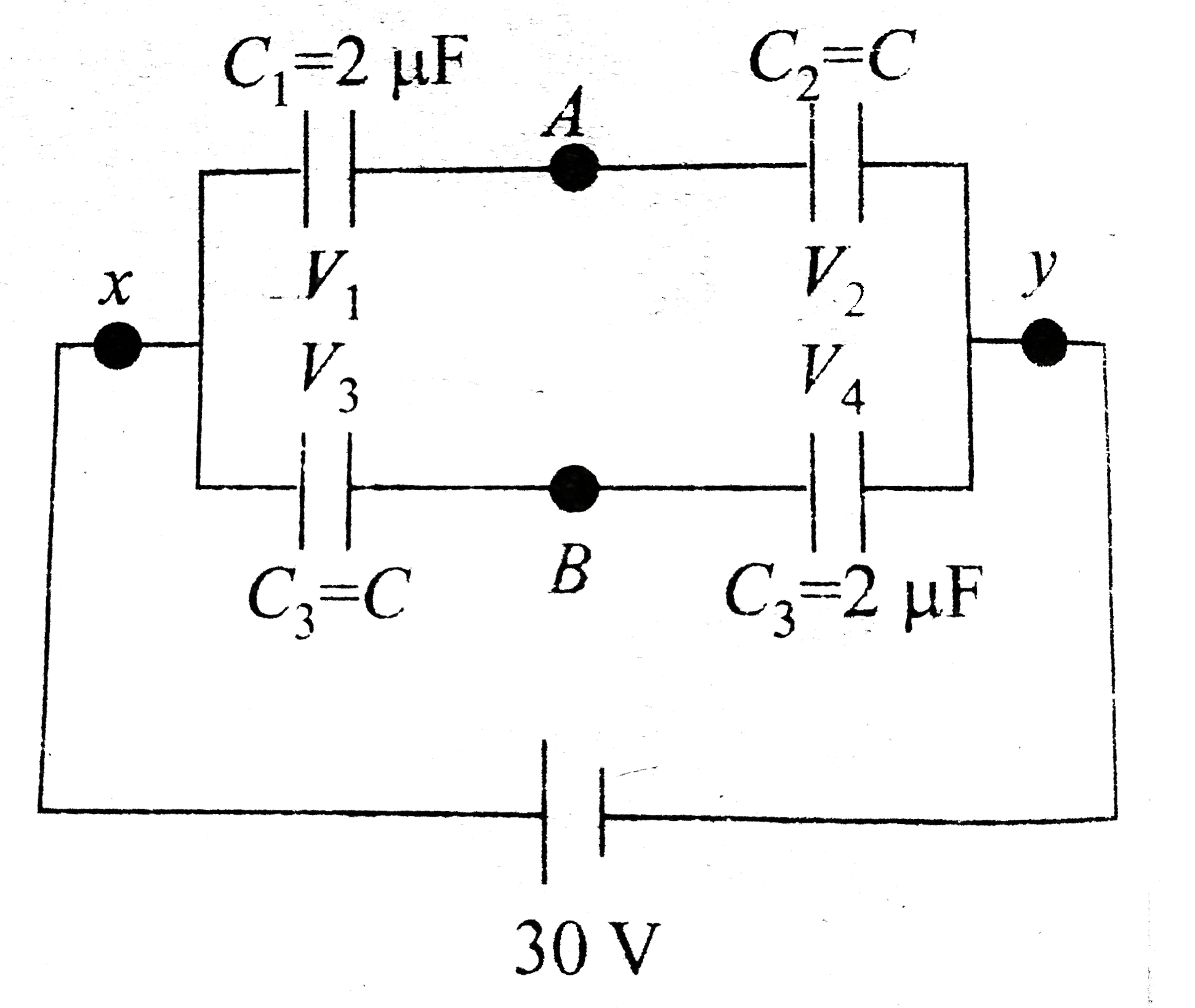
The given circuit shows an arrangement of four capacitors. A potential differnce `30 V` is applied across the combination. It is observed that potentials at connected between A and B differ by `5 V`. Also if a conducting wire is connected between A and B, electrons will flow from `A` to `B`. Of course, we have bot actually connected any wire between `A and B`, we have described only an `if` situation. Answer the following question.
.
Equivalent capacitor between `X` and `Y` is.

A

`2.34 muF`

B

`1.54 muF`

C

`1.22 muF`

D

`0.77 muF`

Text Solution

Verified by Experts

The correct Answer is:
A

Potential differnce across `C_(4)` is `V_(4)`. As discussed above
`V_(4)=V_(1)`
`V_(4)=17.5 V`
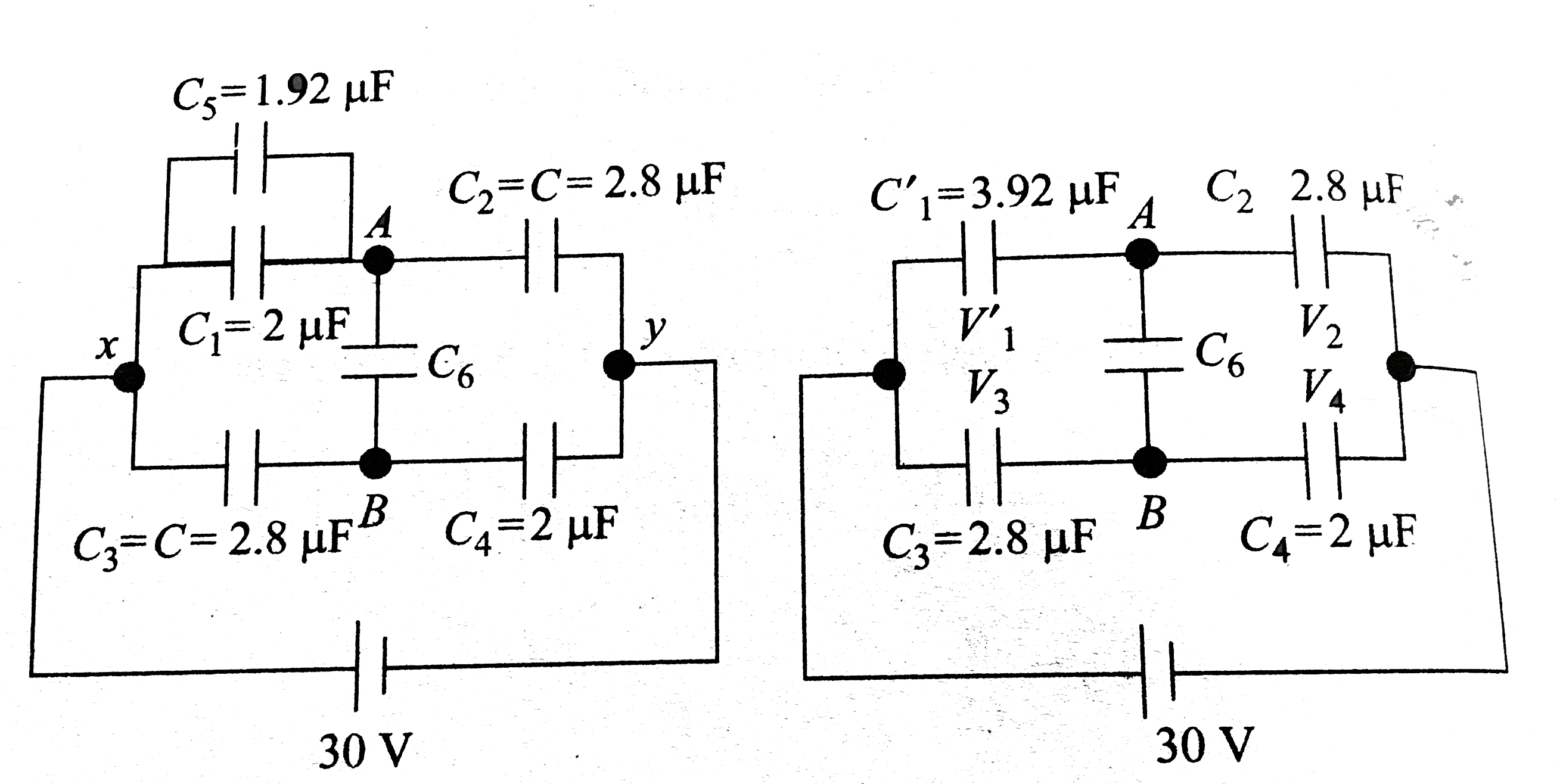
Consider any branch say, `XAY`
Since `C_(1)` and `C_(2)` are in series, charge on `C_(2)` is also `35 mu C`.
Using `Q = CV` for `C_(2)`
`C_(2) = C = (35)/(V_(2)) = (35)/(12.5) = 2.8 mu F`
Equivalent capacitance of branch `XAY` is the series equivalent of `C_(3)=C=2.8 muF` and `C_(4)=2 muF` i.e., `1.17 muF`. There branches are in parallel between `X` and `Y`, Hence equivalent capacitance between `X` and `Y` is `1.17+1.17=2.34 muF`.
Capacitor `C_(5)` is connected in the part of circuit between `X` and `A` either in series or parallel with `C_(1)=2 muF`. Let the equivalent capacitance of `C_(1)` and `C_(5)`, i.e., the equivalent capacitance between `X` and `A` be `C'_(1)`.
Capacitor `C_(6)` is connected between `A` and `B` Obviously, the circuit then becomes a Wheatstone bridge. Further, since equivalent capacitance between `X` and `Y` is independent of the value of `C_(6)`, it implies that bridge is in the balanced condition and potentials at `A` and `B` are now equal, so that
`(C'_(1))/C_(3)=C_(2)/C_(4)` or `(C'_(1))/(2.8)=(2.8)/2` (`C_(2)=2.8 muF`, as or determined earlier)
or `C_(1)=3.92 muF`
`C'_(1)` is the equivalent capacitance of `C_(1)=2 muF` and `C_(5)`, Since `C'_(1)gtC_(1)`, we can conclude that `C_(1)` and `C_(5)` are in parallel, So each individual capacitance .Hence, `C_(1)` and `C_(5)` are in parallel, so
`C'_(1)=C_(1)+C_(5)` or `C_(5)=C'_(1)-C_(1)=3.92-2=1.92 muf`
`V'_(1)+V_(2)=30`
.
.
Since the bridge is in a balanced condition, `A` and `B` at same potential and `C_(6)` has zero charge. `C'_(1)` and `C_(2)` are in series. Therfore, charge on `C'_(1)` and `C_(2)` has the same value, so that potential differnce will be in the inverse ratio of capacitance
[`Q=CV` or `V=Q/C "hence for same" Q,Vprop1/C']`
`(V'_(1))/(V'_(2))=(2.8)/(3.92)~~0.71` or `V'_(1)=0.71 V_(2)`
From Eq. (iv), `0.71 V_(2)+V_(2)=30` or `V_(2)=17.5 V`
Hence `V'_(1)=30-V_(2)=12.5 V`
Since `C'_(1)`, is parallel equivalet of `C_(1)` and `C_(5)`, so potential differnce across each is `V'_(1)=12.5 V`.
Hence, charge on `C_(5)` is
`C_(5)V'_(1)=1.92 xx12.5=24 muC`.
Promotional Banner

Topper's Solved these Questions

  • CAPACITOR AND CAPACITANCE

    CENGAGE PHYSICS ENGLISH|Exercise Integer|5 Videos
  • CAPACITOR AND CAPACITANCE

    CENGAGE PHYSICS ENGLISH|Exercise Multile Correct|11 Videos
  • ATOMIC PHYSICS

    CENGAGE PHYSICS ENGLISH|Exercise ddp.4.3|15 Videos
  • CENGAGE PHYSICS DPP

    CENGAGE PHYSICS ENGLISH|Exercise subjective type|51 Videos

Similar Questions

Explore conceptually related problems

The given circuit shows an arrangement of four capacitors. A potential differnce 30 V is applied across the combination. It is observed that potentials at connected between A an B differ by 5 V . Also if a conducting wire is connected between A and B , electrons will flow from A to B . Of course, we have bot actually connected any wire between A and B , we have described only an if situation. Answer the following question. . Charge on capacitor C_(1) is.

The given circuit shows an arrangement of four capacitors. A potential differnce 30 V is applied across the combination. It is observed that potentials at connected between A an dB differ by 5 V . Also if a conducting wire is connected between A and B , electrons will flow from A to B . Of course, we have bot actually connected any wire between A and B , we have described only an if situation. Answer the following question. . Potential differnce across C_(4) is.

In the circuit shown if a conducting wire is connected between points A and B, the current in this wire will :-

In the circuit shown if a conducting wire is connected between points A and B, the current in this wire will :-

In the given circuit, the potential difference between A and B is

If 100 volts of potential difference is applied between a and b in the circuit of , find the potential difference between c and d .

In the given circuit, potential difference between B and A is

In the circuit shown, if a wire is connected between points A and B. How much current will flow through that wire?

In given circuit , the potential difference between points A and B is

In the figure the potential difference across 6 ohm resistor is 48 V. Then the potential difference between A and B is

CENGAGE PHYSICS ENGLISH-CAPACITOR AND CAPACITANCE-Comprhension
  1. In each capacitance C(1) is 6.0 muF, and each capacitance C(2) is 4.0 ...

    Text Solution

    |

  2. In each capacitance C(1) is 6.0 muF, and each capacitance C(2) is 4.0 ...

    Text Solution

    |

  3. Condsider . In the circuit shown is the switch can be shifted to p...

    Text Solution

    |

  4. Condsider . Now the switch is shifted to position 2. The charge ap...

    Text Solution

    |

  5. Condsider . The charge on capacitor C(1) is.

    Text Solution

    |

  6. For the system shown in capacitance is C The left plate is given a cha...

    Text Solution

    |

  7. For the system shown in capacitance is C The left plate is given a ch...

    Text Solution

    |

  8. Consider the circuit shown in figure, after switch S is closed. W...

    Text Solution

    |

  9. Consider the circuit shown in figure, after switch S is closed. W...

    Text Solution

    |

  10. Two capacitors of capacity 6 muF and 3 muF are charge 100 V and 50 V s...

    Text Solution

    |

  11. Two capacitors of capacity 6 muF and 3 muF are charge 100 V and 50 V s...

    Text Solution

    |

  12. Two capacitors of capacity 6 muF and 3 muF are charge 100 V and 50 V s...

    Text Solution

    |

  13. Two capacitors of capacity 6 muF and 3 muF are charge 100 V and 50 V s...

    Text Solution

    |

  14. The given circuit shows an arrangement of four capacitors. A potential...

    Text Solution

    |

  15. The given circuit shows an arrangement of four capacitors. A potential...

    Text Solution

    |

  16. The given circuit shows an arrangement of four capacitors. A potential...

    Text Solution

    |

  17. Let us now connect two more capacitors in the circuit. One of them, C(...

    Text Solution

    |

  18. Let us now connect two more capacitors in the circuit. One of them, C(...

    Text Solution

    |

  19. Shows a diagonal symmetric arrangement of capacitors and a battery. ...

    Text Solution

    |

  20. Shows a diagonal symmetric arrangement of capacitors and a battery. ...

    Text Solution

    |

