Home
Class 12
PHYSICS
The capacitor shown in figure has been c...

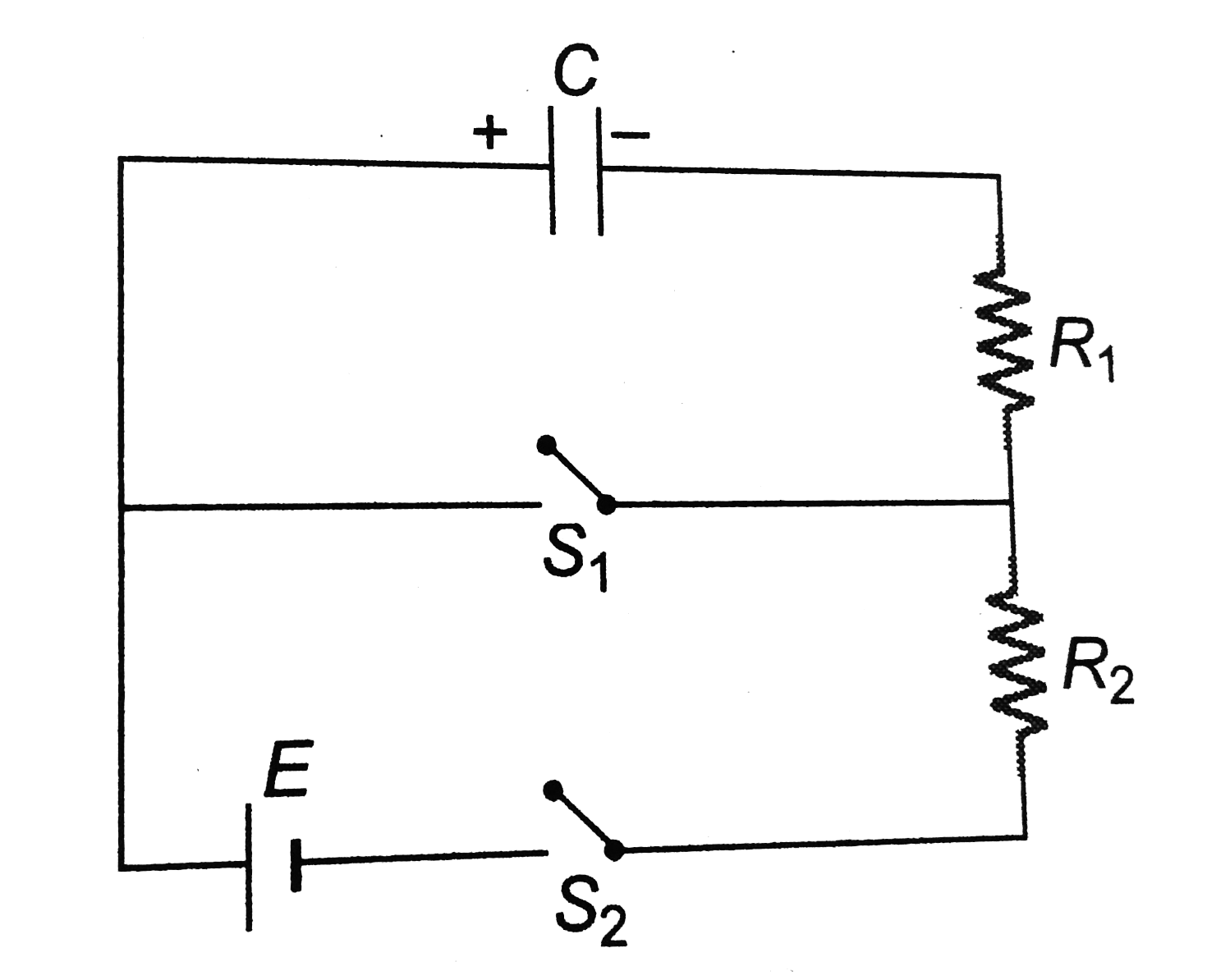
The capacitor shown in figure has been charged to a potential difference of `V` volt, so that it carries a charge `CV` with both the switches `S_1 and S_2` remaining open. Switch `S_1` is closed at `t = 0`. At `t= R_1C` switch `S_1` is opened and `S_2` is closed. Find the charge on the capacitor at `t= 2R-1C + R_2C`.

Text Solution

Verified by Experts
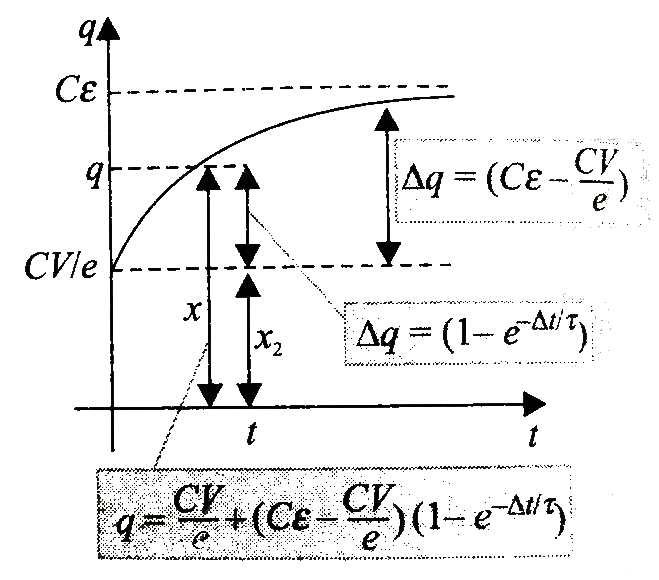
First, capacitor will discharge through `R-1`.
At `t =R_1C, q_1 = CV(e^(-R_1C//R_1C)) =(CV)/(e )`
Now it will be charged through `R_1+R_2`. so
`int_(q1)^q (dq)/(Cepsilon -q) = int_(R_1C)^(2R_1C+R_2C) (dt)/((R_1+R_2)C)`
or `q = Cepsilon (1-(1)/(e )) +(CV)/(e^2)`

When the switch `S_1` is opened and `S_2` is closed, the capacitor
is finally chaged ot `q_(final) =Cepsilon`. Hence, capacitor is charged from `q_0 "to" q_f` exponentially. in this case, the time after `S_2` is closed is
`Deltat = (2R_1C+R_2C)-R_1C)-R_1C = (R_1C+R_2C) =(R_1+R_2)C`
The time constant of the circuit after switch `S_2` is closed is
`tau = (R_1+R_2)C`
Hence, required value of charge si
`q=(CV)/(E )+(Cepsilon-(CV)/(e ))(1-e^(-((R_(1)+R_(2))C)/((R_(1)+R_(2))C)))`
`=(CV)/(e )+(Cepsilon-(CV)/(e ))(1-e^(-1))=Cepsilon(1-(1)/(e )) +(CV)/(e^2)`
Promotional Banner

Topper's Solved these Questions

  • ELECTRIC CURRENT AND CIRCUIT

    CENGAGE PHYSICS ENGLISH|Exercise Solved Examples|12 Videos
  • ELECTRIC CURRENT AND CIRCUIT

    CENGAGE PHYSICS ENGLISH|Exercise Exercise 5.1|28 Videos
  • ELECTRIC CURRENT & CIRCUITS

    CENGAGE PHYSICS ENGLISH|Exercise Kirchhoff s law and simple circuits|15 Videos
  • ELECTRIC FLUX AND GAUSS LAW

    CENGAGE PHYSICS ENGLISH|Exercise MCQ s|38 Videos

Similar Questions

Explore conceptually related problems

The switch S in the circuit diagram is closed at t = 0. The charge on capacitors at any time is

In the circuit in Fig. switch S_(1) was closed for a long time . At time t = 0 the switch is opened. Find the angular frequency of oscillation of the charge on the capacitor.

Two capacitors C_(1) and C_(2) are charged to same potential V , but with opposite polarity as shown in the figure. The switches S_(1) and S_(2) are then closed

A capacitor of capacitance C_(1) is charged to a potential difference V and then connected with an uncharged capacitor of capacitance C_(2) a resistance R. The switch is closed at t = 0. Choose the correct option(s):

n the circuit shown in the figure, the capacitor C is charged to a potential V_(o) The heat generated and charge flow, in the circuit to when the switch S is closed, is

In the circuit shown, the capacitor initially charged with a 12V batteryy, when switch S_(1) is open and switch S_(2) is closed. The maximum value of current in the circuit when S_(2) is opened and S_(2) is closed is

Two capacitors C_(1) = 4 muF and C_(2) = 2muF are charged to same potential V = 500 Volt, but with opposite polarity as shown in the figure. The switches S_(1) and S_(2) are closed.

In the circuit shown in the figure, if switches S_(1) and S_(2) have been closed for a long time, then charge on the capacitor.

For a circuit shown in figure 5.235 switch S_1 is closed at t= 0, then at t = (2R_2+R_1)C, S_1 is opened and S_2 is closed. a. Find the charge on capactior at t = (2R_2 + 2R_1)C. b. Find current through R_2 (adjacent to the battery) at t = (3R_1 +2R_2)C.

In the circuit shown in figure C_(1) = 2 C_(2) . Capacitance C_(1) is charged to a potential of V. The current in the circuit just after the switch S is closed is

