Home
Class 12
PHYSICS
Refer to Fig. 7.49. At t = 0 , the ...

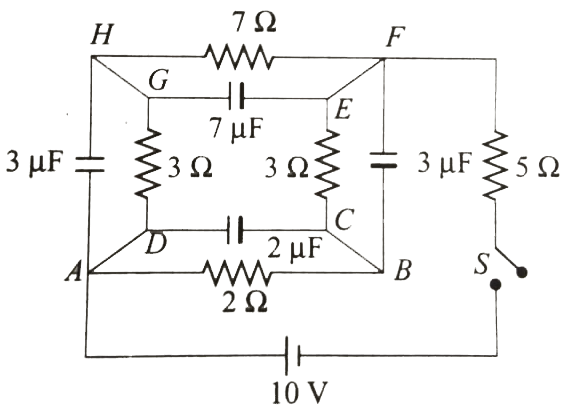
Refer to Fig. `7.49`.

At `t = 0` , the switch is closed . Just after closing the switch, find the current through the `5 Omega` resistor.

A

`(4)/(5) A`

B

`(2)/(5) A`

C

`(6)/(5) A`

D

`2 A`

Text Solution

Verified by Experts

The correct Answer is:
D

Initially, When all the capacitors are uncharged, they will act as conducting wires. Hence, all the resistances `( "except" 5 Omega)` will be short - circuited. So no resistance occurs between `A and F`. Thus current through the `5 Omega` resistor will be `(10 // 5)A = 2 A`.
In steady state, distibution of current is shown.
Loop `ABCEFMA , 10 = 2I_(1) + 3I_(1) + 5(I_(1) + I_(2))`
or `10 I_(1) + 5 I_(2) = 10` .....(I)
Loop `ADGHFMA , 10 = 3I_(2) + 7I_(2) + 5(I_(1) + I_(2))`
or `5I_(1) + 15I_(2) = 10` .......(ii)
From Eqs. (i) and (ii) , `I_(1) = (4)/( 5) A, I_(2) = (2)/(5) A`
Hence , current through the `5 Omega` is `I_(2) + I_(2) = (6//5) A`. Potential
difference across the ` 2 mu F` capacitor is
`2 I_(1) = 2 xx (4)/( 5) = (8)/( 5) V`
Energy in it is given by
`U_(1) = (1)/(2) xx 2((8)/(5))^(2) = ( 64 // 25) mu J`
Potential difference across is `3 muF` capacitor is
`3 I_(1) = 3 xx (4)/(5) = (12)/(5) V`
Energy in it is given by
`U_(2) = (1)/(2) xx 3 ((12)/(5))^(2) = (216 // 25) muJ`
Potential difference across the `3 mu F` capacitor is
` 3I_(2) = 3 xx (2)/(5) = (6)/(5) V`
Energy in it is given by
`U_(3) = (1)/(2) xx 3((6)/(5))^(2) = ( 54//25) mu J`
potential difference across the `7 muF` capacitor is
`7 I_(2) = 7 xx (2)/(5) = (14)/(5) V`
Energy in it is given by
`U_(4) = (1)/(2) xx 7 ((14)/(5))^(2) = (686// 25) muJ`
Thus , whole of the energy stored in all capacitors will be dissipated after the switch is opened. So the energy dissipated is `U_(1) + U_(2) + U_(3) + U_(4) = 40.8 muJ`.
Promotional Banner

Topper's Solved these Questions

  • HEATING EFFECT OF CURRENT

    CENGAGE PHYSICS ENGLISH|Exercise Integer|5 Videos
  • HEATING EFFECT OF CURRENT

    CENGAGE PHYSICS ENGLISH|Exercise Calculating Thermal Power in Resistance|14 Videos
  • HEATING EFFECT OF CURRENT

    CENGAGE PHYSICS ENGLISH|Exercise Assertion - Reasoning|6 Videos
  • GEOMETRICAL OPTICS

    CENGAGE PHYSICS ENGLISH|Exercise Integer Type|4 Videos
  • INDUCTANCE

    CENGAGE PHYSICS ENGLISH|Exercise Concept Based|8 Videos

Similar Questions

Explore conceptually related problems

Refer to Fig. 7.49 . Long time after closing the switch , find the current through the 5 Omega resistor.

When the switch is closed, the initial current through the 1Omega resistor is

When the switch is closed find the charge flown through switch?

As the switch S is closed in the circuit shown in figure, current passed through it is.

Initially the switch is in positions 1 for as long time then shifted to position 2 at t=0 as shown in figure. Just after closing the switch, the magnitude of current through the capacitor is

If the switch is closed then current will flow.

A 35.0 V battery with negligible internal resistance, a 50.0Omega resistor, and a 1.25 mH inductor with negligible resistance are all connected in series with an open switch. The switch is suddenly closed (a) How long after closing the switch will the current through the inductor reach one-half of its maximum value? (b) How long after closing the switch will the energy stored in the inductor reach one-half of its maximum value?

The circuit consists of two resistors (of resistance R_(1) = 20 Omega and R_(2) = 10 Omega ), a capacitor (of capacitance C =10 muF ) and two ideal cells. In the circuit shown the capacitor is in steady state and the switch S is open the circuit is in steady state with switch S closed. Now the switch S is opened. Just after the switch S is opened. the current through resistance R_(1) is

In the circuit shown, the switch 'S' is closed at t = 0 . Then the current through the battery steady state reached is

The circuit consists of two resistors (of resistance R_(1) = 20 Omega and R_(2) = 10 Omega ), a capacitor (of capacitance C =10 muF ) and two ideal cells. In the circuit shown the capacitor is in steady state and the switch S is open The current through the resistor R_(2) just after the switch S is closed is :

