Home
Class 12
PHYSICS
In Fig,, if the image of object O has t...

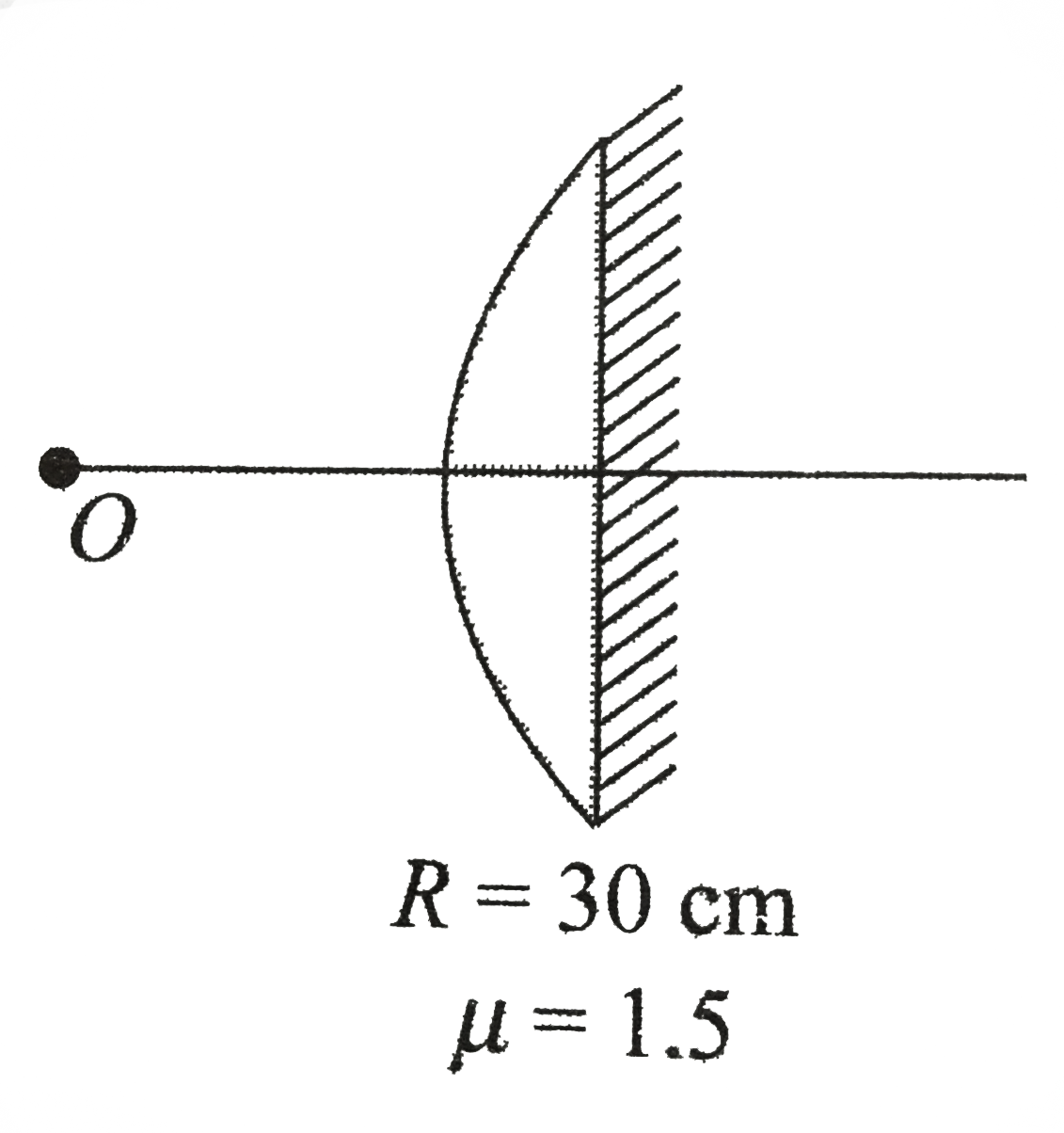
In Fig,, if the image of object O has to coincide with itself, then where must the object be placed at a distance from the lens?

Text Solution

Verified by Experts

Let F is the effective focal length of this concave mirror. Then,
`(1)/(F)=(1)/(f_(m))-(2)/(f_(1))`
`f_(m)=oo, (1)/(f_(1))=(mu-1)((1)/(R))`
`(1)/(F)=(mu-1)(2)/(R)rArr F=(-R)/(2(u-1)`
`F=(-30)/(2(1.5-1))=-30cm`
So, object should be placed at `2F=60cm` from the lens to coincide the image with the object.
Promotional Banner

Topper's Solved these Questions

  • GEOMETRICAL OPTICS

    CENGAGE PHYSICS ENGLISH|Exercise Subjective|26 Videos
  • GEOMETRICAL OPTICS

    CENGAGE PHYSICS ENGLISH|Exercise Single Correct|221 Videos
  • GEOMETRICAL OPTICS

    CENGAGE PHYSICS ENGLISH|Exercise Exercise1.6|15 Videos
  • ELECTRON,PHONTS,PHOTOELECTRIC EFFECT & X-RAYS

    CENGAGE PHYSICS ENGLISH|Exercise dpp 3.3|15 Videos
  • HEATING EFFECT OF CURRENT

    CENGAGE PHYSICS ENGLISH|Exercise Thermal Power in Resistance Connected in Circuit|27 Videos

Similar Questions

Explore conceptually related problems

Two thin converging lenses are placed on a common axis, so that the centre of one of them coincides with the focus of the other. An object is placed at a distance twice the focal length from the left hand lens. Where will its image be? What is the lateral magnification? The focal of each lens is f.

Two thin converging lenses are placed on a common axis, so that the centre of one of them coincides with the focus of the other. An object is placed at a distance twice the focal length from the left hand lens. Where will its image be? What is the lateral magnification? The focal of each lens is f.

Two thin converging lenses are placed on a common axis, so that the centre of one of them coincides with the focus of the other. An object is placed at a distance twice the focal length from the left hand lens. Where will its image be? What is the lateral magnification? The focal of each lens is f.

Draw a labelled ray diagram for the formation of image by a convex lens of focal length 15 cm when the object is placed at a distance of 25 cm from the lens. Determine the size of the image formed, if size of the object is 4 cm.

An extended real object is placed perpendicular to the principle axis of a concave of focal length 10 cm , such that the images found is half the size of object (a) Find the object distance from the lines (b) Find the image distance from the lens

A plano convex lens of refractive index 1.5 and radius of curvature 30cm. Is silvered at the curved surface. Now this lens has been used to form the image of an object. At what distance from this lens an object be placed in order to have a real image of size of the object.

A converging lens has a focal length of 0.12 m. To get an image of unit magnification the object should be placed at what distance from the converging lens ?

The focal length of a simple convex lens used as a magnifier is 10 cm. For the image to be formed at a distance of distinct vision D = 25 cm, the object must be placed away from the lens nearly at a distance of

A lens is made of three thin different mediums. Radius of curvature and refractive index of each medium is shown iin Figure., Surface AB is straight. An object is placed at some distance from the lens by which a real image is formed on the screen placed at a distance of 10cm from the lens. Find the distance of the object from the lens.

An object is placed in front of a concave lens. A virtual image of the object is formed on the same side of the lens as the object but is closer to the lens. Will rays form this image refract once again at the lens to form a second image?

CENGAGE PHYSICS ENGLISH-GEOMETRICAL OPTICS-Exercise1.7
  1. Figure, shown two converging lenses. Incident rays are parallel to the...

    Text Solution

    |

  2. In Figure., find the position of final image formed.

    Text Solution

    |

  3. In Fig. what should be the value of d so that image is formed on the ...

    Text Solution

    |

  4. In Fig,, if the image of object O has to coincide with itself, then w...

    Text Solution

    |

  5. A convex lens of focal length 20cm is placed 10cm away from a second ...

    Text Solution

    |

  6. When an object is placed at the proper distance ot the left of a conve...

    Text Solution

    |

  7. A telephoto combination consists of convex lens of focal length 30cm a...

    Text Solution

    |

  8. A convex lens is cut in half along its principal axis and the two halv...

    Text Solution

    |

  9. A plano-convex lens is silvered on its plane side. The radius of curva...

    Text Solution

    |

  10. A convex lens of focal length 10cm is placed 30 cm in front of a secon...

    Text Solution

    |

  11. A concave mirror of focal length 30 cm is placed on the flat horizont...

    Text Solution

    |

  12. The convex side of a thin concavo-convex lens of glass of refractive i...

    Text Solution

    |

  13. The source is placed 30 cm from a convex lens which has a focal length...

    Text Solution

    |

  14. If final image after two refractions through the lens and one reflecti...

    Text Solution

    |

  15. A point object O is placed at a distance of 20 cm from a convex lens o...

    Text Solution

    |

  16. The focal length of a thin convex-lens is 30cm. At a distance of 10 cm...

    Text Solution

    |

  17. A plano-convex glass lens (mu(g)=3//2) of radius of curvature R=10cm i...

    Text Solution

    |

  18. On a horizontal plane mirror, a thin equiconvex lens of glass is place...

    Text Solution

    |

  19. A pin is placed 10cm in front of a convex lens of focal length 20cm, m...

    Text Solution

    |

  20. A convex lens of glass (mu=1.5) is formed by combining two surfaces of...

    Text Solution

    |
